- Place
- Birštonas Municipality
- Region
- Dzūkija
- Type
- museum of Birštonas town and resort history in the interwar timber Villa Ramunė
- Address
- Vytauto g. 9, LT-59211 Birštonas
- Coordinates
- 54.60464, 24.03253
- Visit duration
- 45-75 minutes for the permanent exhibition and villa architecture; longer with a tour or temporary exhibition
- Best time
- during the day from Tuesday to Saturday; begin at least 1.5-2 hours before closing if visiting both museums
Katelė Villa, Villa Ramunė, Birštonas Local Museum
From a school exhibition to a town museum
The museum began with an exhibition prepared by geography teacher Petras Kazlauskas and his pupils for the resort's 120th anniversary in 1966. Its favourable reception encouraged Kazlauskas and Antanas Serafinas Zenkevičius, then chair of the Birštonas executive committee, to develop a permanent museum.
The institution dates its formal beginning to 1967. Petras Kazlauskas became its first head; historian Juozas Šleikus later created the permanent exhibition and expanded the building. VLE also gives 1967 as the foundation year, so 1966 is best understood as the initiative and first exhibition rather than a competing opening date.
The Sacred Museum was established in Birštonas's old rectory in 2000. It belongs to the same institution but occupies a different address and covers a different subject, so the two should be planned as separate stops.
Katelė Villa, later called Ramunė
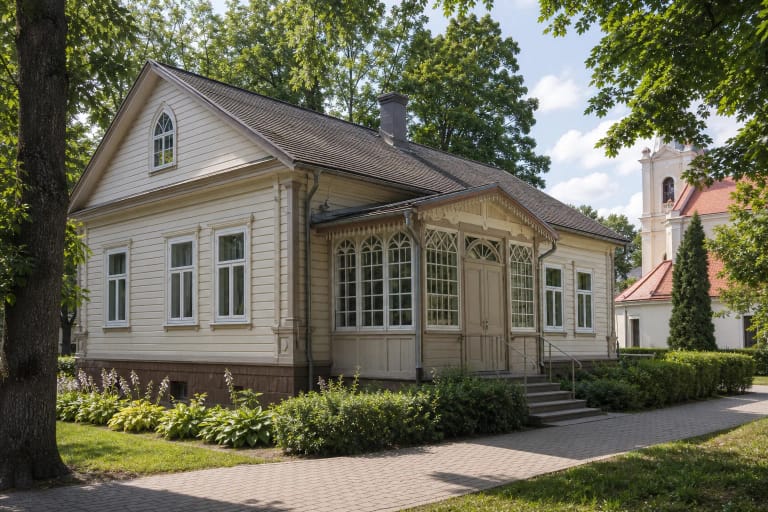
Forester Antanas Katelė commissioned the present building as a resort summer villa. Engineer Vladas Muzikevičius prepared the design in 1932, and the two-storey log house was built in 1932-1933. Until 1941 its rooms were rented to teachers receiving treatment in Birštonas.
Nationalised in 1948, the house entered the resort's accommodation system and acquired the name Villa Ramunė. The museum moved in during 1967. A kitchen and store built in the yard in 1937 have disappeared, while a two-storey extension later replaced the former open veranda as the museum grew.
The asymmetrical resort-villa silhouette combines a complex sheet-metal roof, two pointed turrets, a timber-columned porch, balconies, and pierced geometric ornament. Parts of the original timber floors, windows, opening mechanisms, and wall paint survive inside. The building therefore deserves attention beyond its role as an exhibition container.
From the rulers' Birštonas to a therapeutic resort
The permanent exhibition brings together early town history, finds from the Grand Duchy of Lithuania, and the resort's nineteenth- and twentieth-century development. Documents, photographs, printed material, and everyday objects show not only the famous mineral springs but the people who treated patients, worked, rested, and created here.
The resort story becomes especially tangible through treatment technology. Visitors can see a water pipe hollowed from a single thick tree trunk, a trolley used to carry therapeutic mud, a mineral-water treatment bath, and a blood-pressure instrument belonging to balneologist Jurgis Venckūnas.
This is not an unchanging store of objects. The museum has spaces for temporary exhibitions and educational programmes, so the contents of any visit may extend beyond the permanent resort display. Check the official programme for the current exhibition.
Objects not to miss
One of the most memorable exhibits is a horse-drawn phaeton used for travel between Birštonas and Kaunas. It recalls a period when reaching the treatments was a substantial journey in itself and resort access depended on overland transport and routes along the Nemunas.
A more intimate medical layer appears through the furniture and tools of Birštonas dentist Ignas Šablauskas and the personal effects of resort doctor Jurgis Venckūnas. A model of the area made by Polish servicemen interned in Birštonas during the Second World War records a difficult episode that cannot be reduced to cheerful resort advertising.
Look for the connection between object and town: the phaeton speaks of travel, the timber pipe of water supply, the mud trolley and bath of treatment infrastructure, and the villa rooms of the scale of interwar holiday life.
Hours, tickets, and practical choices
On 27 July 2026, the official site listed opening hours of 10 am-6 pm Tuesday-Saturday and 10 am-4 pm Sunday, with Monday closed. Hours are shortened by one hour on the day before a public holiday. Guided visits and educational sessions require advance arrangement.
On the same date, admission to one museum cost €2 and a combined Birštonas Museum plus Sacred Museum ticket cost €3. Adult educational sessions were €6, children's sessions €4, and a museum tour started at €30. Prices, concessions, and hours can change, so recheck the official visitor page.
This historic two-storey timber villa contains stairs and spaces of varying character. The official visitor information did not provide a complete account of step-free access to every gallery, so contact the museum in advance about wheelchairs, lifts, assistance, or other individual requirements. The Google Maps listing showed 4.7 out of 5 from 240 reviews on 27 July 2026; the figure changes.