- Place
- Beržoras, Plungė District Municipality
- Region
- Žemaitija National Park
- Type
- small Žemaitija National Park lake by Beržoras village
- Coordinates
- 56.02080, 21.81900
Beržoras
A small glacial lake beside the larger Plateliai routes
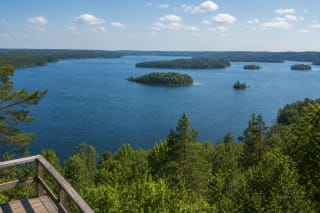
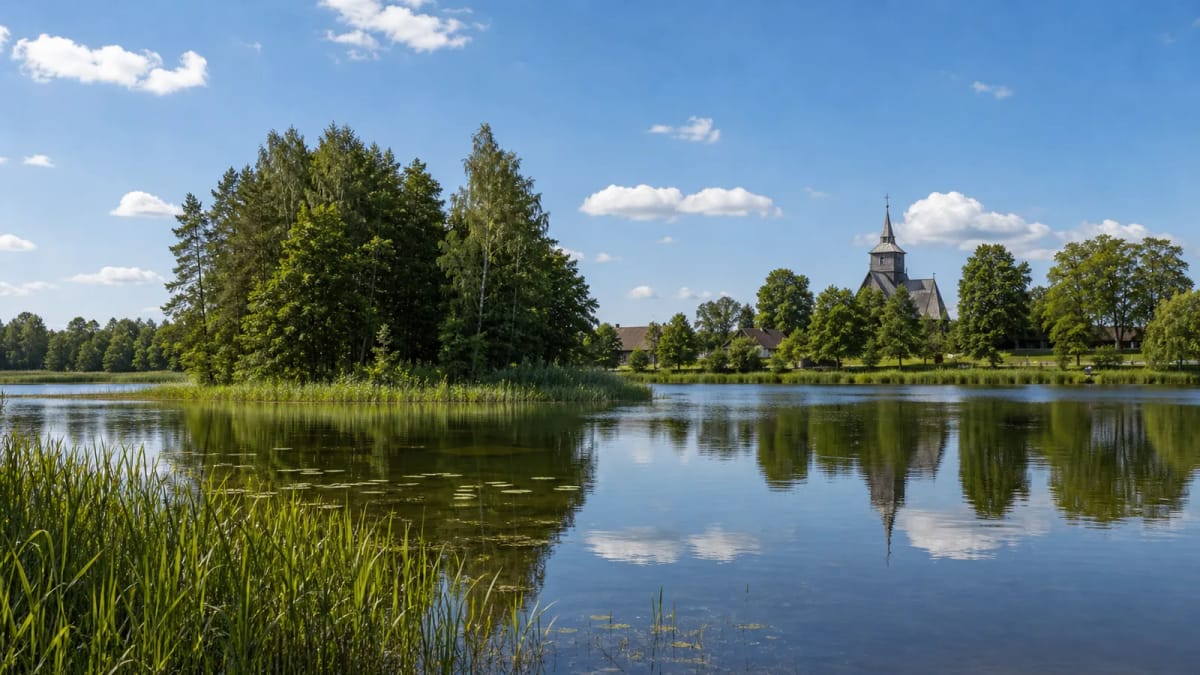
Lake Beržoras could easily disappear in the shadow of Lake Plateliai if judged only by size. VLE places it in Plungė District Municipality, 2 km south of Plateliai, inside Žemaitija National Park, and gives its area as about 52 ha. It is much smaller than its famous neighbor, but that gives it a quieter, more rural character.
VLE notes that the lake basin was left by a block of dead ice during the last glaciation and that the water surface lies at 148.1 m above sea level. It is a convenient stop when you want not only a broad lake panorama, but also a smaller body of water, an old village, and a sacred landscape.
Dimensions, island, and the Beržuoja flow
VLE gives concrete figures: Lake Beržoras is about 1.1 km long, up to 0.7 km wide, with a maximum depth of 6.3 m and an average depth of 4.6 m. Its basin covers 2.4 km2, and its annual water exchange is about 36%. Except on the western side, the shores are high, so the water can be viewed well from many points.
The lake has a 0.4 ha island, identified by VLE and Žemaitija National Park as a hydrographic natural heritage object. The Beržuoja stream flows through the lake and belongs to the Minija basin, so Beržoras is part of the park's water system rather than an isolated pond. VLE lists perch, roach, bream, pike, and rudd among its fish.
Beržoras church village: the 1746 wooden church and cemetery
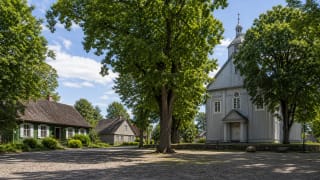
Žemaitija National Park presents Beržoras as an old linear village, mentioned from the 15th century and protected as a cultural value. The lake shore is completed by the church-village landscape, centered on the wooden Beržoras church built in 1746. According to the park, it is one of the oldest wooden sacred-architecture buildings in Lithuania.
The churchyard contains the old cemetery of the Plateliai parish, among the older cemeteries in Lithuania. Notable local people are buried there, including folk artist Stanislovas Riauba and historian-museologist Juozas Mickevičius. For that reason Lake Beržoras cannot be separated from the village: here water, culture, and sacred setting form one landscape.
Beržoras Calvary chapels and cross-crafting heritage
Beržoras is also known in Samogitia as a Calvary place. According to Žemaitija National Park, 14 wooden chapels of the Stations of the Cross were built in the village in 1759-1760. They were demolished in the early 1960s during the Soviet period and later rebuilt, so the chapel route can once again be walked.
The village has many restored or surviving small chapels, crosses, and chapel-posts: a living example of Lithuanian cross-crafting in a protected area. Visit Beržoras slowly, because the lake, church, cemetery, and Calvary chapels together form a single Samogitian heritage landscape.
Protected area and visiting etiquette
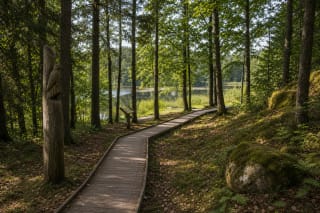
Lake Beržoras is part of Žemaitija National Park, so use existing roads, paths, and stopping places. The small lake's shores are sensitive to improvised driving, and high banks can be slippery after rain.
The best plan is to visit it as a Beržoras village and national-park route, not as a random descent to the water. A slow rhythm - a short stop by the lake, a look at the village structure, then a walk toward the church and Calvary chapels - shows why Beržoras differs from the busier Plateliai shores.
What to combine with Beržoras
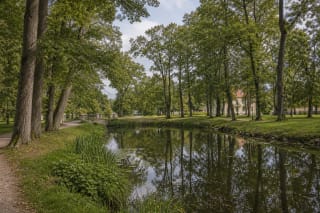
Lake Beržoras pairs best with Plateliai town, Lake Plateliai, and Plateliai Manor Park. That route lets visitors compare different scales of Žemaitija National Park: a small lake by a village, a large island lake, and the park's cultural infrastructure.
With more time, continue to the Paplatelė trail or the Plokštinė forests. Beržoras then becomes a calm, less noisy counterpoint to larger park objects, while the sacred landscape adds a cultural layer to the nature experience.