- Place
- Balninkai, Molėtai District Municipality
- Region
- Aukštaitija
- Type
- a community-run museum of Lithuanian glass, art and Balninkai local history
- Address
- 10 Gedimino Street, Balninkai, LT-33303, Molėtai District
- Coordinates
- 55.29568, 25.12017
- Visit duration
- 1-1.5 hours for the permanent displays; about 2.5 hours with a pre-booked workshop
- Best time
- on a weekday year-round or a Saturday from April to October, after confirming the current hours
Glass Museum and Picture Gallery in Balninkai, Balninkai Vladas Miškinis Picture Gallery, Balninkai Glassware Museum
Lithuania's first specialised glassware museum
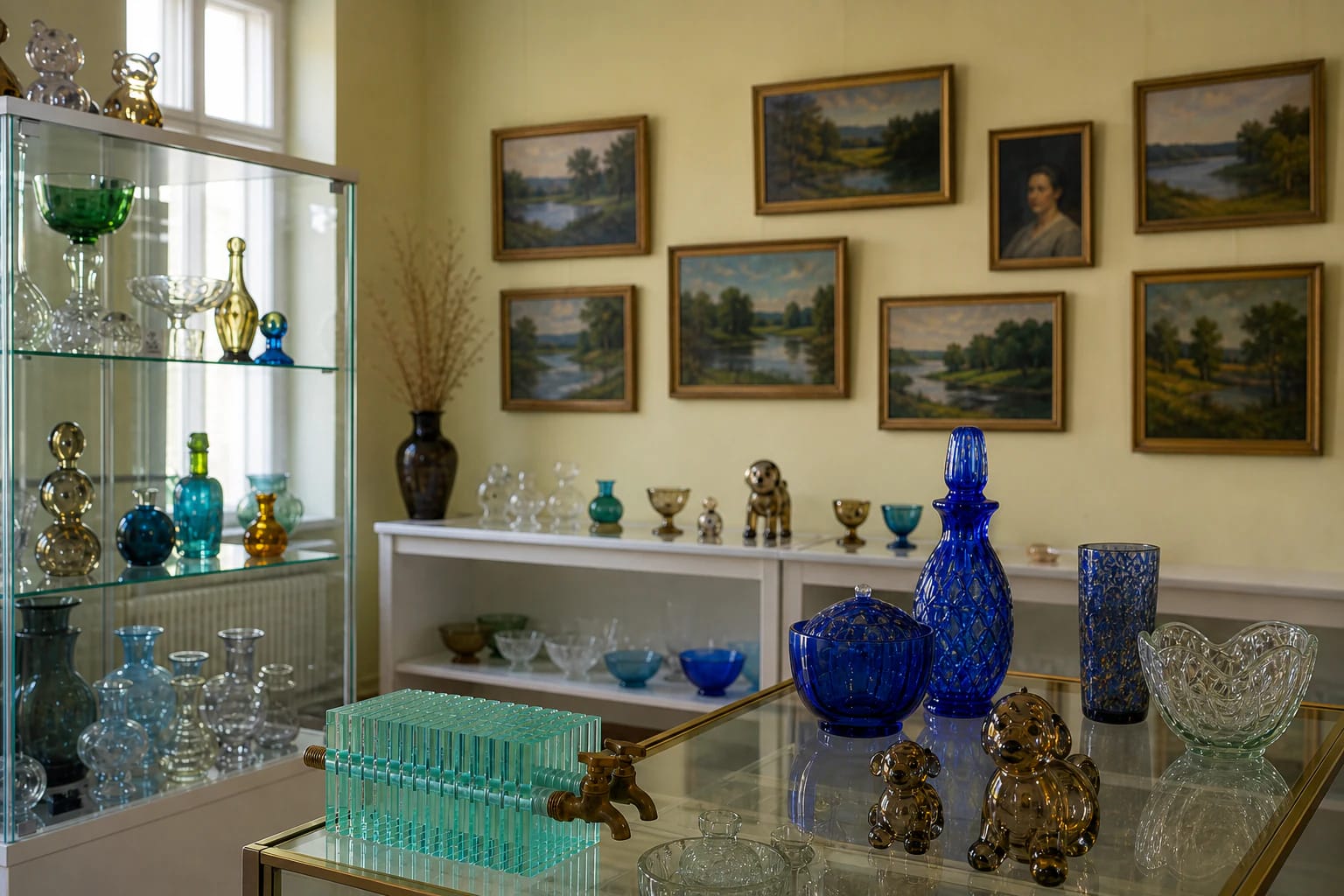
The operator presents Balninkai as Lithuania's first museum devoted specifically to glassware. It is neither a working factory nor a glassblowing furnace. Its rooms preserve household, decorative, souvenir and studio glass made in Lithuania or by Lithuanian makers, allowing visitors to compare mass production with individual artistic form.
Most exhibits relate to the period after 1972, when decorative glass production was re-established in Lithuania. Factories in Panevėžys, Kaunas and Vilnius are represented alongside artists who donated their own work. Fragments of glass and refractory materials from seventeenth- to nineteenth-century manufactories broaden the chronology beyond the principal late-twentieth-century collection.
Look beyond colour when examining the objects. Pressed, blown, cut and layered surfaces handle light differently, while a seam, base or trapped bubble may reveal how an item was made. Labels help distinguish factory production from a studio piece.
A gift of 367 objects and the 2002 opening
Kazys Strazdas, a glass technologist originally from Balninkai, collected Lithuanian glass over many years with his wife, Javita Emilija Strazdienė. On 10 September 2001, they donated 367 objects to Balninkai. This was the museum's founding collection, not a fixed count of everything held today.
The museum opened ceremonially on 8 November 2002, when Lithuanian President Valdas Adamkus cut the ribbon. A catalogue compiled by Kazys Strazdas and Javita Emilija Strazdienė records objects made in Lithuania or by Lithuanians during the twentieth century and first decade of the twenty-first, together with makers and the founders' biographies.
On 8 November 2016, responsibility for the museum passed to the Balninkai public institution Kaimynystės namai. The collection is consequently not an isolated historical display but part of an active multifunctional community centre.
The picture gallery came first
The picture gallery opened on 24 October 1998, four years before the glass museum. Its foundation was the work of Vladas Miškinis, an artist and teacher at the Balninkai school. The operator's current account records 160 donated paintings, while a public 2022 interview with the museum director used a figure of 151. These may reflect different inventories or display moments and should not be confused with the number hanging at one time.
Miškinis painted portraits of prominent Lithuanian cultural figures, historic monuments, castles and hillforts, although scenes of the lakes around Balninkai and his home landscape form the largest group. The gallery later received 40 prints from Onutė Pusvaškytė and twelve lithographs and screenprints by Stasys Aukštuolis.
Art is only part of the programme. The operator also lists a display of Balninkai history, culture and household objects from the eighteenth to early twentieth centuries, a temporary exhibition room and a section on the B Unit of the anti-Soviet Great Fight Partisan District. This breadth explains why a visit often lasts longer than a quick look at the glass cases.
Hours, tickets and accessibility in 2026
The operator's page updated on 7 April 2026 lists Monday-Friday hours of 10:00-16:00 and Saturday hours of 11:00-15:00 from April through October. The museum closes to visitors for a cleaning day on the final working day of each month. Older directories and map listings still show other schedules, so check the official page or call +370 674 22631 before travelling.
When this guide was researched, the Molėtai Tourism and Business Information Centre listed general admission at €3, entry for children aged 5-15 at €1, and €2 for school or nursery groups, seniors and visitors with disabilities. As the operator's main page does not publish the standard ticket price, confirm these amounts by phone.
Kaimynystės namai describes the museum as accessible to visitors with disabilities and pet-friendly. This is a general operator statement rather than a detailed audit of individual needs. If you require step-free access, a parking arrangement or assistance, or plan to bring a large dog, agree the details in advance.
A workshop and a meaningful Balninkai route
The glass-painting workshop begins with a short museum overview before participants learn contemporary decoration methods and make an object of their own. The operator lists a duration of 90 minutes, a minimum group of six and a fee of €8 per person, including materials, museum admission and guiding. Advance booking is required, and the price and availability should be reconfirmed.
Allow at least an hour for an independent visit. Children can inspect the glass closely but should not touch cases or fragile objects. After the museum, walk into central Balninkai and towards the view of Lake Alaušai; a longer cultural route can continue to Alanta Manor or Videniškiai.
VLE records Balninkai in written sources from 1338 and places the town on high ground between lakes Alaušai and Piršenas. Donations made by local people reveal that long history from within, through household objects, familiar landscapes and the deliberate preservation of industrial glass.