- Place
- Pasvalys District Municipality
- Region
- Aukštaitija
- Type
- Karpis family manor estate complex and park
- Address
- Karpių g. 1, Joniškėlis, Pasvalys District
- Coordinates
- 56.03187, 24.16889
Karpis Manor, Joniškėlis Manor Estate
The Karpis manor complex
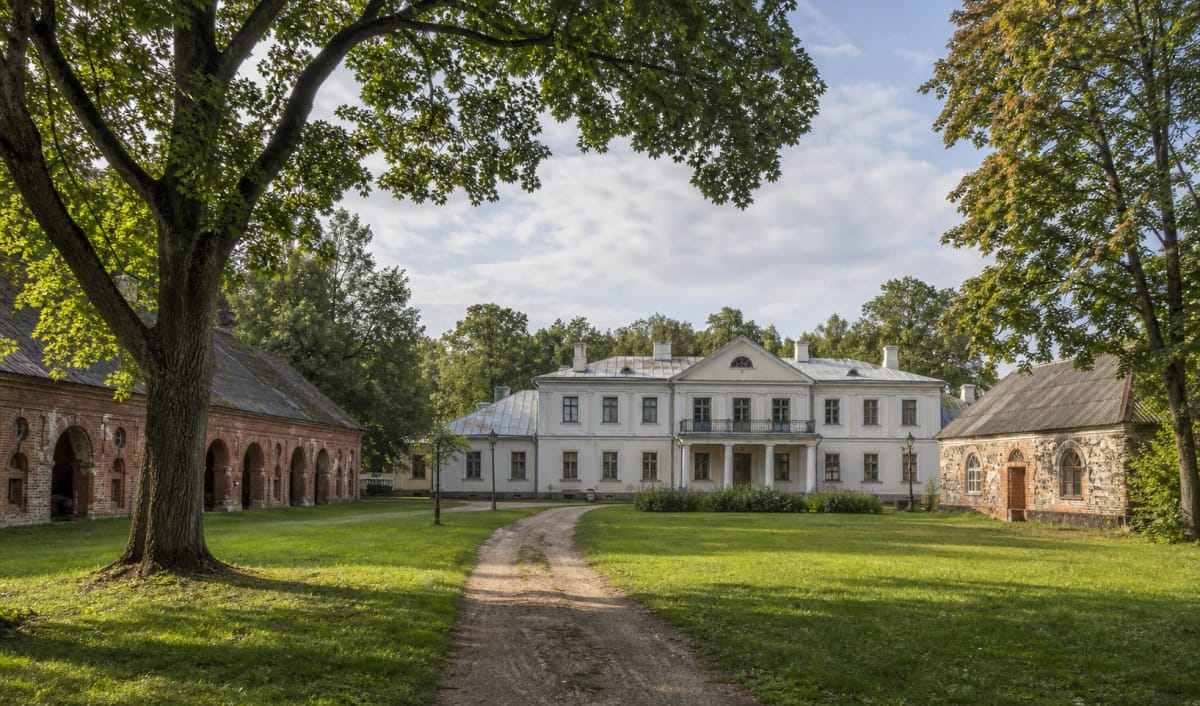
Joniškėlis Manor is a state-protected manor estate complex of national significance. The Register of Cultural Property lists it under unique code 424, with a registration date of April 13, 1992.
This is not just a palace. The register identifies 21 components, including the palace, west and east offices, granaries, cattle barn, watermill warehouse, smokehouse, smithy, workers' houses, orangery remains, gardener's house, barn, and park.
From the Švobas to the Karpis family
According to the Register of Cultural Property, the manor probably existed already in the seventeenth century; in 1611 Janiškiai passed to Kasparas Aleksandras Švoba. Povilas Chrizostomas Karpis acquired the manor in 1723, and by 1733 it belonged to Jokūbas Ignotas Karpis.
The Karpis family became the central thread of Joniškėlis Manor history. After a mid-eighteenth-century fire destroyed or damaged the wooden manor buildings, a Classicist ensemble of palace, east office, granary, and the central part of the park was formed.
Benediktas and Ignotas Karpis: an Enlightenment manor
Benediktas Karpis (1734-1805) was a philanthropist and patron influenced by the French Encyclopedists, the Physiocrats, and especially Jean-Jacques Rousseau. He advocated reforms in the Polish-Lithuanian Commonwealth and improvements in the condition of serfs. In 1792 he built the brick church at Joniškėlis; during the 1794 uprising he represented Joniškėlis in the Grand Duchy of Lithuania's Central Deputation and funded the first iron foundry in Vilnius.
Ignotas (Ignas) Karpis (1780-1809) turned those ideas into a concrete act. In his 1808 testament he freed about 7,000 serfs from serfdom, though without land, so most remained working on the estates, and allocated about 400,000 auksinai to the Joniškėlis parish school, hospital, and pharmacy. Under the testament, the school founded in 1811 also operated as the first agricultural school under Vilnius University regulations, giving Joniškėlis a nationally significant social-modernization story.
Architects and nineteenth-century layers
VLE mentions architect J. Szantyras, while the Register of Cultural Property connects later nineteenth-century work with German architect F. Lehmann, who contributed to the historicist brick-style buildings and park redesign.
This explains why Joniškėlis Manor is not a pure ensemble from one period. Late eighteenth-century, early nineteenth-century, and late nineteenth-century architectural layers meet here.
Visiting
Research did not find a stable public timetable or ticketing system for interior visits. The safest plan is to treat Joniškėlis as an exterior, park, estate-complex, and town-heritage visit unless local institutions announce a specific event or guided tour.
Because the complex is large, do not give all your attention to the palace alone. The farm buildings and park help explain the Karpis estate as a self-contained historical system, not merely a handsome facade.