
Spring to early summer
Pentecost in Meironys: swimming cattle and remembered tradition
Pentecost, the seventh Sunday after Easter; check event dates and locations separately
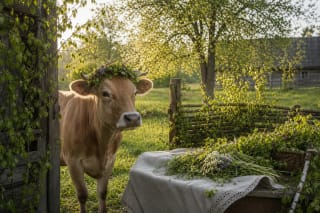
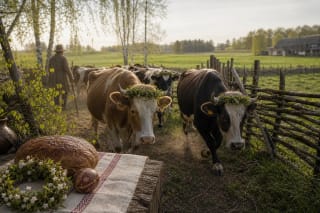
Cows wearing wreaths in the water became a recognisable image of Pentecost in Meironys. Yet an image surviving in memory does not mean the action still takes place every spring. This example helps distinguish three related things: a grazing custom, its public celebration and later remembrance after everyday farming life has changed.
Tradition context
- When
- Pentecost, the seventh Sunday after Easter; check event dates and locations separately
- Season
- Spring to early summer
- Themes
- Meironys, Palūšė, Aukštaitija, Pentecost, grazing, garlanded cows, memory
Meironys Pentecost became known for garlanded cows swimming to grazing land. Sources from 2025 describe a changed situation: a commemoration with archival material was announced in Palūšė, while a museum account explained that no cows remained in the village.
Why were cows central to the celebration?
The Ethnic Culture Council’s regional account presents Meironys as an example of distinctive Pentecost customs: garlanded cows swimming to grazing land. This detail connects decoration with a particular task and landscape. It is more than an attractive festival symbol: the cattle belonged to households and caring for them was daily work. Changes in the custom therefore need to be considered alongside changes in grazing and village life.
A short sequence of documented change
The council’s regional description uses the present tense for the swimming custom. This identifies the practice but does not say when it was last performed. For a traveller, the distinction matters: a sentence in a cultural overview does not confirm an event in a future year.
On 5 June 2025, the Molėtai Regional Museum explicitly explained that the Meironys cattle crossing had become a matter of remembrance because no cows remained. The Ignalina District Cultural Centre’s Palūšė programme published for 8 June included archival material and communal celebration. These two dated sources give a more precise picture than an undated statement in the present tense.
What does the 2025 programme actually establish?
The organiser invited people to gather in Palūšė after worship, recall customs, cook an egg dish, play music and dance. The announcement marked the thirtieth anniversary of celebrating the Meironys Pentecost tradition. That describes a particular commemoration; the anniversary figure should not be taken to mean that the grazing custom itself began thirty years earlier.
A programme establishes what was announced and planned. It is not itself a report of what happened or a recording of every activity. The reference to archival material does not identify a specific film number, production date or permission for reuse. We therefore do not present it here as a verified publicly accessible archival recording or assign an invented catalogue reference.
Does a custom disappear when it can no longer be repeated?
Swimming cattle, a staged presentation and an account of the crossing are different forms of heritage. Without a herd, the actual grazing activity cannot be described as though it still happens annually. People’s experiences, family photographs, place names, shared food and music can remain. A commemoration can preserve these connections when it clearly identifies what is being performed now and what is being remembered.
This distinction does not make the present celebration less meaningful. It respects people whose daily lives have changed and protects the place from tourism promises that no longer match local life. A new event can have its own value without pretending to be an exact copy of an earlier village task.
Preparing a visit or a school project
Before travelling, check the organiser’s programme for the relevant year: is the event in Meironys, Palūšė or elsewhere, and does it offer storytelling, an exhibition or music? Here the 2025 announcement is evidence of change, not a timetable for a future celebration. Watching cattle swim is not promised to visitors.
For a school project, compare the regional overview with the two 2025 accounts and note the verb tenses. Label each statement as a historical action, an announced programme or a recollection. This small source-comparison exercise shows change more accurately than a general assertion that a custom is “still celebrated this way today”.
Main Meironys Pentecost customs and meanings
This local account complements the general Pentecost page. Its focus is not to repeat every greenery custom, but to explain what sources published at different times actually establish about Meironys and Palūšė.
Historical practice. Garlanded cows swimming to pasture linked the feast with grazing; this is not a currently guaranteed visitor attraction.
The 2025 commemorative format. The organiser’s programme included recollections, an egg dish, music, dancing and archival material.
Local memory. Community accounts and images can preserve knowledge of a custom after its former farming conditions have disappeared.
Meironys Pentecost: songs, sutartines, and related pages
The Pentecost page explains the feast’s calendar position and shepherd customs. St George’s Day adds the context of the beginning of the grazing season.
Meironys Pentecost: frequently asked questions
Can visitors come to watch cows swimming today?
This page does not establish that opportunity. The 2025 museum account says no cows remained, and the commemoration programme featured archival material.
Is the Palūšė commemoration the same as the historical crossing?
No. They are connected through local memory, but a commemoration featuring images, food and music differs from moving real cattle to pasture.