
Spring
Lalavimas: Easter house visiting
At Easter; often on Easter Sunday evening and during the night
At the centre of lalavimas is an encounter at a home: a visiting group addresses the household, sings or speaks its wishes, and the residents respond with hospitality and a gift. Traces of the custom lead to different Lithuanian localities and neighbouring cultural environments. The Council for the Protection of Ethnic Culture includes lalavimas among the characteristic communal traditions of Dzūkija.

Tradition context
- When
- At Easter; often on Easter Sunday evening and during the night
- Season
- Spring
- Themes
- Easter visiting groups, household visits, spoken greetings, lalynkos, hymns, gifts, Dzūkija, Lithuania Minor
Lalavimas is Easter house visiting with hymns, songs and good wishes, reciprocated with decorated eggs or other food. Asking permission, offering greetings and requesting gifts form its basic sequence, while timing, participants, language and repertoire vary between local traditions.
When did lalavimas begin?
The Lithuanian Museum of Ethnography describes groups setting out on Easter Sunday evening and continuing until Monday morning. The 2026 ethnic culture olympiad answer key likewise specifies the evening of the first Easter day. Lalavimas therefore cannot be universally restricted to Easter Monday. For an individual record, identify not only the festival day but whether it concerns an evening, a night, a recollection or a later stage performance.
Three parts of the encounter
The spring folklore seminar material published by EKGT distinguishes three parts: asking permission to perform, offering ritual good wishes and requesting gifts. This structure reveals a dialogue rather than merely a song performance. The first action establishes contact with the household, the second names the hoped-for good fortune, and the third anticipates a response. It helps us read different texts without fixing the number or precise order of songs used by every group.
Who took part, and what did they do?
The museum account describes young men preparing their repertoire and assigning a leader, musician and egg carrier. These roles help us picture a group that has made practical arrangements. Who will open the conversation? Who will start the tune? Who will receive gifts? Even in a small group these are different tasks, so an account of the custom should attend to people’s actions as well as their clothing or baskets.
Prosperity for the household and greetings to young women
The repertoire also depends on whom the visitors address. Discussing Lithuania Minor customs recorded by Carl Cappeller, the Lithuanian Museum of Ethnography mentions texts devoted to the householder and the farm. EKGT seminar material associates songs from southern and eastern Dzūkija with unmarried women’s future marriages. Similar house visiting thus has different poetic centres: the household’s livelihood in one case, youth and a possible wedding in another.
When reading such a text, first note the form of address. Then distinguish what happens in the song, what is wished for and what may only be imagined. A poetic garden, ring or future bridegroom does not automatically describe a real event. This reading sequence helps us hear a song as speech directed to someone and avoids assigning every image a single meaning across Lithuania.
The gift and the reply
Birutė Imbrasienė’s festival collection describes thanks for food received and hostile wishes when no gift was given. Museum teaching material on gift customs also stresses opportunities for young people to show interest in one another. A decorated egg in this encounter is therefore more than payment for music: it belongs to an exchange involving good wishes, welcome, generosity and sometimes affection.
Historical mockery can be discussed without directing it at someone who does not want to participate. For a learning event today, agree on participation and gifts beforehand: people may contribute a song, a story or an egg if they wish. This is a present-day organising practice. It need not be presented as an exact reconstruction of a historical rite or turn a gift into an obligatory fee.
Multiple languages and changing participants
LMTA’s Metų ratas describes later participation by women, girls and married men, along with Lithuanian, Polish and Belarusian repertoire in the multilingual environment of eastern Lithuania. A model restricted to young unmarried men therefore does not cover every documented variant. A source’s description of an ongoing custom does not itself guarantee that a visitor can hear it in a particular village this year; that requires local information.
How to listen and compare variants
For a selected recording, note the locality, performer, language and recording date wherever these are supplied. Listen for speech, hymn singing, song and instrumental sound. Mark where the person addressed changes or a request begins. Compare it with another documented variant, not merely a similar tune. If metadata are absent, say so: an unknown location does not mean “all Lithuania.”
In a small group, arrange cards showing the three actions and explain the purpose of each. Participants can then create a short greeting of their own, clearly identifying it as a new text. This teaches the structure of the custom without manufacturing an archival example. Learning a historical item requires a specific published text and melody, with their conditions of use checked.
What the sources and illustration establish
This overview draws on LMTA’s educational publication, teaching material published by EKGT and museum explanations. The museum web texts were consulted through excerpts available in the search index; they are not new field research. Song texts and recordings are not republished here. The header image is a thematic illustration, not a documentary photograph of performers. The provenance and rights of an individual performance require separate checking.
Main Lalavimas customs and meanings
The sequence of actions and the person addressed help identify lalavimas. Receiving an egg at Easter alone does not tell us whether the occasion was lalavimas, children collecting eggs, a family visit or another kind of visiting.
A household is visited and its members addressed.
Good wishes may be delivered through hymns, songs or speech.
Greetings are reciprocated with decorated eggs, other food or hospitality.
Lalavimas: songs, sutartines, and related pages
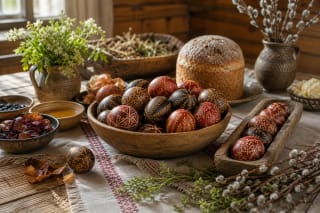
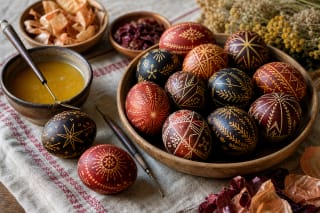
Lalavimas connects the Easter calendar, gift exchange and singing. Atvelykis has a separate date, while decorated eggs and folk instruments help explain the material and musical sides of the encounter.

Lalavimas sources and useful pages
- LMTA Metų ratas: Easter, St George’s Day and Pentecost, “Songs” section
- EKGT: 2026 olympiad tasks and answers, years 11–12, p. 6
- EKGT: Spring festival folklore, 2026 seminar material, pp. 9–11
- Lithuanian Museum of Ethnography: Easter customs, lalavimas and swings
- Lithuanian Museum of Ethnography: Easter customs of Lithuania Minor
- B. Imbrasienė, ed.: Lithuanian Calendar Festivals, 1990, p. 51
- EKGT: gift customs, “Easter: gifts to young people” slide
- EKGT: distinctive traditions of Dzūkija and Dainava
Lalavimas: frequently asked questions
Does lalavimas take place only on Easter Monday?
No. Sources explicitly mention Easter Sunday evening and the night leading into Monday. Precise timing should be tied to a local tradition.
Is every Easter song a lalavimas?
No. The context matters: visiting a household, the person addressed, and the exchange of greetings and a response.
Does this page reproduce an authentic song transcription?
This page explains the custom and links to sources. It is not an edition of a particular recorded text or performance.