
Summer
Devintines: Corpus Christi in Lithuania
The ninth week after Easter; traditionally Thursday, often moved to Sunday in Lithuania
Devintines is a feast of greenery and procession in which Eucharistic devotion meets very practical human concern: to bring home blessed herbs, protect the house from thunder, ease illness, guard the garden, and close the spring work season.
Tradition context
- When
- The ninth week after Easter; traditionally Thursday, often moved to Sunday in Lithuania
- Season
- Summer
- Themes
- Corpus Christi, Devintinis, wreaths, procession, herbs, nine wreaths, birch trees, medicinal plants, garden protection, Deivakunis
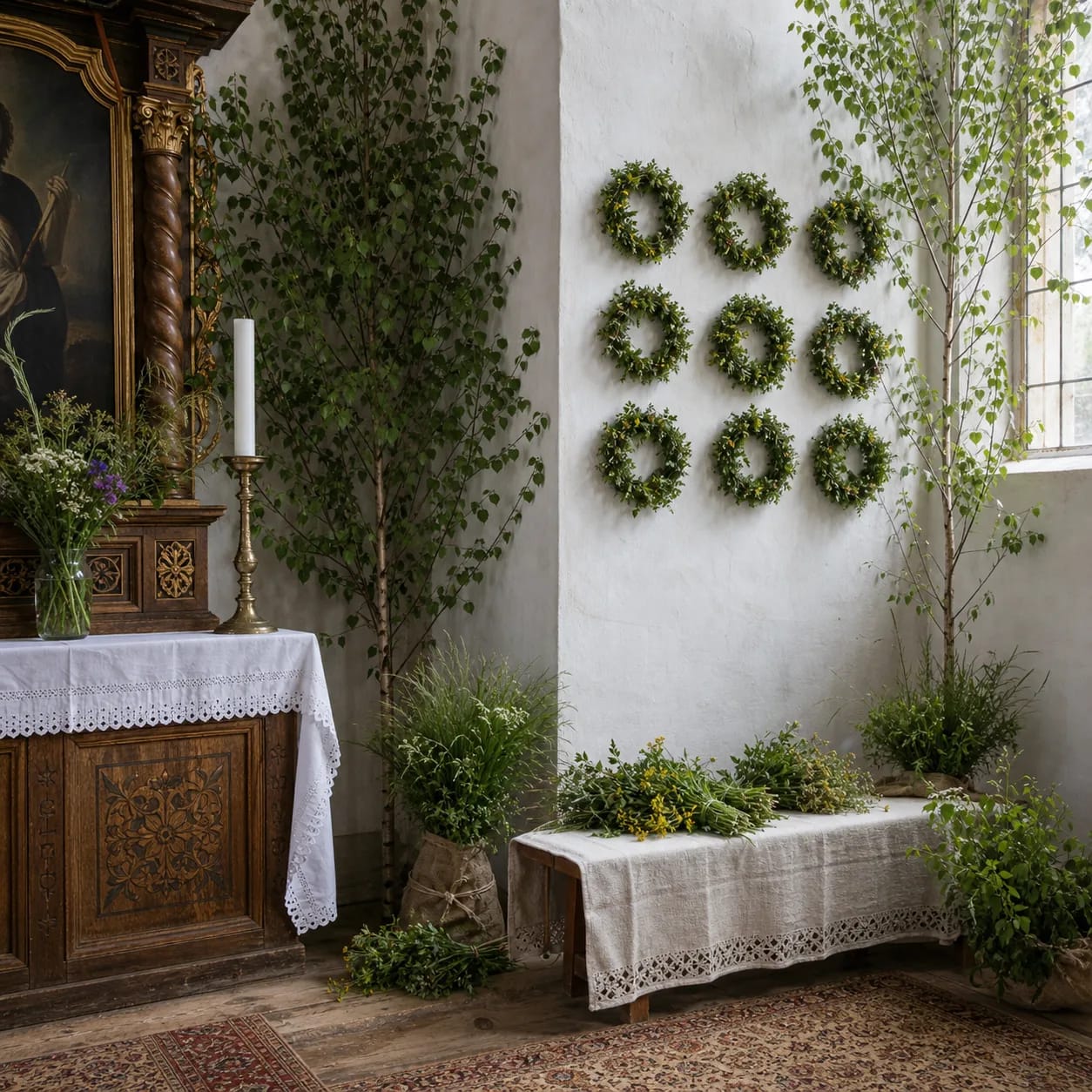
Devintines, the feast of the Most Holy Body and Blood of Christ, stands out in Lithuanian custom through greenery: churches decorated with birches, nine wreaths of rue and medicinal plants, blessed herbs kept at home, and their use for healing, protection from thunder, garden care, and the symbolism of nine dishes.
When Are Devintines Celebrated?
VLE states that Devintines begin in the ninth week after Easter, traditionally on Thursday. In some countries and in Lithuania the feast is transferred to Sunday, so the rule for calculating the date matters more than a fixed calendar day.
The church name is the feast of the Most Holy Body and Blood of Christ. Klimka describes it as the end of the spring liturgical cycle lasting nine weeks from Easter. Folk practice gave this ending the form of greenery, wreaths, and household protection. According to VLE, Devintines began to be celebrated in 1246 in the Diocese of Liège, and in 1264 Pope Urban IV, in the bull Transiturus, ordered it observed throughout the Church; Thomas Aquinas composed the texts of the Mass and liturgy.
Why Were Devintines Called Wreaths?
Klimka writes that a folk name for the feast was Vainikai, “Wreaths,” because the church and procession space were decorated with living greenery. This was not only decoration: herbs were brought to be blessed as a gift of God's creation to people.
VLE also notes that in Lithuania churches were decorated with field grasses, leaf wreaths, birches, and more rarely young oaks. Blessed greenery from the final day of Devintines was later used not only for beauty but for protection.
Nine Wreaths and Keeping Herbs
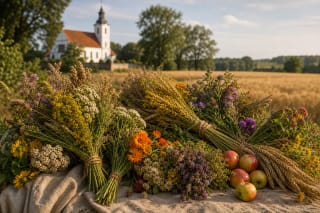
In village churches, birches were set by side altars and families' girls hung nine small wreaths made of rue and medicinal plants on the walls. Klimka notes that these wreaths remained in church through nine Vespers.
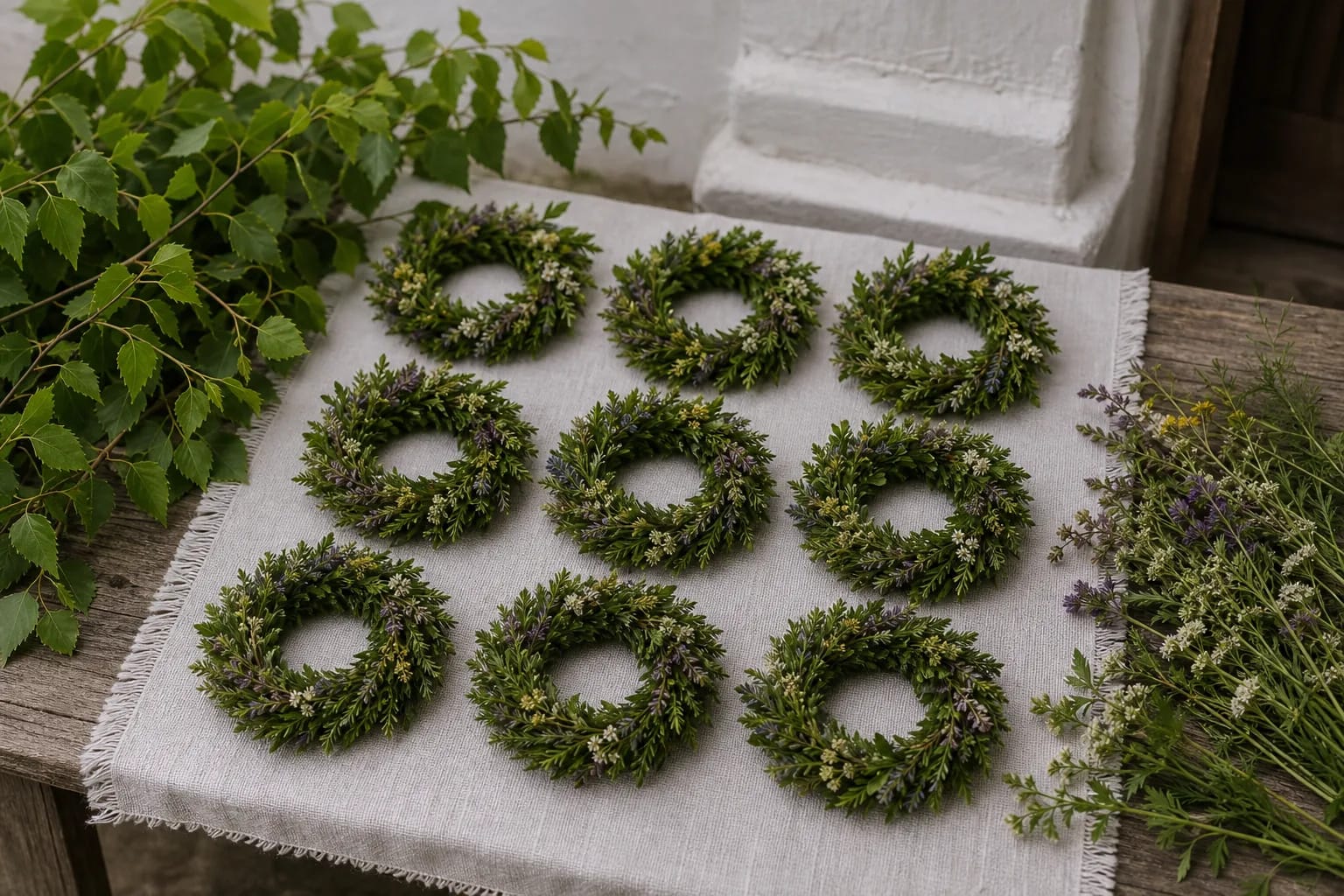
At home the dried wreaths were kept on a small shelf or in the krikstasuole corner near holy pictures. During storms their herbs were burned by the bread oven, given as tea to the sick, and in Samogitia and Dzukija placed in the pillow of a deceased person's coffin.
Birches, Loft, and Garden
After birches were blessed in church, people broke off a branch and brought it home to tuck under the roof batten. Such a branch was expected to guard the house against lightning strikes.
Blessed greenery also went to the garden. Klimka mentions women placing herbs into seedling beds to drive away moles and setting birch branches between cabbage rows so worms would not attack the cabbages.
The Number Nine in Food and Work
VLE stresses that the number nine dominates folk customs of Devintines: nine wreaths were woven and nine small pies baked. Klimka adds that a housewife was reminded to prepare not only cheese for the shepherd but nine dishes for the family, such as curd pancakes, crescent pastries, or grated-potato cakes.
Devintines also marked a boundary after which people no longer sowed or planted gardens, because the short Lithuanian summer might not let the crop mature. This practical rule explains why the feast is so sensitive to greenery, gardens, and the season.
Samogitian Deivakunis
In Samogitia, Devintines were dialectally called Deivakunis. Klimka emphasizes that here the customs resemble Aukstaitian Sekmines: houses were decorated with birch branches, cows and sheep were crowned, and shepherds' feasts were held.
This is an important regional note. It would be inaccurate to say that all these Sekmines-like actions belonged equally to all Lithuania on Devintines. In Samogitia they appear as a layer shaped by a later summer and coastal climate rhythm.
Main Devintines customs and meanings
The customs of Devintines are dominated by the number nine and living greenery. Churches are decorated with birches, people bring herbs, girls weave small wreaths, and dried branches and plants are kept at home for the whole year.
A movable date. Devintines begin in the ninth week after Easter, traditionally on Thursday; in Lithuania the feast is often moved to Sunday.
The procession. A solemn procession honors the Blessed Sacrament during Devintines.
The name Wreaths. In folk usage the feast was called Devintines, Devintinis, and, as L. Klimka notes, Vainikai, “Wreaths,” because church and procession were decorated with greenery.
Church greenery. Churches were decorated with wreaths of field grasses and tree leaves, with birches, and more rarely with young oaks.
Nine wreaths. In village churches, each family's girls hung nine small wreaths of rue and medicinal plants on the walls.
Keeping herbs. Blessed herbs were kept at home near holy pictures or in the krikstasuole corner and used for fumigation and healing.
Protection from thunder. Blessed birch branches were tucked under roof battens or into the loft to guard the house from lightning.
Samogitian Deivakunis. In Samogitia, Devintines, dialectally Deivakunis, absorbed some Aukstaitian Sekmines customs: birches, crowning livestock, and shepherds' feasts.
Where to experience it
Where to experience Devintines in Lithuania?
Devintines belongs to church, town street, household corner, and garden bed. The procession is public, but the life of blessed herbs continues privately at home, near the stove, in the loft, or in the garden.
Church and Procession
The main setting is church and the solemn procession with the Blessed Sacrament, wreaths, and greenery.
Vilnius Old Town and Kalvarijos
Klimka mentions an old Vilnius tradition of holding the Devintines procession through Old Town streets and toward Kalvarijos.
The Household Corner
Dried Devintines wreaths were kept by holy pictures or in the krikstasuole corner for fumigation and healing when needed.
Garden Beds
Blessed herbs and birch branches were taken to seedling and cabbage beds in hopes of protecting plants from pests.
Devintines: songs, sutartines, and related pages
Devintines belongs near Sestines and Sekmines because it closes the Easter season. Through herbs it also connects with Zoline, and through the boundary of sowing with grain symbolism.
Sestines
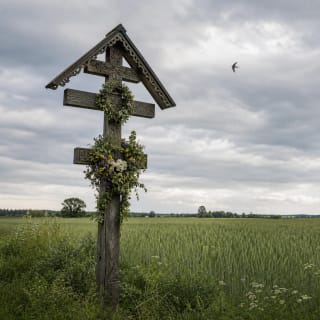
An earlier Easter-season feast also linked with processions, crosses, and protection of fields.
Sekmines
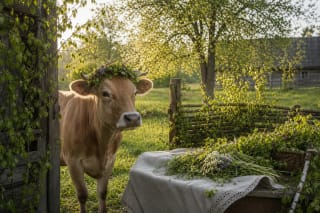
A greenery and shepherds' feast whose customs overlap with Samogitian Deivakunis.
Zoline
A later summer feast of herbs and harvest, close to the meaning of blessed Devintines plants.

Grain, Rye, and Seeds
Helps explain why Devintines marked a boundary after which sowing and planting stopped.
Devintines sources and useful pages
Devintines: frequently asked questions
When are Devintines celebrated?
Devintines begin in the ninth week after Easter, traditionally on Thursday. In Lithuania they are often moved to Sunday.
What is the church name of Devintines?
The church name is the feast of the Most Holy Body and Blood of Christ. It is a feast honoring the Blessed Sacrament.
Why were Devintines called Wreaths?
Because of the greenery and wreaths: churches, processions, and altars were decorated with field grasses, birches, wreaths, and herbs brought by people.
Why are nine wreaths woven?
In folk custom the number nine is important for Devintines. Klimka mentions nine rue and medicinal-plant wreaths that remained in church through nine Vespers.
How were blessed Devintines herbs used?
They were kept at home, burned during storms, used for healing, placed in tea for the sick, put in coffin pillows, and taken to gardens against moles or pests.
Why was a birch branch tucked into the loft?
A blessed birch branch brought home from church was tucked under roof battens or into the loft in the belief that it would protect the house from lightning.
What is Deivakunis?
Deivakunis is the Samogitian name for Devintines. In Samogitia it includes birches, crowning animals, shepherds' feasts, and customs close to Aukstaitian Sekmines.
Do Devintines and Sekmines duplicate each other?
No. They are different feasts, but some greenery and shepherd customs overlap regionally in Samogitia. That is a Deivakunis layer, not an all-Lithuanian rule.
Why was nothing sown after Devintines?
In folk practice Devintines marked a point after which new sowing or planting might not mature before autumn frosts. It was a practical rule of Lithuania's short summer.