
Life cycle
Įžegnojimas: confirmation and growing up in Lithuania Minor
Įžegnojimas, įžegnotuvės and žegnonė are Lithuanian names for confirmation encountered in historical sources. Among the Lithuanian-speaking Lutheran communities of Lithuania Minor, the occasion mattered in church, family and youth life. Understanding it requires separating the profession of faith from the social entitlements historically associated with it. Recognition of a fourteen-year-old within a youth community is not the same as present-day legal adulthood.

Tradition context
- When / context
- On the occasion of confirmation; dates depend on the parish
- Tradition area
- Life cycle
- Themes
- Confirmation, Lithuanian Lutherans, Lithuania Minor, youth, family, certificates
In Lithuania Minor, confirmation marked a religious commitment and a passage from childhood into the youth community. Dated accounts allow comparison between its earlier links with school, work and family customs and later practice.
Clothing, refreshments and gifts
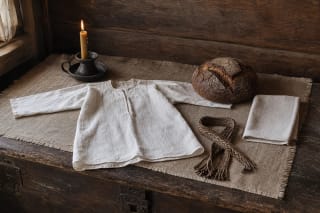
The Encyclopaedia of Lithuania Minor describes the occasion through a break with everyday life: the family prepares clothes, guests and refreshments. It mentions different colours of girls’ dresses, so neither black nor white should become a universal rule for Lithuanian Lutherans. Clothing in pictures and albums needs to be read alongside the date, parish and family circumstances; colour alone cannot establish a person’s identity.
Gifts could be connected with faith, personal remembrance or future household life. The encyclopaedia mentions religious books, clothing and other presents. The size and restraint of a family celebration depended on its setting. A present-day gift can continue the idea of remembrance, but copying one historical object does not establish a compulsory “traditional” gift.
A 2005 example: what can one account tell us?
Page 82 of the Lithuanian Institute of History publication records a respondent from Katyčiai describing her confirmation in Žemaičių Naumiestis on 10 July 2005. It includes preparation with the pastor, festive clothing and relatives gathering afterwards. This case shows the later life of the custom, but does not by itself prove that the entire older social order of Lithuania Minor survived unchanged. The research location, event date and narrator’s experience are equally important.
What can a confirmation certificate tell us?
The encyclopaedia presents Wilhelm Jonat’s 1912 certificate from Dituva, signed by Priekulė pastor Vilius Gaigalaitis. Held by the History Museum of Lithuania Minor, it is a dated example connecting a person and a parish. The article also includes illustrations from other periods. Their captions can begin a family-history search, but cannot replace the original document or museum catalogue information.
For a family document, separately record the name as printed, date, parish, language and later handwritten additions. Avoid normalising the spelling immediately or treating a later note as part of the original certificate. An album photograph may complement it, but an unknown photograph date should remain explicitly unknown. A digital copy preserves information; permission to publish it is a separate question.
Historical custom and religious life today
Current preparation requirements, ages and ceremony dates should be checked with the religious community itself. Ethnographic accounts explain past life rather than set present church rules. This page offers an editorial synthesis of the sources; it does not reproduce certificate images or present one family’s celebration as a mandatory script for everyone.
Confirmation customs: main practices and meanings
These accounts belong to particular places and periods. They help interpret a family album, but do not prescribe one current system of preparation for confirmation.
Preparation. Historical accounts connect confirmation with religious instruction and a public profession of faith.
Special clothes. New clothing and family preparations marked the occasion; colours were not uniform everywhere.
Remembrance. Certificates, photographs and religious books preserved traces of the individual, parish and family celebration.
Confirmation customs: context and related pages
The childhood and baptism pages add the wider life-cycle context. Confirmation shows why families from the same region should also be compared with attention to denomination.

Confirmation customs sources and useful pages
Confirmation customs: frequently asked questions
Do įžegnojimas and confirmation mean the same occasion?
Here įžegnojimas, įžegnotuvės and žegnonė are historical Lithuanian names for Lutheran confirmation.
Does confirmation always take place at fourteen?
Fourteen is significant in the historical sources discussed here. Present preparation and age requirements are determined by the religious community.