
- Type
- God
- Domain
- Prussian god, wealth, abundance, harvest, full barns
- Source status
- well attested
Pilnytis, Pilnitis, Piluuytus, Pilwitus
Who is Pilvytis in Prussian mythology?
Pilvytis is an old Prussian god of wealth. In the Sudovian Book, around 1520-1530, he is called Pilnytis and described as a god who enriches people and fills barns. His field is not money in the modern sense, but agrarian wealth: abundant grain, full barns, and farm surplus.
Such a god mattered deeply to an agricultural community. Whether a family would survive the winter and have seed for the next year depended on the fullness of the harvest, so a deity of abundance held a significant place in the Prussian worldview.
Pilvytis' name: Pilnytis and Piluuytus
The god's name appears in several forms: Pilvytis, Pilnytis or Pilnitis, Piluuytus, and Pilwitus. The Sudovian Book form Pilnytis is especially revealing because it clearly evokes fullness and filling, fitting the god who fills barns.
These spellings matter as reflections of the same divine name in different sources. They show that the god of wealth and abundance was known more widely than a single isolated mention.
God of wealth and abundance: the one who fills barns
Pilvytis' main field is abundance and fullness. The Sudovian Book calls him a god who enriches and fills barns; Maciej Stryjkowski describes him as giving wealth and filling barns; and Jonas Bretkūnas calls him a god of plenty who makes a person rich.
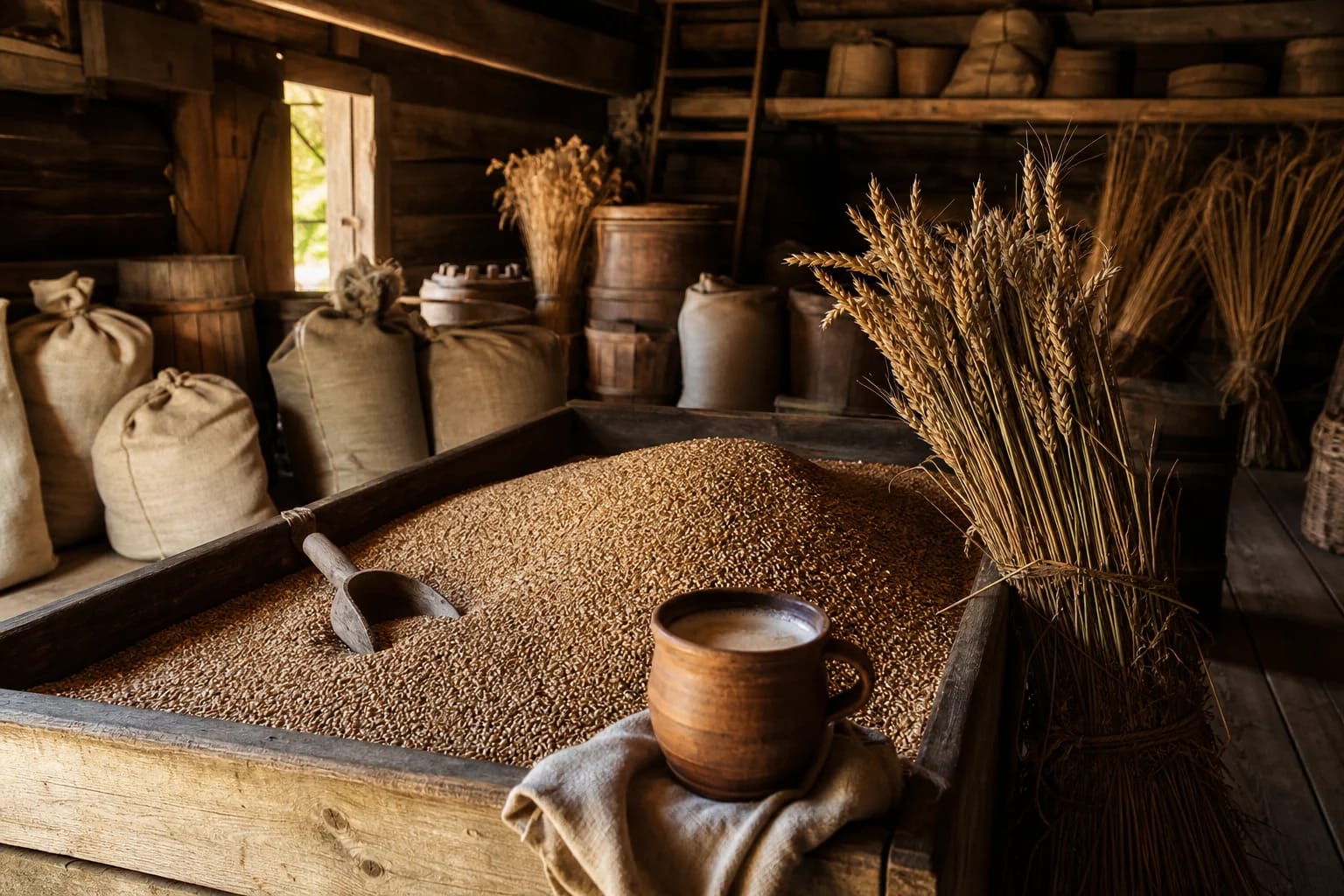
These testimonies agree on the essential point: Pilvytis was understood as a god on whom farm surplus depended. His favor meant full barns; his disfavor meant poverty and hunger.
Pilvytis and harvest: spring requests
Pilvytis was petitioned already at the beginning of the agricultural season. Jonas Bretkūnas writes that every spring, before sowing began, people asked Pilvytis to grow large ears of grain and increase the harvest in barns. The wealth god therefore belonged to the whole growing cycle, from hope at sowing to fullness at harvest.
This spring request shows that wealth in old religion was not understood as accidental luck, but as divinely given abundance that had to be asked for at the right time and with respect.
Pilvytis during the Pergrubinės festival
Aleksander Guagnini says that during the spring festival Pergrubinės (Pergrubi), beer was offered to Pilvytis so that people would succeed in accumulating wealth. Pilvytis was thus woven into the same spring ritual cycle in which other Prussian fertility gods were honored.
The beer offering is not incidental: beer, made from grain, is itself a sign of harvest and abundance. By offering it to the wealth god, people symbolically returned part of abundance and asked that it come back again in full barns.
Pilvytis and Pluto
Jan Malecki-Sandecki compared Pilvytis, in the form Piluitum, with Pluto, the Roman god of the underworld and wealth. Such comparisons were typical of early modern writers, who explained unfamiliar gods through classical examples.
The comparison with Pluto emphasizes wealth, but it should be read carefully. It does not mean that Pilvytis was an underworld god; rather, it shows that an ancient god of wealth seemed to the author the closest equivalent for the Prussian abundance deity.
Pilvytis' sources and place in the pantheon
Pilvytis is mentioned in the 1530 decision of the Prussian bishops of Pomesania and Sambia, in the form Piluuytus, in the Sudovian Book, and also in writings by Jan Łasicki, Jonas Bretkūnas, Maciej Stryjkowski, and Aleksander Guagnini. This broad source base allows him to be treated as a well-attested Prussian deity.
In Prussian lists of gods from the sixteenth and seventeenth centuries, Pilvytis is mentioned before Perkūnas. This suggests that the god of wealth and abundance held an important, not secondary, place in the Prussian pantheon.