- Type
- God
- Domain
- Prussian god, waters, fertility, grain, success
- Source status
- well attested
Who is Patrimpas?
Patrimpas is a Prussian god, one of the most important gods in the western Baltic pantheon. Although he is known primarily from Prussian religion, he matters for the broader Baltic mythological context as one of the better documented figures.
A god named Patrimpas, Potrimppo, was first mentioned by Simon Grunau in 1529. Some researchers consider Natrimpas, mentioned in a 1418 letter of the bishop of Warmia, a possible earliest attestation, likely a distorted form of Patrimpas' name.
Patrimpas in the Prussian divine triad
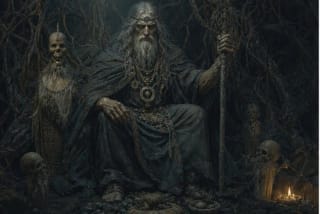
Grunau names Patrimpas as one of the most important Prussian gods, together with Patulas and Perkūnas. According to him, these three gods were depicted on the banner of the Prussian king Vaidevutis, and their images were kept in niches carved into the trunk of the sacred oak at the main sanctuary of Rikojotas.
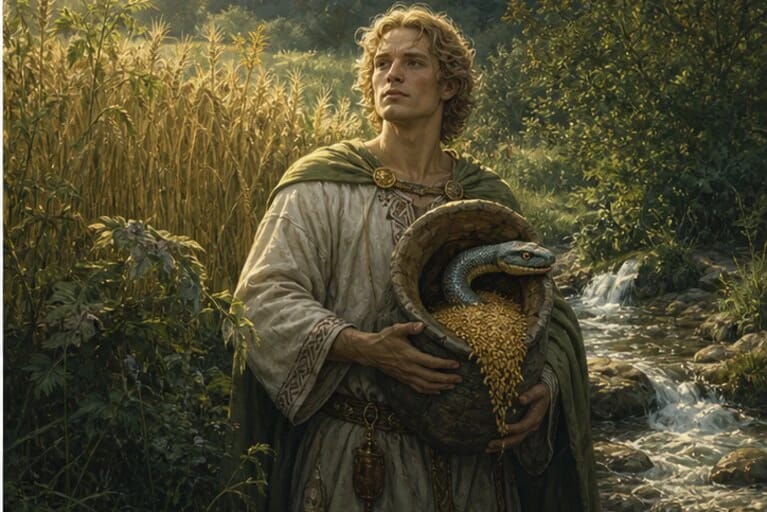
Patrimpas was portrayed as a beardless, cheerful youth with a wreath of ears of grain, a sign of fertility and youth. His symbol was a snake, probably a grass snake, and Grunau even says human sacrifices were made in his honor by a sacred oak.
A god of success, grain, or waters?
Patrimpas' functions are described unevenly in the sources. Grunau calls him both a god of success, including victory in war and success in disputes, and a god of grain, connecting him with spring, summer, fruitfulness, and fertility.
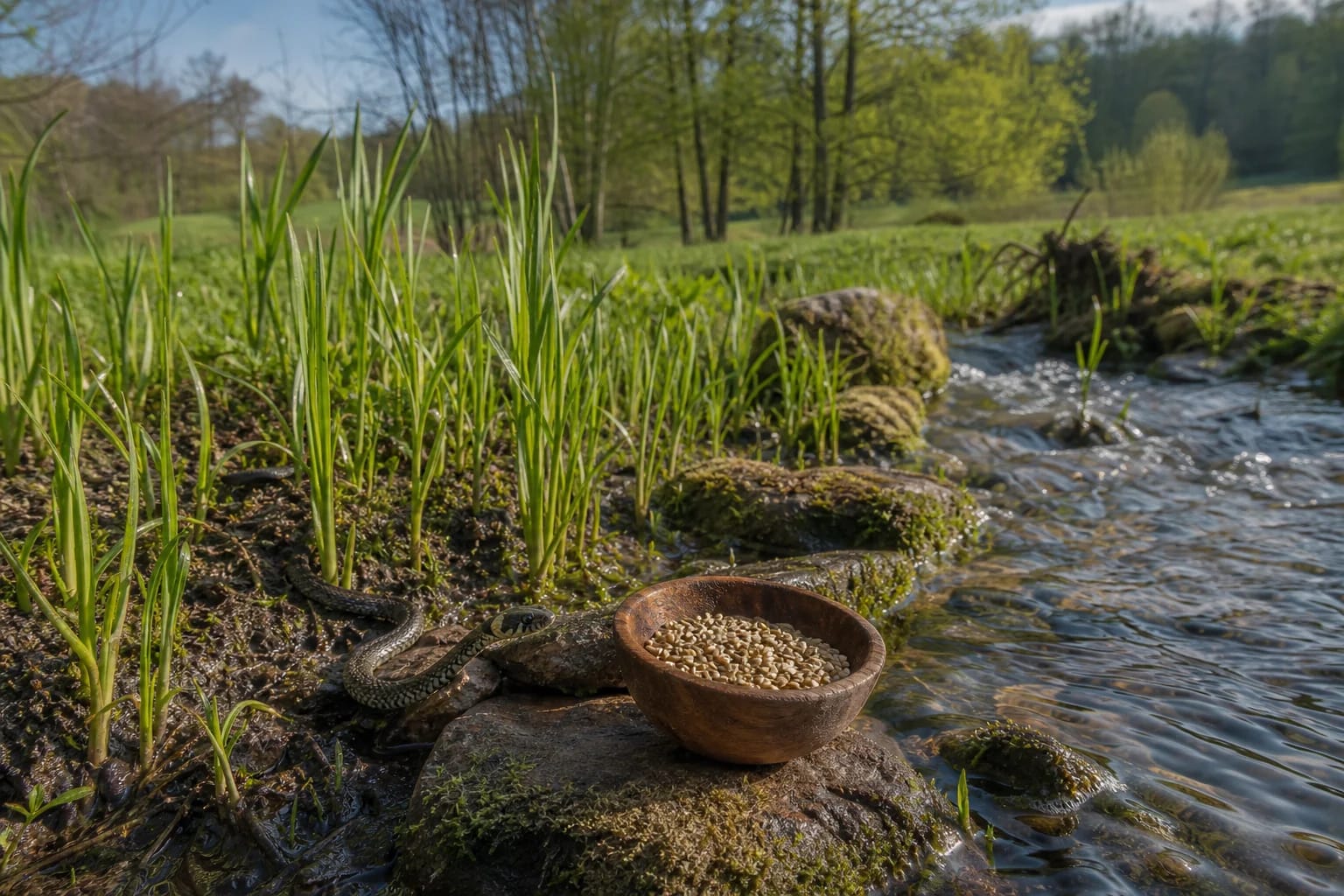
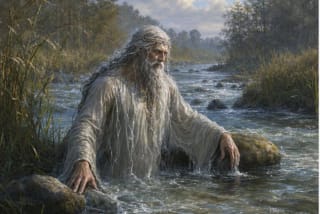
Other sources emphasize water: the Sudovian Book calls Patrimpas a god of flowing waters; Johannes Malecki-Sandecki and Jan Łasicki call him a god of rivers and springs; and Matthäus Praetorius calls him a water god and compares him with the Roman Neptune. This duality shows that his image changed over the centuries.
Patrimpas' name and origin
Patrimpas' name was studied by Kazimieras Būga, Vladimir Toporov, and Norbertas Vėlius. In their view, it is formed from the prefix po- and the root trimp-, linking Patrimpas with a broader group of Baltic divinities.
According to Toporov, the Prussians may earlier have worshipped a fertility god Trimpas, whose functions were later divided between two gods: Autrimpas, god of waters, and Patrimpas. This helps explain why Patrimpas joins the fields of both water and fertility.
Patrimpas today
Patrimpas matters as one of the best documented Prussian divinities, helping explain western Baltic religion and its relationship with Lithuanian mythology. His triad with Perkūnas and Patulas is one of the clearest images of a Baltic pantheon.
Patrimpas should be read cautiously: some data come from late and disputed sources, especially Grunau. Still, his connection with fertility, grain, water, and youthful force is the stable core of his image.