
- Type
- God
- Domain
- Homestead, landholding, household economy, farm prosperity
- Source status
- well attested
Žemėpačiai, Žempatis, Zemepatis
Who is Žemėpatis?
Žemėpatis is an old Lithuanian earth god: lord of the homestead and landholding. His name is made from žemė, 'earth', and pats, 'lord', so it means the lord of the earth, the figure on whom farm prosperity depends.
Žemėpatis is one of the better-attested Lithuanian deities. He is mentioned by Martynas Mažvydas in 1547, the Wolfenbüttel Postil, Matthäus Praetorius, Jonas Bretkūnas, Daniel Klein, Jakob Brodowski, and Pilypas Ruigys, an unusually broad circle of sources.
Lord of the homestead: Žemėpatis and farm prosperity
According to Matthäus Praetorius, Žemėpatis is the god of the homestead, on whom the prosperity of the whole farm depends, and every farmer has his own Žemėpatis. He is also thought to have been guardian of a particular piece of cultivated land, so there could be many žemėpačiai.
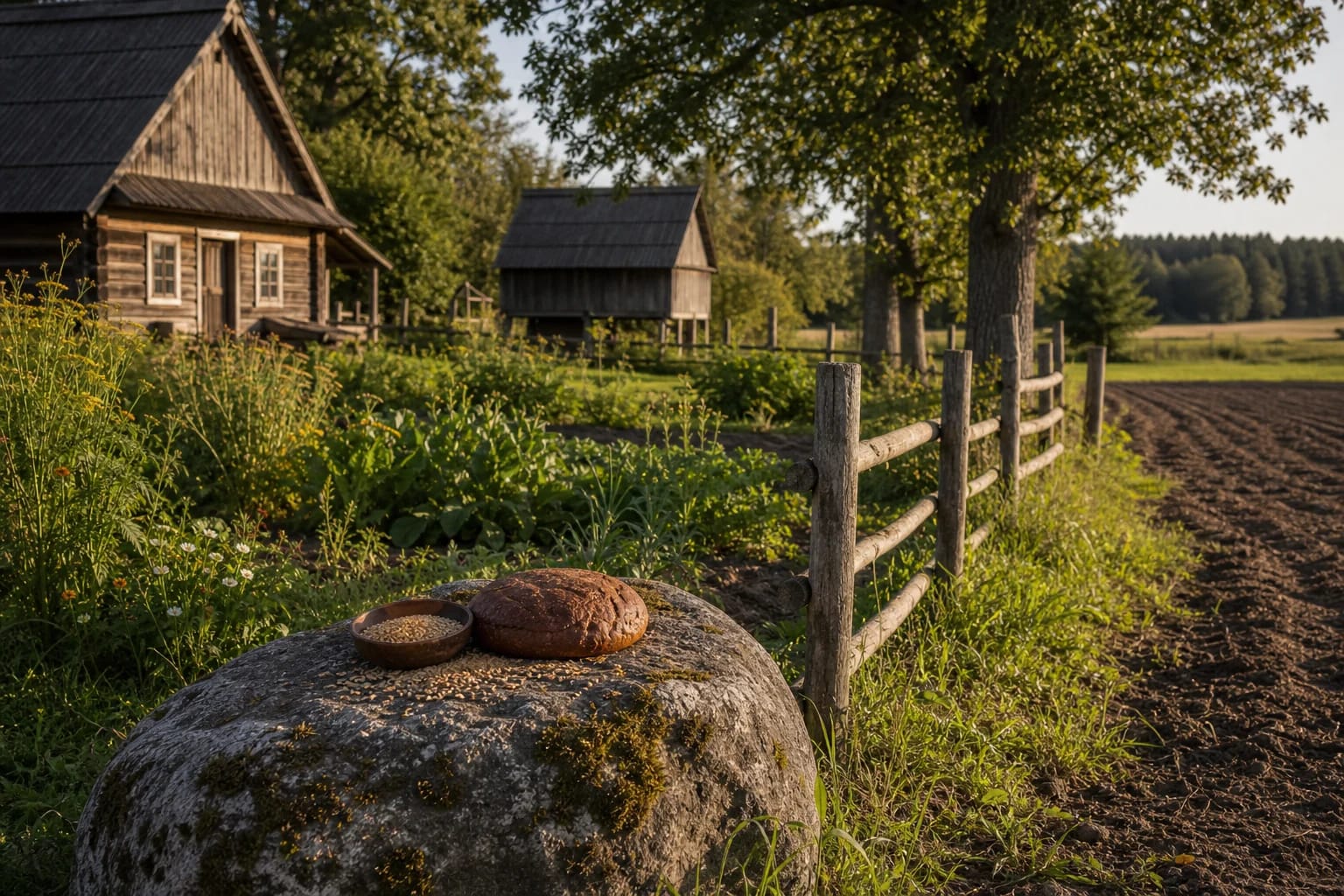
This shows that land in the Lithuanian worldview was not an abstract resource but a living, protected holding. Each homestead had its own god guarding its harvest, animals, and home.
Offerings and the December festival
Offerings were made to Žemėpatis or to his sister Žemyna at the beginning and end of farm work, and also at birth, weddings, and funerals: all the major thresholds of life and household economy. A separate festival in his honor was held in December.
The connection with Žemyna is important. Praetorius calls them brother and sister, so Žemėpatis, homestead protection, and Žemyna, earth fertility, form a pair. Together they cover the farmer's whole relationship with the land, from fertility to household well-being.
Žemėpačiai and žemininkai
Some sources distinguish a group of gods called žemininkai; Praetorius calls them household gods. Jan Łasicki mentions many earth gods, žemėpačiai, and describes rites for them, so Žemėpatis can be understood both as a single deity and as a whole group of earth deities.
This boundary between one Žemėpatis and many žemėpačiai shows how Lithuanian household religion did not always separate deities sharply. Žemėpatis, Žemininkas, and Dimstipatis form an overlapping field of homestead and earth guardians.
Žemėpatis today
Žemėpatis helps explain how Lithuanians sacralized the homestead and landholding: even a specific cultivated plot had its own guardian god, to whom offerings were made at important work and life moments.
Žemėpatis is best read together with Žemyna and Dimstipatis. All three reveal an agrarian worldview in which home, yard, field, and harvest are not merely economics but protected and respected sacred space.