- Type
- God
- Domain
- Prussian god of the underworld, darkness, anger, and the dead
- Source status
- well attested
Patulas, Pikuls
Who is Pikulas?
Pikulas is a Prussian god of the underworld and darkness. In the Elbing Vocabulary the word Pyculs is explained as hell, while the Sudovian Book, around 1520-1530, calls Pikulas the god of hell and darkness, whose subordinates are the Pokuliai.
Like Patrimpas, Pikulas is known primarily from Prussian religion but matters for the broader Baltic context. In Prussian god lists he is mentioned immediately after Perkūnas, so he belongs to the very top of the pantheon.
Pikulas in the divine triad and ritual
During the Pergrubrijus sacrificial festival, the village elder would ask Perkūnas to strike down Pikulas and grant early rain. Pikulas is thus placed on the opposite side from heavenly and harvest-giving forces. A 1530 decree of the Prussian bishops' synod compares him with Pluto, god of the underworld.
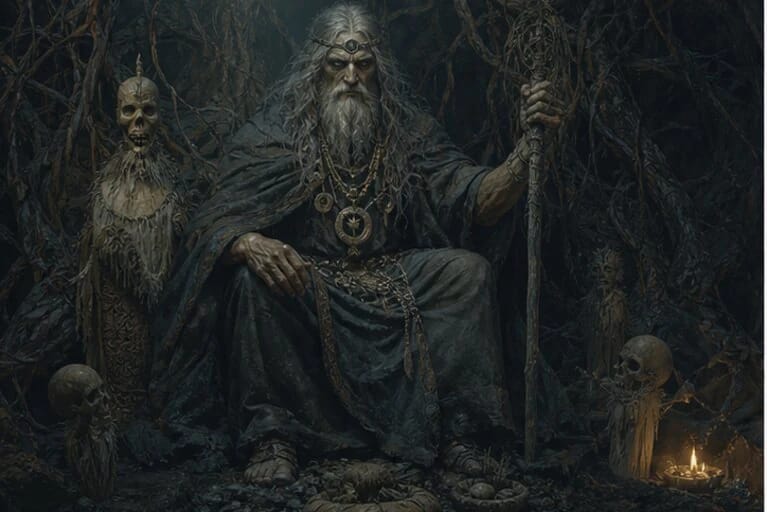
In his Chronicle of the Prussian Land (1588), Jonas Bretkūnas describes Pikulas as an old, pale, gray-haired man with a beard who harms and kills; the heads of dead humans, horses, and cows were sacrificed to him. Praetorius calls him a god of anger and misfortune whom people feared more than Perkūnas.
Pikulas and Patulas: one god or two?
The names Pikulas, Patulas, and Poklius are often confused. Christoph Hennenberger (1595) regarded Pikulas as the same god as Patulas, and later sources usually mention Pikulas instead of Patulas.
It is thought that these may be two names of the same god, or that Patulas, from pa-/po-, under, and tula, earth, meaning under-earth or subterranean, was one of Pikulas' epithets. There is no single agreement on whether there was one underworld god with different names or several closely related gods.
Pikulas' name and transformation into a devil
The divine name Pikulas is derived from pykti, to be angry, and piktas, evil or angry. According to Vėlius, links with Slavic pekla, hell, are unfounded. The name directly expresses anger, darkness, and danger.
In Prussian catechisms from 1545 and 1561, the word pikulas was already used to name the devil, and Hartknoch mentions that children were frightened with Pikulas' name. As Christianity became dominant, the old underworld god merged with images of the devil and hell.
Pikulas today
Pikulas matters as an example of a Prussian chthonic underworld god and as part of the Baltic triad Perkūnas-Patrimpas-Pikulas. He helps explain how the Balts imagined the force of darkness, death, and the underworld.
Pikulas should be read cautiously: in late sources his image was strongly affected by Christian images of the devil and hell. Still, his core as a god of underworld, darkness, and fear remains clear.