- Type
- God
- Domain
- Prussian and Baltic harvest, grain, reaping idol, fertility spirit
- Source status
- disputed
Kurkis, Kurka, Curche, Curcho, Gurcho
Who is Kurkas in Baltic mythology?
Kurkas, recorded in Prussian and German sources as Curche, is a western Baltic harvest deity or spirit. He is especially important because he is the earliest documented Baltic deity of all. His name is preserved not by a late chronicle, but by a living historical document from 1249.
Kurkas is a difficult and disputed figure. We securely know his name and his connection with harvest, but not his exact nature: some sources and scholars treat him as a god, others rather as a grain spirit or even a reaping idol without full divine status. He is best presented by separating firm fact from interpretation.
Kurkas and the 1249 Treaty of Christburg
Kurkas is first mentioned in the Treaty of Christburg, dated February 1249, an agreement between the Teutonic Order and recently baptized Prussian tribes. Because it is a surviving legal document, it is considered the most reliable early source for Baltic religion.
In the treaty, baptized Prussians promise to stop worshipping an idol called Curche. This mention makes Kurkas exceptional: most Baltic gods are known from chronicles written centuries later, while Kurkas appears in an official thirteenth-century document.
A harvest idol made from the last ears of grain
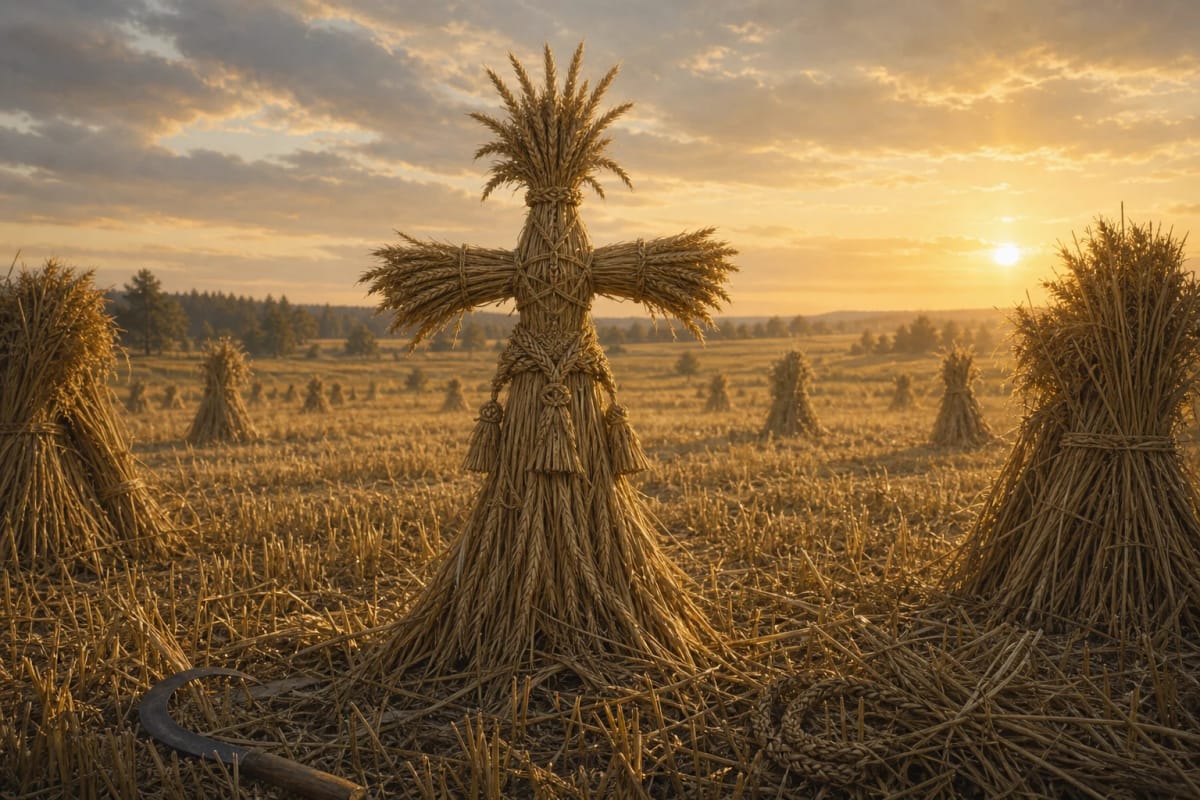
The Treaty of Christburg describes Kurkas very concretely: an idol that Prussians made every year after harvest from the last ears of that year's grain and worshipped as a god. The treaty therefore connects him directly with reaping and the final gathered sheaf.
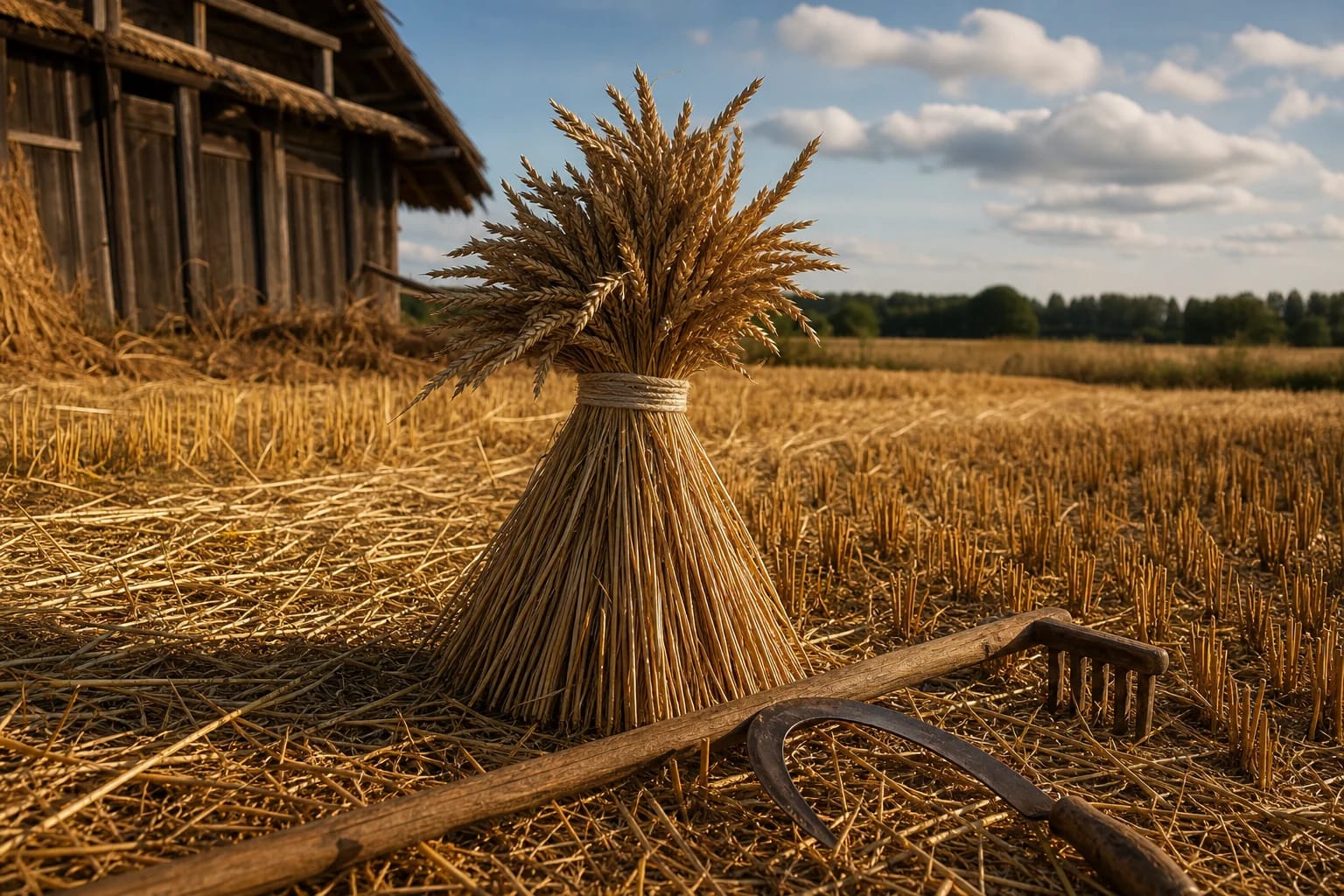
This description points not to an abstract deity but to a ritual object, a figure made of grain into which harvest power seems to be embodied. Veneration of the last sheaf is widely known in European farming custom, and it is the main key for interpreting what Kurkas may have been.
Kurkas in Grunau's chronicle: god of food and drink
The sixteenth-century chronicler Simon Grunau raised Kurkas, as Curcho, to the top of the Prussian pantheon, listing him among the most important gods and calling him a god of food and drink. According to Grunau, his idol stood at Heiligenbeil, where first sheaves were offered to him.
Grunau's testimony must be read cautiously: his Prussian pantheon is considered partly constructed and unreliable. His elevation of Kurkas to a god of food and drink is therefore better treated as a later interpretation, not as firm evidence on the level of the 1249 treaty.
Was Kurkas a god or a grain spirit?
The central question is whether Kurkas was a god at all. The treaty's description, an idol from the last ears, supports the interpretation that Kurkas may have been not a high god but a fertility spirit embodied in the last harvest sheaf, like the grain mother or grain old man in other European traditions.
Vladimir Toporov compared Kurkas rites with the Latvian custom of driving the grain god Jumis out of the field. He interpreted Kurkas as a fertility spirit that could harm grain but, if properly honored, increase the harvest. In this view Kurkas is closer to Lithuanian and Latvian last-sheaf customs such as jievaras, kūlis, and pjūties boba than to a high divine hierarchy.
Interpretations of the name Kurkas
Kurkas' name has been explained in several ways. It is often connected with the Baltic verb kurti, 'to create, make', and also 'to kindle fire'; under this interpretation the name could point to a power of making or creating. Kazimieras Būga connected the form Kurka with Lithuanian krūmas, 'bush', while Matthäus Praetorius, using the form Gurcho, derived it from gerklė, 'throat'.
These differing explanations show how unclear Kurkas remains: even the origin, gender, and exact meaning of the name are unsettled. The etymology should be presented as an open scholarly question, not a solved fact.
Kurkas and Krūkis: do not confuse them
Kurkas is easy to confuse with the Lithuanian god Krūkis, but they are different figures. Krūkis is a guardian of pigs and homestead livestock known from Jan Łasicki's list of Samogitian gods; his name is sound-symbolically connected with a pig's grunt.
Kurkas, by contrast, is a western Baltic, Prussian harvest figure from the 1249 Treaty of Christburg and later Prussian chronicles. Only the surface similarity of the names connects them; their fields, origins, and sources are entirely different. This difference is worth emphasizing, because the similar sound of the names is a known cause of confusion.
Kurkas' reliability and absence from the Sudovian Book
Kurkas is a rare case in which the name of a deity is very securely attested, through the 1249 treaty, while his nature remains disputed. The firm fact is his connection with harvest and the last grain; everything else, divine status, gender, and name origin, depends on interpretation.
It is also notable that Kurkas is absent from the sixteenth-century Prussian Sudovian Book, which lists Okopirmas, Svaikstikas, Aušautas, Pergrubrijus, Pilvytis, and others. That absence is often used to argue that Kurkas may not have been a permanent high god, but rather a ritual harvest idol made from the last grain.