- Type
- God
- Domain
- Home, homestead, fire, family space
- Source status
- in late sources
Who is Dimstipatis?
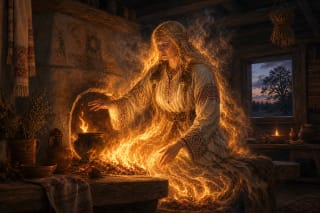
Dimstipatis is a Lithuanian god of home and fire, belonging to a lower layer of deities connected with homestead and household economy. He was first mentioned by J. Lavinskis in 1583, and later appears in Jesuit reports from 1604 and 1605 and in the eighteenth-century writing of S. Rostowski.
Dimstipatis is not a sky god. His field is the concrete homestead, yard, and household hearth. He belongs among the gods that survived longest in folk beliefs because they were tied to everyday home life.
Dimstipatis as guardian of fire and home
In some sources Dimstipatis is treated as a fire god who protects the home from fire; a rooster was offered to him, eaten, and its bones burned. In others he is the guardian of housewives: housewives standing in a circle offer him a piglet, whose meat is eaten and bones burned.
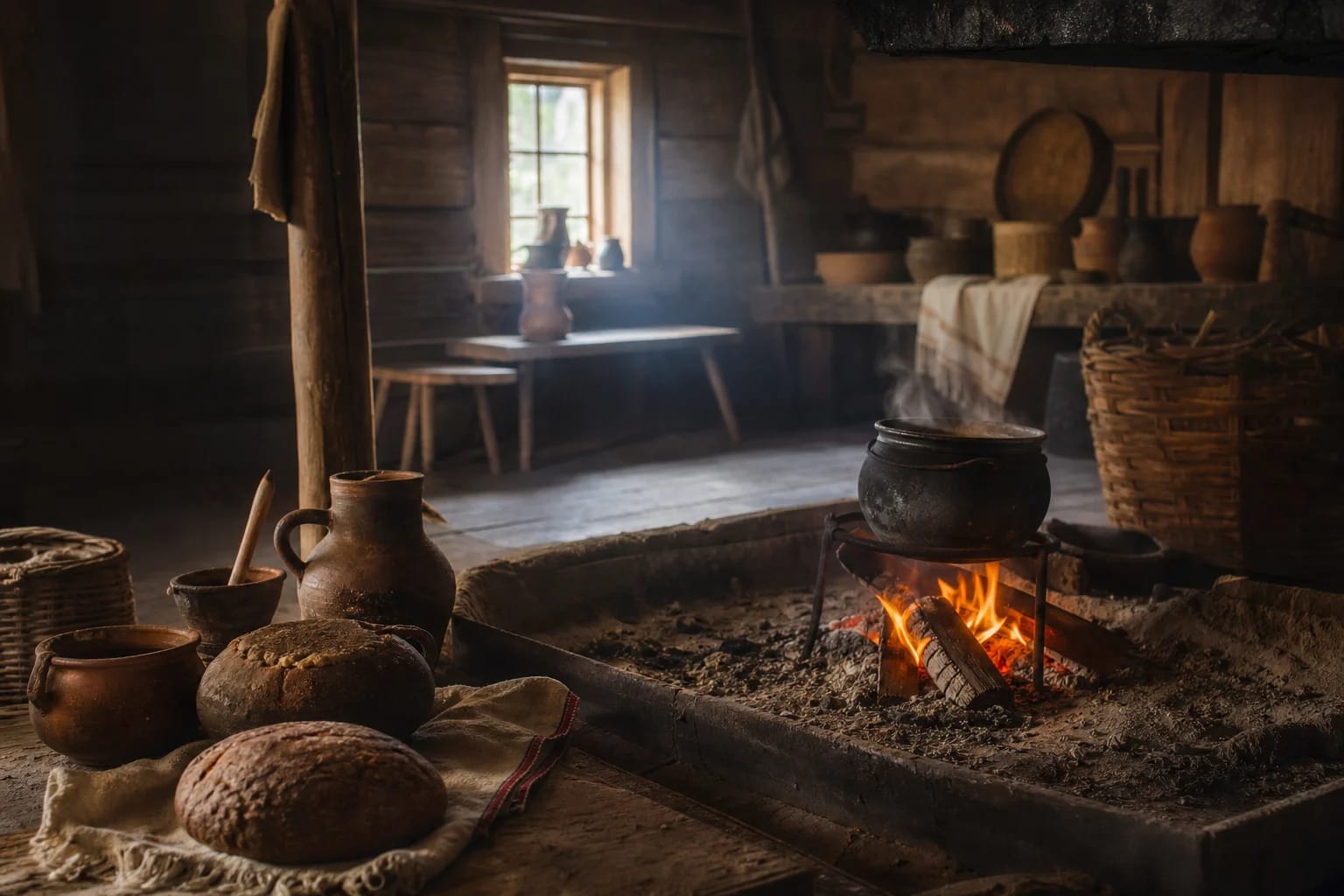
These offerings show that Dimstipatis was closely connected with the household hearth, fire, and homestead well-being. The rites were performed not by all women but by the most important, senior housewives of the homestead, emphasizing his role as lord of the home.
Dimstipatis' name: lord of the homestead
Jonas Basanavičius and Jonas Balys, following etymology, regarded Dimstipatis as a ruler of the yard: dimstis means yard, homestead, or farm, and pats means lord. Dimstipatis is therefore lord of the homestead, while his wife is the pati, the housewife or mistress of the most important man in the homestead.
Hermann Usener simply called him lord of the homestead, while W. E. J. Mannhardt argued that the power of the land plot, Žemėpatis, gradually became Dimstes patis, the lord of the homestead, comparable to Latvian mājas kungs. Dimstipatis is thus connected with farm fertility and home protection.
Dimstipatis among household gods
Algirdas Julius Greimas identified Dimstipatis with the gods Žemėpatis and Žemininkas mentioned by Matthäus Praetorius, and even with Nunadievis from the Hypatian Chronicle. This shows how indistinct the boundaries between household and homestead gods could be.
Dimstipatis is best read with Žemėpatis, guardian of homestead and landholding, and Gabija, the household fire. Together they show how Lithuanians sacralized home, yard, and hearth, the very space of everyday life.
Dimstipatis today
Dimstipatis helps explain the sacredness of home and homestead in the Lithuanian worldview: even the yard and hearth had a guardian to whom offerings were made. He belongs to those gods that survived longest in living customs.
Dimstipatis should be read cautiously: he is known from late sixteenth- to eighteenth-century sources, and his identification with other household gods is scholarly interpretation. Still, his connection with home, fire, and homestead is clear.