- Type
- God
- Domain
- Prussian god, healing, health, illness
- Source status
- well attested
Auschauts, Auskutas, Auššveitis, Aušlavis
Who is Aušautas in Prussian mythology?
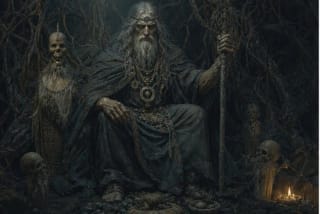
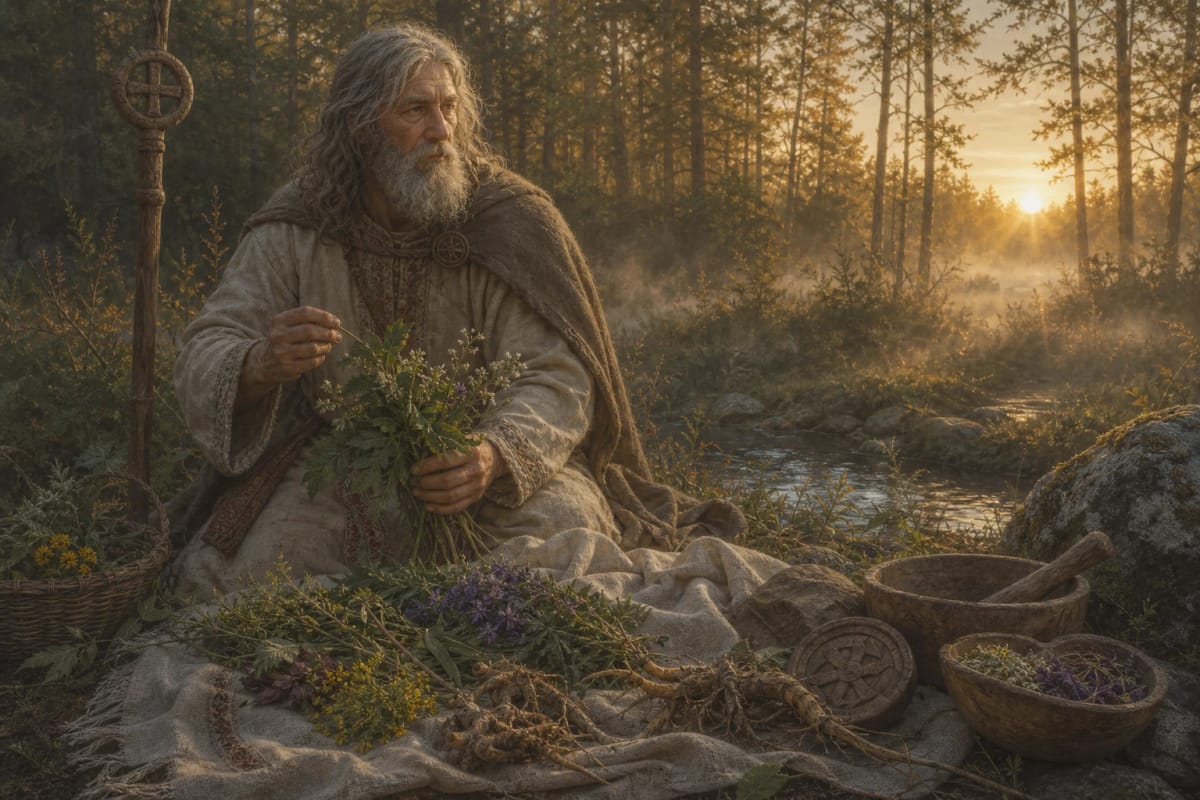
Aušautas is an Old Prussian god of healing. In some sources he is described more broadly as a god of the sick and the healthy, that is, one who governs both illness and health. He is one of the more important West Baltic, Prussian, deities known from sixteenth-century written sources.
A god of health and illness is a very practical figure in old religion. The causes of disease were not understood, so its arrival and departure were naturally explained by divine will. Aušautas embodies this field: bodily health, healing, and the threat of becoming ill.
The name Aušautas and its variants
The name of Aušautas is recorded in several forms. In Prussian synod decrees he is called Auschauts; Jan Łasicki in the sixteenth century calls him a Lithuanian god Auskutas; Jonas Bretkūnas gives Auššveitis; and later historiography uses Aušlavis.
These forms matter not as separate gods but as traces of the same healing god left by different recorders and languages. Still, they also raise a real scholarly question: whether all of these names mark one god, or whether Prussians and Lithuanians had different healing gods with similar names.
Healing god: guardian of the sick and healthy
The main domain of Aušautas is human health. As a healing god, he was asked for health, recovery from disease, and protection from ailments. The fact that sources call him a god not only of the sick but also of the healthy shows that he was understood to rule the whole field of health and illness.

Such a god mattered most to a community in crisis: during sickness, epidemics, and bodily affliction. The position of healing deities in a pantheon is therefore often high, because human life directly depended on their favor.
Aušautas and Asclepius
Old sources compare Aušautas with Asclepius, the Greek and Roman god of healing. This kind of comparison was a typical way for writers of the period to explain an unfamiliar god through a known classical example: to describe Aušautas' sphere, they looked for the closest familiar equivalent.
The comparison should be read as an explanatory tool, not as proof that Aušautas and Asclepius are identical. It helps identify the god's domain, healing and health, but does not mean the Prussian healing god had the same mythology as classical Asclepius.
Aušautas' place in the Prussian hierarchy
In Prussian god lists, Aušautas is mentioned after the supreme god Okopirmas, or Ukopirmas, and the light god Svaikstikas. This placement points to a high status for Aušautas in the Prussian pantheon: he belongs among the first and most important gods.
That fits the importance of a healing god. For a community without modern medicine, a god of health was vital, so it is natural that he appears in the lists beside deities of sky and light.
Sources for Aušautas
Aušautas is first mentioned in the 1530 synod decrees of the bishops of Prussia, Pomesania, and Sambia. These decrees are an important source because Christian clergy listed pagan gods still being worshipped at the time, unintentionally preserving their names.
Later, Aušautas is mentioned under different names by Jan Łasicki, as Auskutas, and Jonas Bretkūnas, as Auššveitis. These testimonies allow the healing god to be treated as a well-attested, non-accidental figure of the Prussian pantheon, even though the relationship among the individual names remains under study.
Did Prussians and Lithuanians have different healing gods?
One open question not answered unambiguously by the sources is whether Prussian Aušautas and similar names in Lithuanian-related sources, such as Auskutas and later Aušlavis, refer to one and the same god or to different healing gods. It is not known whether Prussians and Lithuanians had separate healing deities.
This uncertainty should be stated honestly. We have reliable testimony for a Prussian healing god, but his relationship to a possible Lithuanian counterpart remains an assumption. Such caution is typical of reconstructing old Baltic religion from sparse and uneven sources.
Aušautas in the context of Baltic mythology
Aušautas is important as one of the clearest Baltic examples of a healing deity. He shows that in old West Baltic religion, health and disease were understood as a sphere ruled by gods, not only as bodily matters.
Together with the light god Svaikstikas, the spring god Pergrubrijus, the wealth god Pilvytis, and others, Aušautas belongs to the Prussian circle of gods recorded in sixteenth-century sources, helping reconstruct the wider Baltic pantheon.