- Field
- Lithuanian folk children's toys, wood carving, and objects of village childhood
- Type
- folk art
- Heritage status
- well attested
- Context
- wooden toys, little horses, carts, animals, whistles, rattles, spinning tops, moving toys, shepherd children's work, miniature implements, wood carving
Folk wooden toys, Children's wooden objects, Shepherd children's toys, Wooden horses, Wooden whistles
Wooden Toys forms and objects
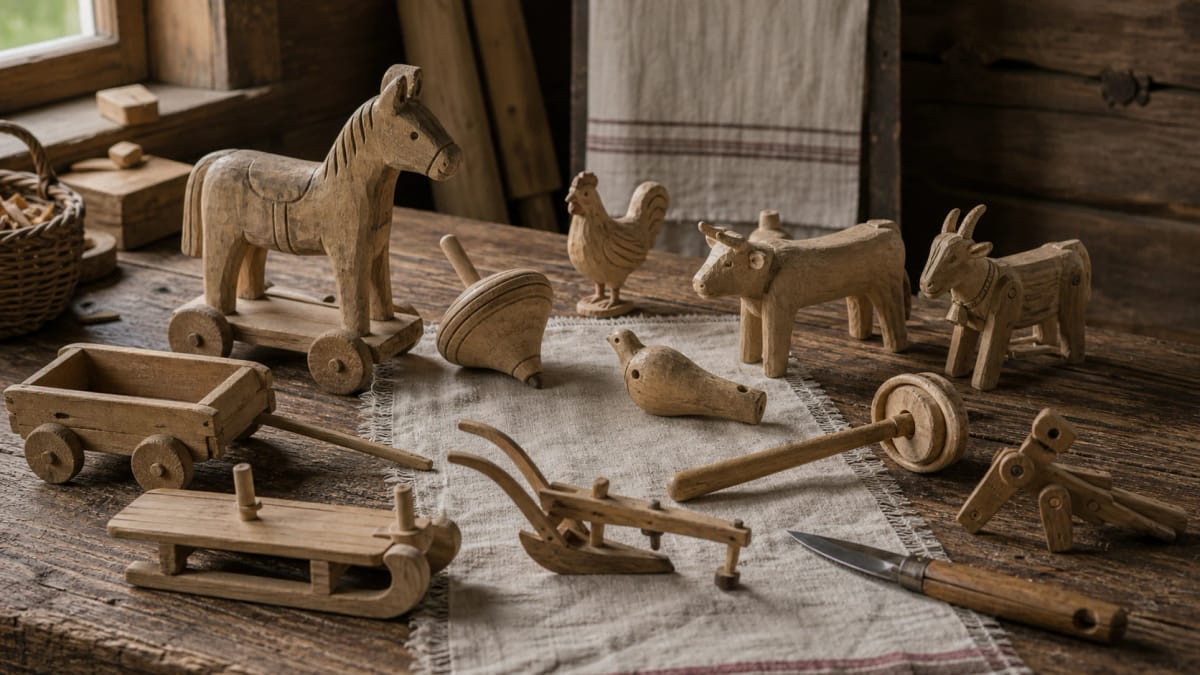
Animal figurines: Little horses, cows, goats, roosters, birds, and other village animals, often carved in a very generalized form.
Moving toys: Horses on wheels, carts, sleds, pulled animals, or simple mechanical toys whose movement creates play.
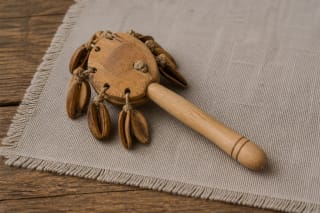
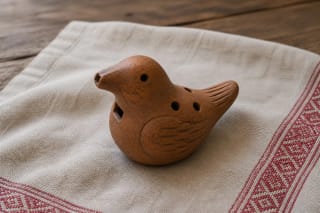
Sound toys: Whistles, rattles, clappers, and other objects that create sound, connecting play with folk music and sound worlds.
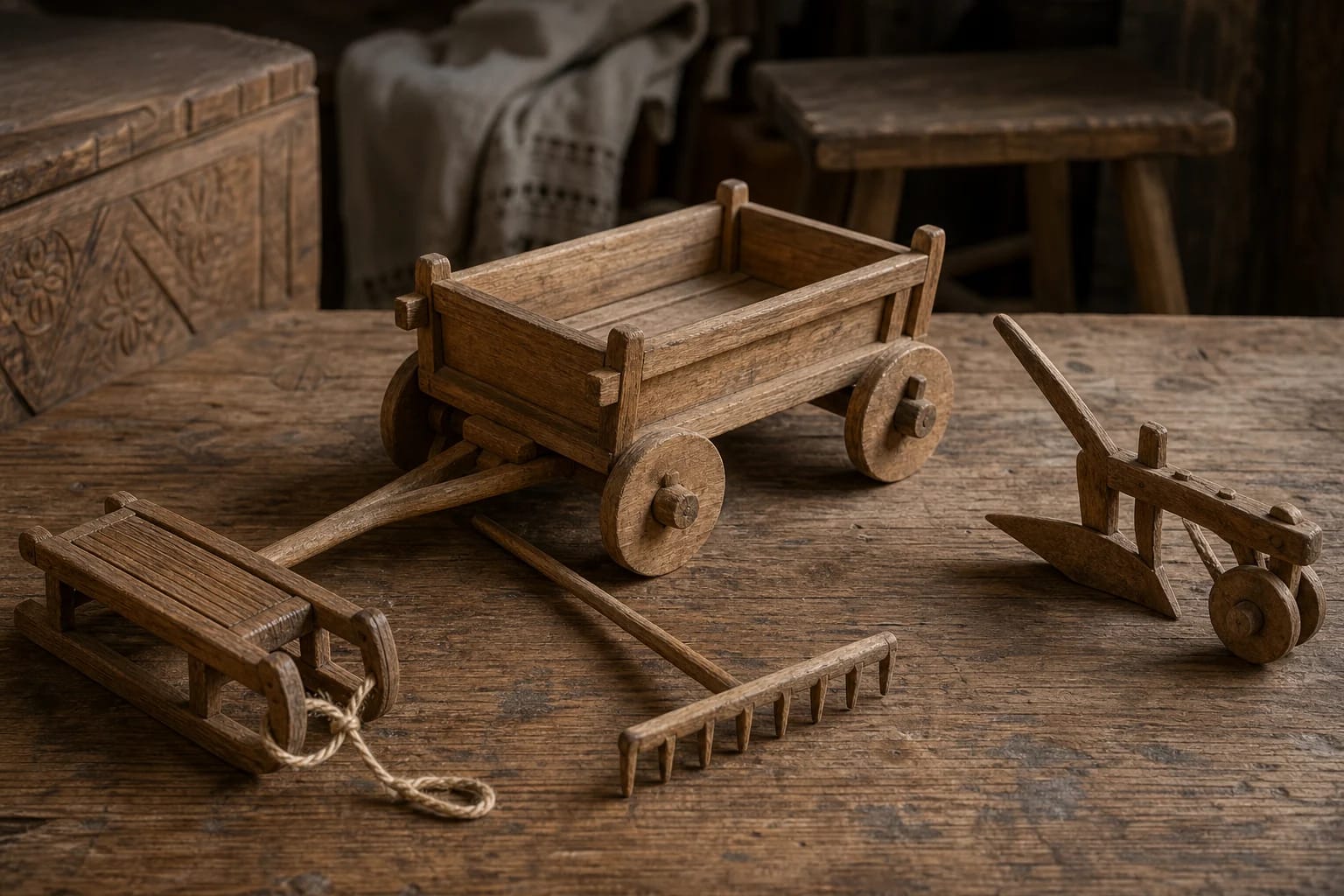
Miniature work tools: Small ploughs, harrows, sleds, carts, or household objects through which children repeated the adult world of work.
What are wooden toys?
Wooden toys are handmade wooden objects for children: animals, little horses, carts, whistles, rattles, spinning tops, sleds, miniature implements, and simple moving mechanisms. They belong to small household folk art and the culture of village childhood.
This topic has no single strict canon for all Lithuania. Many toys were made at home, used until they broke, and rarely preserved as valuable objects. We therefore know them from museum collections, education, ethnographic descriptions, memories, and analogies with village life. Archaeology gives a firm base: the oldest toys found in Lithuania date to the twelfth-thirteenth centuries, and excavations have found 351 toys in total, mostly sports objects (154) and board games (59), with most from Vilnius (276), Kernavė (19), and Trakai (16).
The most important point is that a wooden toy was close to the child's environment. It often repeated what the child saw every day: horse, cart, livestock, plough, sled, birds, shepherding objects, or adult work tools.
Who made them?
Wooden toys could be made by parents, grandparents, older brothers, village craftspeople, or children themselves. Shepherd children in the fields had time to carve simple figures, whistles, stick toys, and other small things.
Toys made by adults were often sturdier: a horse on wheels, cart, sled, rocking horse, or moving toy requires more tools and structural understanding. Children's objects were usually simpler, but important as signs of learning and independent creativity.
Toy craftsmanship does not necessarily mean ornament. A good toy has to be held in the hand, move, make sound, show an animal clearly, or let the child repeat an adult action.
Animals and little horses
The little horse is one of the most important wooden-toy images. The horse was part of everyday work, travel, status, and fairy-tale worlds, so in children's play it naturally became a pulled, wheeled, rocking, or hand-held object.
Other animals, cows, goats, sheep, roosters, birds, dogs, repeated the homestead world. They could be very schematic: four legs, head, tail, and a few incised lines. Such a form is enough for a child to recognize the animal.
Animal toys taught children names, work, the relationship with the herd, and household order. Play was not separate from reality, but a small model of it.
Carts, sleds, and miniature implements
Village children played with objects that repeated the adult farm: carts, sleds, small ploughs, harrows, little rakes, and other miniature implements. Such toys allowed imitation of ploughing, carrying, haymaking, animal work, and seasons.
A wheeled toy requires construction: axle, wheels, body, and fastening. Even a simple cart teaches the child's hand to understand movement, weight, and cause: pull the string and the wheels turn.
Miniature implements could also be learning tools. The child played, but at the same time absorbed work names, movements, and farm order.
Whistles, rattles, and sound toys
Sound toys connect childhood with the world of folk music. Wooden whistles, bird-shaped whistles, rattles, clappers, or simple rhythmic objects let a child explore sound, calling, noise, and rhythm.
A whistle is harder to make than a simple figure because it needs an air channel, opening, and precisely formed sound edge. Some sound forms therefore belonged more to experienced makers or older children.
A rattle can be simpler: a hollow body, stones, seeds, or wooden pieces. Even here safety, strength, and the ability to withstand a child's movement matter.
Moving and mechanical toys
Moving toys were especially attractive: a pulled horse, spinning top, rocking bird, moving doll, or simple linked mechanism. The simpler the mechanism, the more clearly the child sees how movement appears.
Such toys require an axle, string, joint, weight balance, or repeated movement. Wood carving, household engineering, and a child's curiosity meet in them.
Not all moving toys were equally widespread or documented, so it is better to speak about types rather than claim that every Lithuanian village had the same set.
Materials, tools, and safety
Wood that was easy to carve and not too brittle suited toys. Small objects could use leftover boards, branches, or scraps from spoon and other object blanks. This was economical and fit village household logic.
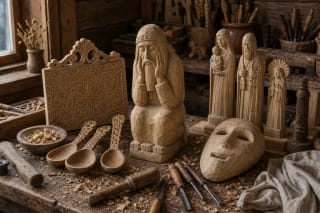
Tools depended on the maker: knife, chisel, drill, small saw, file, and smoothing tools. Toys carved by children were often made with a simple knife, so their forms were simpler.
When reconstructing wooden toys today, safety matters: no sharp splinters, small swallowable parts for little children, toxic paints, or weak joints. Historical form can be recreated, but a toy meant for a child must be used responsibly.
Museums and research limits
Wooden toys often survived poorly because they were used until they broke and then were not saved. Museums therefore have fewer of them than chests, distaffs, or sacred sculptures. This does not mean toys did not exist; it shows their everyday and fragile character.
Museum education and ethnographic reconstruction help recover the world of toys, but documented examples should be distinguished from contemporary pedagogical interpretations. Both are valuable when clearly named.
The best way to present wooden toys is to speak about toy types, materials, children's environments, and the function of play rather than create a supposedly complete list for all Lithuania.
From the nineteenth century toys also began to be produced in factories: in 1947 Lithuania had two toy artels, and in 1985 six enterprises in Vilnius, Kaunas, Kretinga, and Radviliškis produced more than 180 kinds of toys. The Toy Museum in Vilnius was founded in 2012, and the oldest archaeological finds are described in detail in Povilas Blaževičius's 2011 study Seniausieji Lietuvos žaislai.