- Field
- Decorative Palm Sunday verbos of the Vilnius region
- Type
- traditional craft
- Heritage status
- regional tradition
- Context
- Vilnius verbos, Vilnius-region verba-binding tradition, Easter palms, Kaziukas Fair, dried plants, hazel stem, spring, household protection
Vilnius-region verbos, Vilnius-region verba-binding tradition, Easter palms, Kaziukas verbos
Vilnius Verbos forms and objects
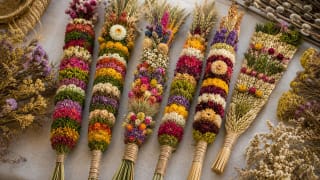
Cylindrical Verba: A round cylinder-shaped verba whose plants are tightly tied around a rod in colored rings, bands, or ornaments.
Flat Verba: A flatter verba with plants arranged toward one or more visible sides, resembling a decorated festive palm.
Figural Verba: A composed verba in which plants form a crown, sunflower, pineapple, or other recognizable silhouette.
Branching Verba: A verba formed from several branches or twigs, closer to a tree or bouquet structure and often emphasizing spring renewal.
What Are Vilnius Verbos?
Vilnius verbos are colorful Palm Sunday bouquets tied from dried, dyed, and natural plants on a hazel or other straight rod. They are especially linked with the Vilnius region, villages northwest of the city, Kaziukas Fair, and local makers’ family traditions.
They should be distinguished from the simple Lithuanian verba. In many places a verba could be a bundle of juniper, willow, pussy willow, or other green branches. A Vilnius verba is a complex folk-art object, with dried plants tied rhythmically into colored bands, rings, wreaths, and figures.
In 2018 the Vilnius region verba-binding tradition was entered into Lithuania’s intangible cultural heritage inventory. In 2025 Lithuania submitted the tradition for UNESCO Representative List inscription. As of June 5, 2026, the nomination was still under evaluation, with a decision expected in December 2026.
Vilnius Verba and Simple Verba
A simple verba is first a Palm Sunday branch recalling Christ’s entry into Jerusalem and spring greenery. It can be modest, tied from local evergreen or early-budding plants. Its meaning comes from blessing, bringing it home, and calendar custom.
A Vilnius verba shares that festive setting, but its artistic form is much more complex. The maker gathers, grows, dries, dyes, and sorts plants through the year, then ties them into color and spatial patterns.
This distinction prevents confusion. Not every verba is a Vilnius verba, and a Vilnius verba is not just a flower bouquet. It has place, history, technique, family transmission, and recognizable form types.
History: From Ruseckas’s Painting to Kaziukas Fair
One of the earliest known images of a Vilnius verba is connected with Kanutas Ruseckas’s 1847 painting, where the verba appears as part of Vilnius region festive culture. Oskar Kolberg also described the tradition in the mid-19th century, giving it both visual and written testimony.
Vilnius verbos are especially visible at Kaziukas Fair. The fair became the place where verbos are sold, seen, and recognized as a sign of Vilnius. For many visitors the fair’s image is inseparable from colorful cylinders, flat bouquets, and branching verbos.
During the Soviet period the religious side of the feast was restricted, but the craft survived through families, makers, fairs, and ethnic-cultural memory. Today it is supported by communities, museums, education, Čekoniškės Verba and Household Room, and new generations of binders.
Who Makes Vilnius Verbos?
The tradition is especially alive in villages northwest of Vilnius, often including Čekoniškės, Maišiagala, and nearby places. Local families, including many Polish-speaking communities of the Vilnius region, sustained it over time.
That should be named with respect. Vilnius verbos are Lithuanian cultural heritage, but their life was created by a multilingual and multicultural regional everyday world. Lithuanian, Polish, and other local identities help explain the tradition’s distinctiveness.
Many makers learned within families. Children helped gather herbs, sort plants, dry flowers, and prepare rods before learning the real rhythm of binding, which requires color judgment, steady hands, and long patience.
Plants and Materials
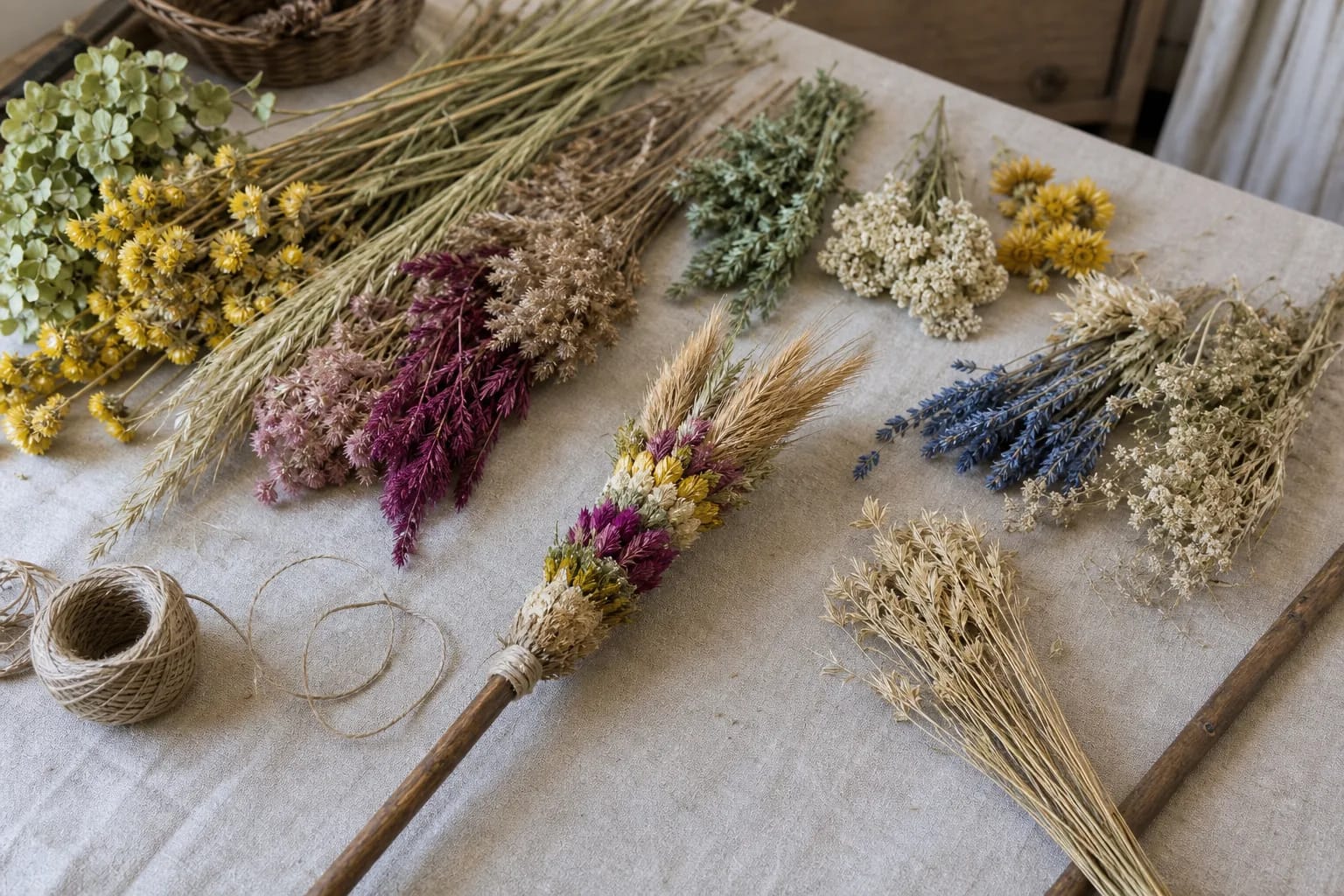
Vilnius verbos use dried and dyed plants: sand everlastings, immortelles, cat’s-foot, grain ears, timothy, reeds, grasses, mosses, leaves, flowers, and many other plants. Every maker can have favorite combinations.
The base is often a hazel rod. Plants are placed around it and tied tightly with thread, layer by layer. Makers balance not only color but stiffness, fuzziness, flower form, seed density, and ability to hold shape.
Sources distinguish wood-shaving (drožlinės), herbal, and paper verbos; the most widespread herbal types can use up to about 30 species of wild and garden plants, including everlastings, cat’s-foot, timothy, reeds, grasses, rye, and barley ears. Since the 1920s they have often been tied spirally to 40-50 cm or longer rods, and in the second half of the 20th century very large 1.5-2 m verbos also appeared as a distinctive decorative art form.
For that reason, binding begins long before Palm Sunday. Plants have to be grown or gathered, cut at the right time, dried, dyed, stored, and only then tied. The final object summarizes a whole year of plant work.
Main Forms
Cylindrical verbos are round and column-like. Plants are tied around the rod in bands, making them look like soft colored posts covered with flowers and grasses. This is one of the most recognizable Vilnius verba forms.
Flat verbos resemble a festive palm arranged in one plane. The front view, plant silhouette, and compositional direction matter. Figural verbos can take crown, pineapple, sunflower, or other forms, while branching verbos move closer to the structure of a small tree, shrub, or bouquet.
Form is not merely aesthetic. It affects how the verba is held, how it appears in church, how it dries, how it survives at home, and how it is recognized at the fair. A well-bound verba has structure as well as color.
Palm Sunday, Blessing, and Home
On Palm Sunday the verba is taken to church for blessing. In Christian tradition it recalls Christ’s entry into Jerusalem, while local customs connect it with spring’s beginning, home protection, health, and renewal of life.
The blessed verba is brought home and kept. It may stand in an honored place, be tucked behind a holy picture, or be treated as a sign of feast and protection. In some places people believed it helped protect the home, fields, or animals.
In a modern city the verba often becomes an aesthetic decoration too, but its ritual core remains important. It is beautiful because it is tied to time, faith, spring, and a concrete Vilnius region community.
UNESCO Status: Candidate, Not Inscribed
Vilnius verbos are often mentioned with UNESCO, so precision is essential. In 2025 Lithuania submitted a nomination seeking international recognition for the Vilnius verba-binding tradition. That means the tradition is on the way to UNESCO, not yet inscribed on the Representative List.
In 2026 the Ministry of Culture stated that international experts were evaluating the nomination and that a decision was expected in December 2026 at the Intergovernmental Committee session in Xiamen, China.
Responsible wording is therefore: the Vilnius verba-binding tradition is a Lithuanian intangible cultural heritage value and a UNESCO candidate. Only an official decision would allow saying it is inscribed on the UNESCO list.
Where to See and Learn
Vilnius verbos are easiest to see at Kaziukas Fair, in Vilnius and Vilnius region churches around Palm Sunday, and at Čekoniškės Verba and Household Room. That site presents the tradition as local life, not only as a product.
Museums and exhibitions allow close study of makers’ work. Exhibitions by the Lithuanian National Museum of Art and other institutions show that Vilnius verbos can be studied as folk art, composition, plant sculpture, and documents of regional identity.
Learning should begin with plants rather than the most complex figural form. Which plants are fragile, which hold color, how flowers dry, how the rod is tied, and how rhythm is maintained are the basis of real mastery.