- Field
- Lithuanian Palm Sunday greenery bundles and Vilnius-region verba craft
- Type
- traditional craft
- Heritage status
- living tradition
- Context
- Verba, juniper, willow, pussy willow, birch twig, Palm Sunday, blessing, hazel stem, dried plants, household protection, spring
Verbos, Juniper verbos, Palm Sunday bouquets, Vilnius-region verbos, Vilnius verbos
Palm Sunday Verba Binding forms and objects
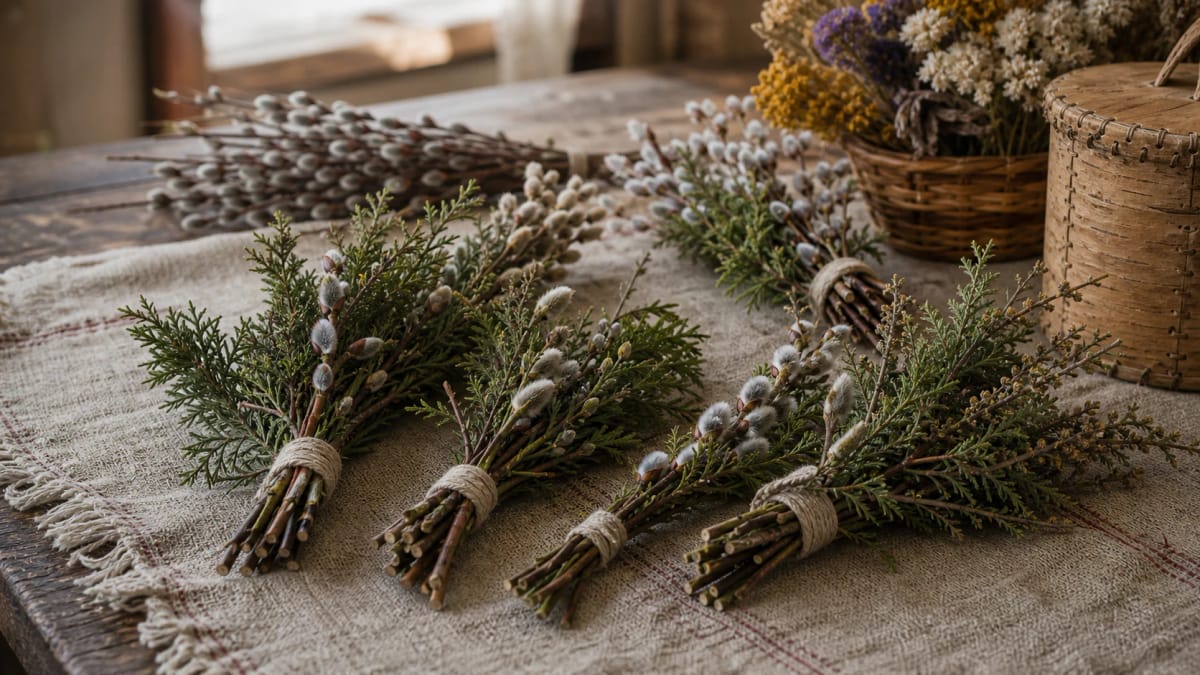
Simple Juniper Verba: An evergreen juniper bundle recognized across Lithuania, sometimes supplemented with pussy willow, willow, or birch twigs.
Greenery and Budding-Twig Verba: A spring branch bundle in which greenness, life, and early awakening are central.
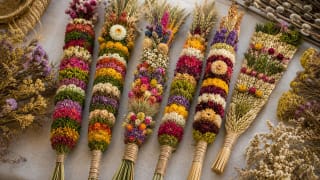
Vilnius Region Verba: A regional verba made from dried grasses, flowers, grain ears, and moss, tied on a hazel rod in cylindrical, flat, or other forms.
Paper or Mixed Verba: In parts of southeastern Lithuania, paper flowers were once added to twigs or rods, so verbos could combine greenery and handmade decoration.
What Is a Verba?
In Lithuania a verba is first of all a Palm Sunday bundle taken for blessing: juniper, pussy willow, willow, birch, or other early spring branches. It may be very simple, tied at home from a few twigs, or very ornate in the Vilnius region form.
Not every verba should be called a Vilnius verba. In much of Lithuania the verba was a bundle of juniper or other green branches. In the Vilnius region, a separate artistic form developed from dried grasses and flowers and became one of the most recognizable signs of regional folk art.
Verba binding therefore has two layers: the broader Palm Sunday and spring ritual, and the specific regional craft in which plants are gathered, dried, dyed, and tied almost all year.
The Simple Verba: Juniper, Pussy Willow, Willow
A verba can be a bundle of juniper, pussy willow, currant, birch, or other early-budding branches, or a rod wrapped with dried flowers and grasses. In Lithuania the most common material for a simple verba is juniper. Lithuanian-language verbos are first mentioned in the Wolfenbüttel Postil prepared by the Lutheran pastor Jonas Bylaukis (c. 1540–1603) in 1573-1574.
Juniper is important for its evergreen character, scent, and prickly strength. Pussy willow catkins, willow, birch, and other locally available spring plants may be added. Such a verba is not primarily a floral decoration but a feast and household ritual object.
A simple verba needs little: branches, thread, ribbon, or cord, and a clear tie. Its beauty comes from fresh greenness, spring scent, and the rhythm of twigs.
Palm Sunday and Blessing
Verbos are taken to church on Palm Sunday, one week before Easter. In Christian tradition they recall Christ’s entry into Jerusalem, while in Lithuania local spring plants naturally replaced palm branches.
The blessed verba returned home and was kept in an honored place. People believed it protected family, house, animals, crops, or bees. These beliefs should be presented as traditional worldview, not literal modern guarantees.
The custom of lightly touching someone with a verba while wishing health and life grows from this same logic. The verba acts as a sign of spring vitality.
Vilnius Region Verbos
The Vilnius region verba is a distinctive variant of the wider Lithuanian verba. It is tied on a hazel rod from dried and sometimes dyed flowers, grasses, grain ears, moss, sand everlasting, cat’s-foot, and other plants.
The national inventory emphasizes that the tradition lives in villages northwest of Vilnius and is passed through families. It has sacred, regional, artistic, and economic functions, especially around Kaziukas Fair and craft education.
The oldest forms are considered cylindrical and flat verbos, but today there are many shapes. The core remains skill: plants must be gathered, dried, selected, dyed or left natural, and tied into a firm rhythm.
Gathering and Drying Plants
Verba making begins long before Palm Sunday. For Vilnius verbos, plants are gathered at different seasons when they suit drying: some flowers in summer, some grasses as they mature, grain ears when they hold form.
Plants must dry without losing shape or molding. Drying too slowly is risky; drying too hot can dull color and make plants brittle. Experienced makers know which plant suits a cylindrical verba, which a flat one, and which works only as a small accent.
For simple juniper verbos, freshness matters more. Branches should be gathered carefully, without damaging habitats, and with the knowledge that juniper stands and spring plants are living ecosystems, not just decoration.
Binding Technique
A simple verba is tied by arranging branches into a comfortable bundle and fastening the lower part. It has to hold, but not be crushed. Over-tight juniper sheds needles; a loose bundle falls apart.
A Vilnius region verba is tied much more precisely. Plants are layered on a hazel rod to form rhythms of color, texture, and ornament. The binding thread must hold the plants while not dominating the image.
A cylindrical verba turns around the rod as a rounded composition. A flat verba resembles an ornamented plane. Both forms require proportion, plant knowledge, and a steady hand.

Household Customs
A blessed verba was not kept simply in a vase. It could be placed near holy pictures, stored in the attic, used for fumigation, for first driving animals out, crop protection, or beekeeping customs. This shows how a blessed object moved from feast to farm work.
In some accounts, verba needles or twigs entered the first spring work: sowing, driving animals out, or tending hives. One belief held that a red woolen thread used to tie blessed verbos could be worn around the waist during rye harvest to prevent back pain; crushed verba needles could also be placed in the first seed basket.
Today many people keep a verba at home as a sign of the Easter season. Even when customs are no longer practiced literally, respect for the blessed object and seasonal greenery remains important.
Region, Identity, and Fairs
Vilnius region verbos are especially connected with Vilnius surroundings, Čekoniškės, Maišiagala, and other villages where families, makers, and local communities sustained the craft. The Polish culture of the Vilnius region is also important, so the tradition should be presented as multilingual regional heritage.
Kaziukas Fair gave verbos a public city stage. Ornate verbos became sold, gifted, and displayed, but their fair life does not erase the meaning of Palm Sunday. These are related but not identical contexts.
Education keeps verba binding alive by teaching not only beautiful color but also plant gathering, drying, regional origin, and the difference between living tradition and plastic imitation.
What to Avoid Today
The largest mistake is calling every verba a Vilnius verba. A simple juniper or willow verba belongs to the wider Lithuanian Palm Sunday tradition, while the Vilnius verba is a specific regional and artistic variant.
Another mistake is turning the verba into only floral decoration. A beautiful composition matters, but without Palm Sunday, blessing, plant gathering, and household customs it loses cultural depth.
A third mistake is replacing traditional materials with plastic and calling it authentic. Contemporary creativity is possible, but the core remains local plants, handwork, and respect for festive time.