- Field
- Lithuanian paper-cut decoration for shelf edges and home interiors
- Type
- folk art
- Heritage status
- living tradition
- Context
- shelf decorations, shelf embellishments, paper cuttings, shelf edges, openwork strip, cut border, teeth, zigzags, rhombi, triangles, sunbursts, fir trees, lily blossoms, etagere, corner shelf
Shelf embellishments, Small-shelf decorations, Paper shelf borders, Paper-cut shelf strips
Shelf Decorations forms and objects
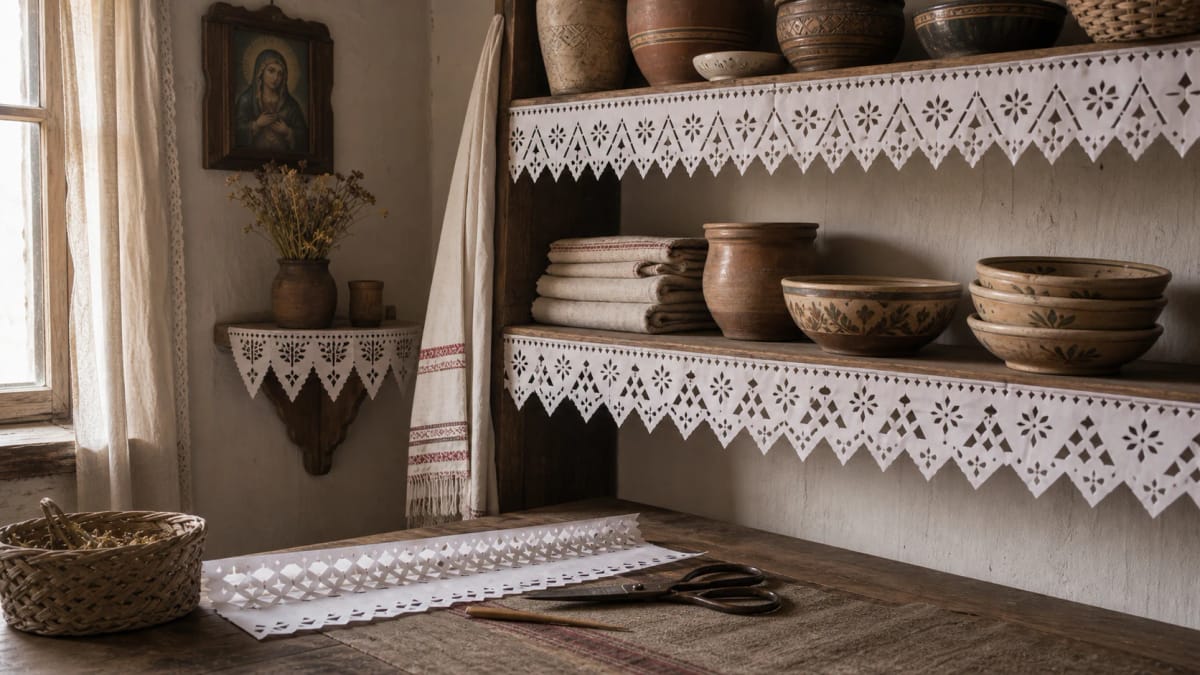
Openwork shelf strip: A paper cutting with openwork motifs across the whole strip, fixed to the front edge of a shelf.
Strip with a cut lower edge: A decoration in which the upper part remains solid while the lower edge is cut into teeth, triangles, rhombi, or plant motifs.
Corner-shelf decoration: A shorter strip or triangular paper cutting adapted to a sacred corner, small etagere, or dish shelf.
Festive shelf decoration: Temporary paper decorations changed before holidays, during house cleaning, or when decorating the area around dishes, towels, and pictures.
What are shelf decorations?
Shelf decorations are strips cut from paper and fixed to the edges of shelves, cupboards, dressers, etageres, or corner shelves. They create a white, openwork, or toothed border that hides the shelf edge and gives the room order and festivity.
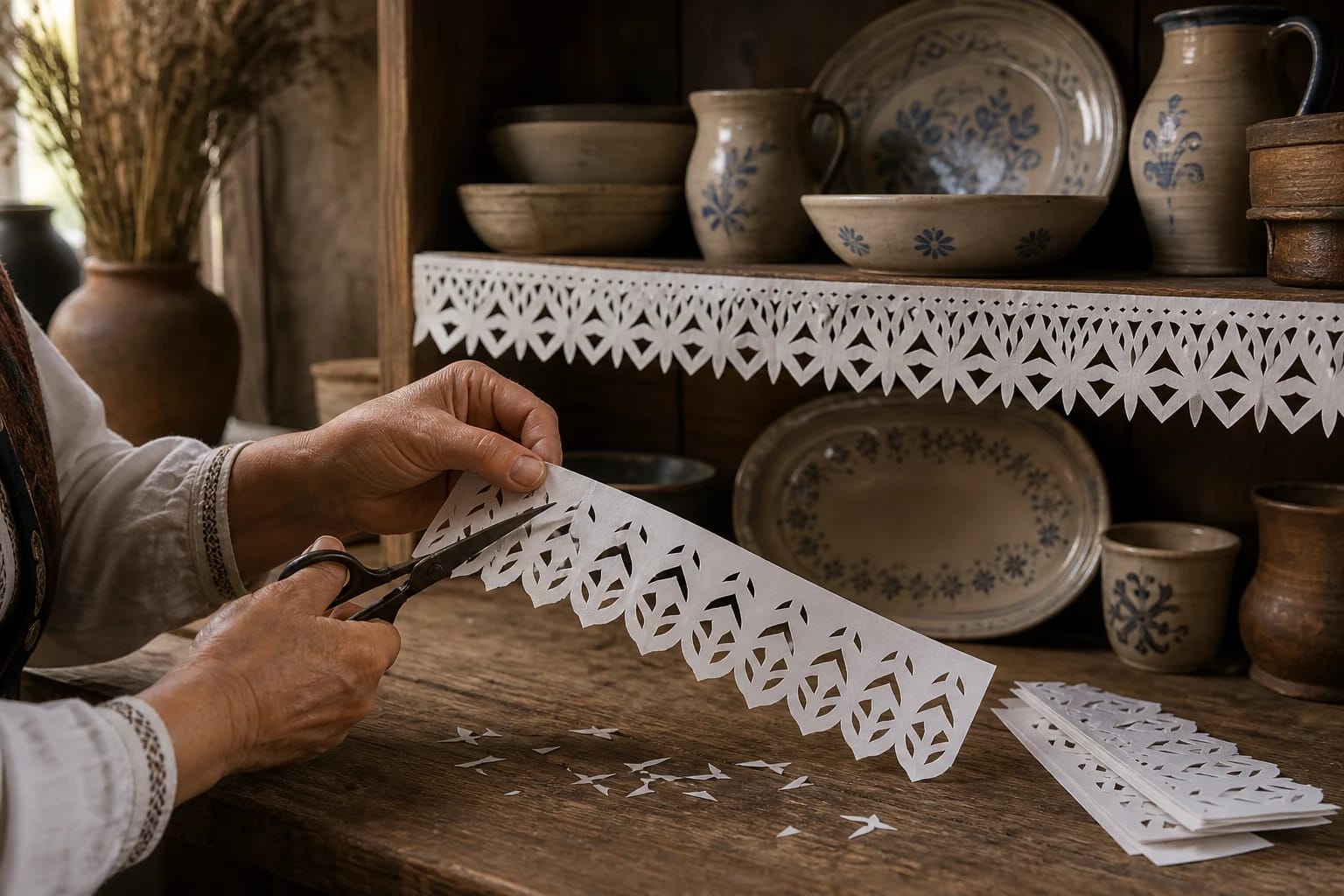
It is important that the Lithuanian word papuošalai here does not mean jewelry. These are paper cuttings for the home interior. They decorate places where objects are kept: a dish shelf, a stack of towels, a sacred corner, or a shelf for medicines and small household things.
The form is very precise. A curtain works with a window and light, while a shelf decoration works with a horizontal edge, objects, and the ordered look of the home.
Official object definition
Traditional heritage product specifications define shelf decorations as paper cuttings intended to decorate interior shelves. They mention strips 20-40 centimeters wide, with the lower edge cut out or the whole surface cut as openwork.
This definition matters because it separates a shelf decoration from any paper decor. The pattern alone is not enough; the place also matters: the front edge of a shelf, cupboard, etagere, or corner shelf.
The page therefore has to speak about a concrete household object, not about paper cuttings in general.
Where were they used?
Shelf decorations could hang on kitchen or living-room shelves where bowls, plates, jars, towels, medicines, prayer books, or small household objects were kept. They gave a decorative rhythm to a modest shelf edge.
Corner shelves and the sacred corner were especially suitable places. A paper strip could frame a sacred image, a little flower vase, or a towel without making the place luxurious, only orderly and bright.
Such decorations were usually temporary. They could be changed before holidays, after major house cleaning, or when the paper yellowed, wore out, or tore.
Motifs and edge
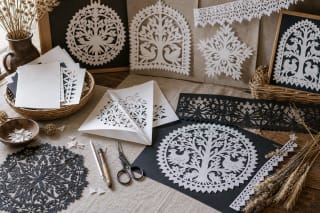
Common shelf-decoration motifs include teeth, zigzags, rhombi, triangles, little stars, sunbursts, fir trees, lily blossoms, and small plant rhythms. The strip has to repeat, because the shelf edge is long and horizontal.
The lower edge is often cut in teeth or waves. This bottom edge recalls lace and lightens the look of the paper. The upper part is usually left stronger so the strip can hold.
Openwork can cover the whole width of the strip, but it has to retain enough connecting points. If the cutting is too open, it tears when objects on the shelf are moved or dust is wiped away.
Difference from cut-paper curtains
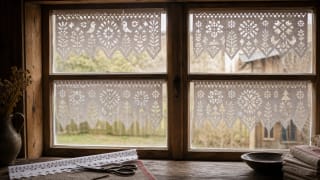
Shelf decorations and cut-paper curtains use the same material and technique, but differ in place. A curtain is made for a window, while a shelf decoration is made for the horizontal edge of a shelf.
For a curtain, light, privacy, and the window frame matter. For a shelf strip, the edge, the background for objects, and the impression of household order matter. It has to hang without catching on dishes or textiles.
This difference helps explain the household variety of paper cutting more precisely. In the village interior, paper cuttings were not only pictures for walls; they worked on windows, shelves, oil lamps, frames, and other surfaces.
Paper instead of lace
Shelf decorations visually resemble lace or textile edging, but their material is much simpler. Paper made it possible to create an openwork border quickly and cheaply without thread, crochet hook, or weaving.
That does not mean the work was lesser. A well-cut strip required composition, an exact hand movement, and understanding of how a pattern would repeat across the whole shelf.
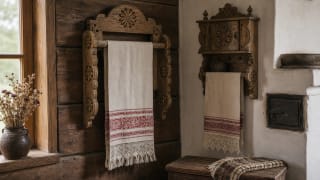
Such paper borders matched clay dishes, linen towels, wooden shelves, and the whitewashed village-house interior. They brought cleanliness and rhythmic ornament into the home.
How is the strip cut?
First the shelf length is measured and the strip width chosen. Then a firm upper part is marked for fastening to the shelf, and the lower part is planned for the cut ornament.
The paper can be folded so motifs repeat. It is cut with scissors or a knife depending on the fineness of the design. Each motif needs enough connections, and the lower teeth must not be too thin.
The finished strip is fastened straight. If it leans, the whole shelf edge looks disorderly. Even a simple paper decoration therefore demands measuring and patience.
Contemporary education and certified makers
Today shelf decorations appear in national heritage, craft-center, and paper-cutting education. Certified makers and craft centers present them as one traditional paper-cutting object, not just as general decor.
In education this form is useful because it is concrete: the participant measures the strip, plans the border, repeats the motif, and understands where the object will hang. The cutting becomes an object with a place, not only a beautiful sheet.
Contemporary homes can use shelf decorations as temporary holiday accents, museum reconstructions, or educational experiments. Authenticity is best supported by natural material, hand work, and a clear household purpose.
Storage and fragility
Paper shelf decorations are sensitive to dust, moisture, grease, sunlight, and mechanical movement. In a kitchen they may wear out more quickly than in a window or sacred corner.
For that reason they were traditionally changed. Fragility does not mean the object is unimportant. On the contrary, temporary paper decoration shows how often people renewed household order with small handmade means.
When preserving an old example, it is best to keep it flat, dry, and out of direct sun. A copy can be made for everyday use, while the original is documented.