- Field
- Lithuanian paper cuttings, window curtains, and household paper decoration
- Type
- folk art
- Heritage status
- living tradition
- Context
- Cut paper curtains, paper curtains, window curtains, karpiniai, paper cuttings, openwork, pierced pattern, teeth, zigzags, diamonds, sun motifs, stars, fir trees, tree of life, birds, rural interior
Paper curtains, Window paper curtains, Paper-cut curtains, Karpiniai curtains
Cut Paper Window Curtains forms and objects
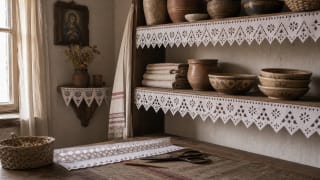
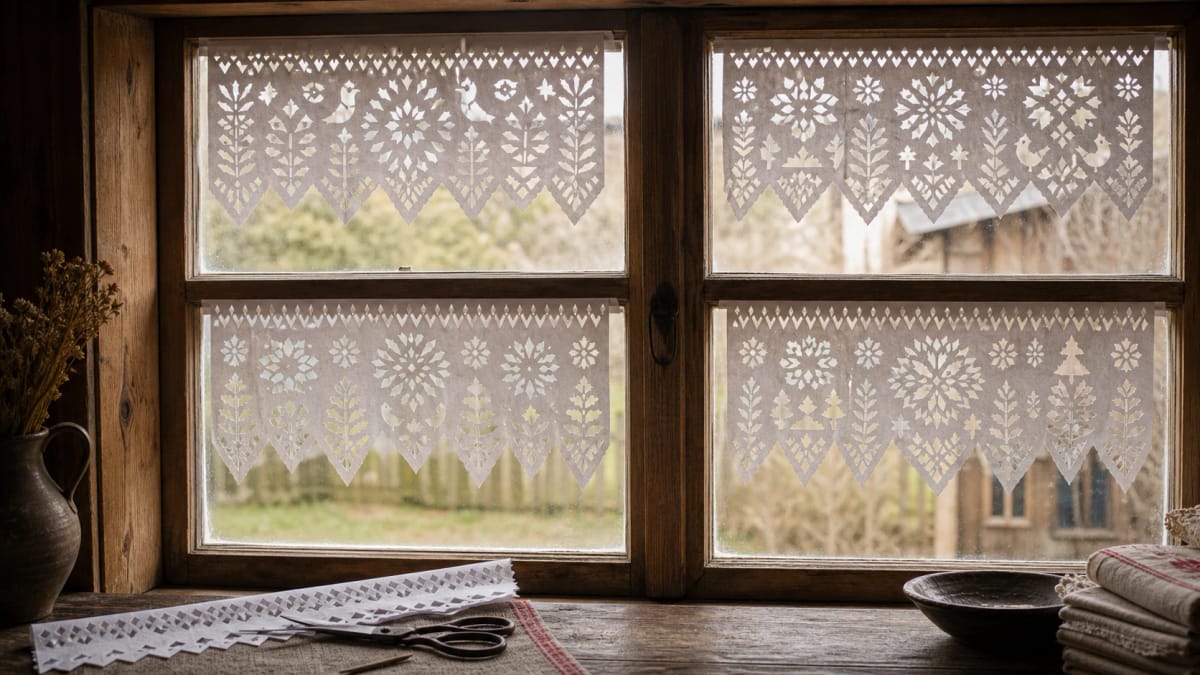
Upper window band: The most common form: a narrow paper band fixed to the upper edge of the window and hanging down like an openwork border.
Lower or middle window band: In some windows, paper cuttings were attached to the lower edge or crossbar to cover part of the glass and create patterned light.
Corner and triangular curtains: Triangular or corner cuttings adapted to window corners, especially when the frame was to be decorated without covering the whole pane.
Festive paper window decoration: Temporary cuttings changed before feasts or house cleaning, often from white or light thin paper.
What are cut paper window curtains?
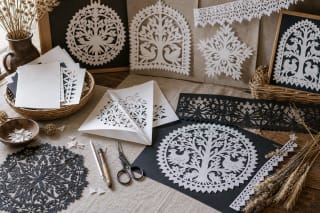
Cut paper window curtains are window decorations cut from paper: narrow openwork borders, bands, or sheets fastened to window glass or frame. They acted as a fragile paper curtain that softened light, decorated the room, and showed the handwork of the household or maker.
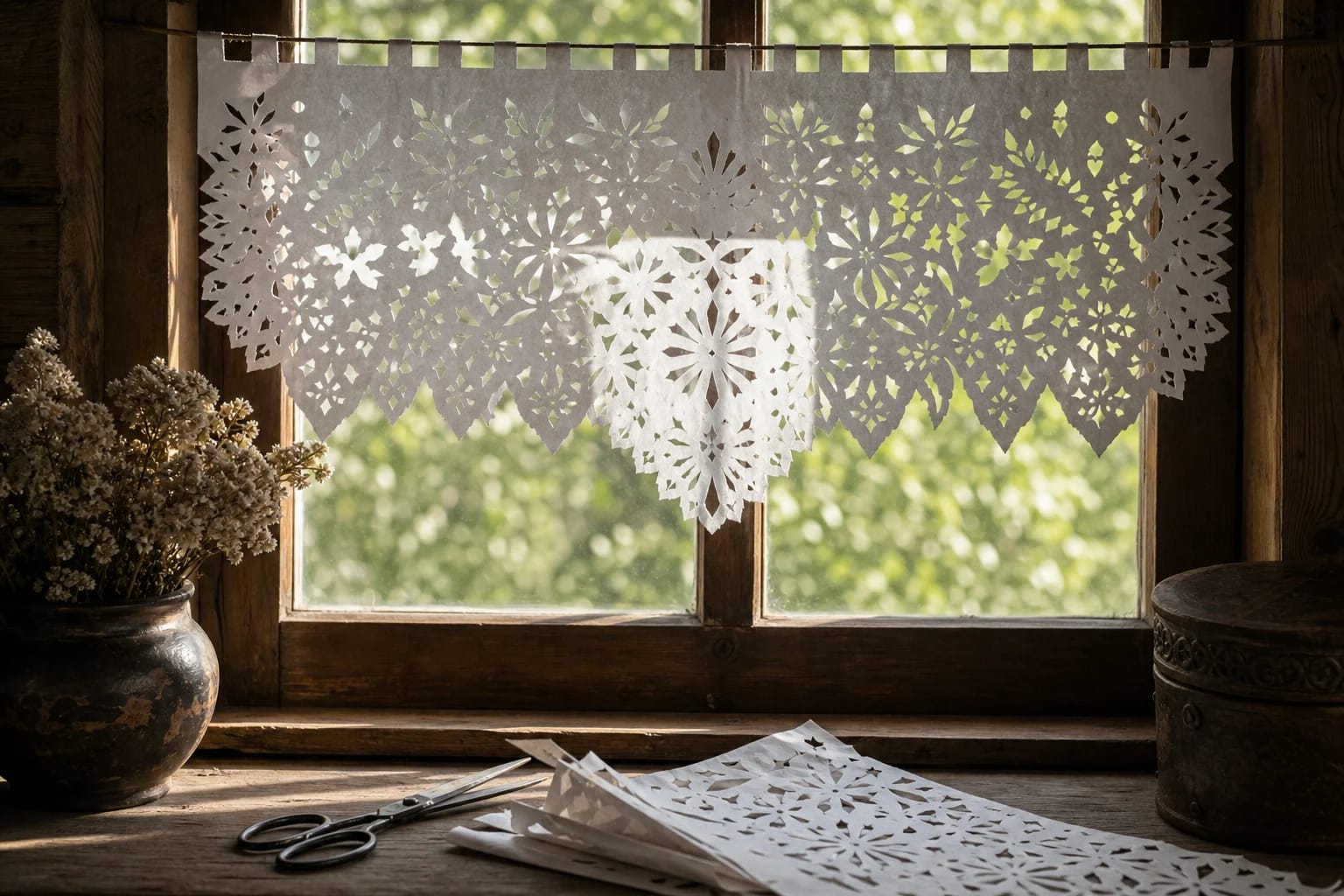
They belong to Lithuanian folk paper cutting, but their purpose differs from paper-cut pictures. A curtain is not a gallery object. It lives in the window, responds to daylight, gathers dust, tears, is replaced, and is therefore deeply domestic.
In rural interiors this decoration was accessible when textile curtains, lace, or tulle were not always affordable or practical. Paper made it possible to create a clean, festive, patterned window quickly.
Why paper?
Paper was cheaper and easier to replace than fabric. From thin white or light paper one could cut complex openwork without a loom, crochet hook, or expensive material. Scissors, a knife, folding, and patience were enough.
White paper suited the window especially well because it let light through and emphasized the pierced pattern. In a darker rural room, window light made the cutting visible even when the paper itself was modest.
This fragility was part of the tradition. The curtains were not meant to last for decades. They could be changed before feasts, after cleaning, when worn, or whenever the room needed refreshing.
Where were they fastened?
Most often cut paper curtains were fastened to the upper part of the window as a narrow band, with the lower edge cut into teeth, arcs, or triangles. In some places paper cuttings also covered the lower pane for privacy.
The curtain could be glued, pinned, tucked into the frame, or held by a thin strip. The method depended on window construction and how temporary the decoration was meant to be.
The window is not just a background. Wooden frame, panes, and the direction of light determine how the cutting looks. Curtains were therefore often made for a particular window.
Motifs and patterns
Common motifs include teeth, zigzags, diamonds, triangles, sun motifs, stars, snowflakes, fir trees, lilies, birds, plant twigs, and tree-of-life compositions. They may be very simple or dense.
The pattern often comes from folding. Paper is folded, cuts repeat, and when the sheet opens a symmetrical rhythm appears. The curtain therefore has a clear edge, middle, and repeated ornament.
For a window, the pattern must not be too heavy. Too much paper darkens the room; too much cutting makes it tear. A good curtain balances light and paper.
Difference from paper-cut pictures
A paper-cut picture is usually an independent image: tree, birds, flowers, scene, or ornamental composition. A cut paper curtain is made for function: it must fit the window, hang there, and work with light.
For that reason the curtain is often band-like, repetitive, and edge-based. Its pattern needs a clear top and bottom, because the window band hangs downward and creates a border.
This distinction prevents confusion: not every paper cutting is a curtain. A curtain is a paper cutting adapted to the window and domestic interior.
When did they spread and why did they decline?
Lithuanian folk paper cuttings are especially associated with late nineteenth- and twentieth-century rural life, when paper became more accessible and homes used more paper decoration. VLE notes that as paper became cheaper in the nineteenth century, peasants also began cutting it, decorating windows, shelves, and the bride's corner, and making Christmas-tree ornaments and toys; window curtains were one of the most practical forms.
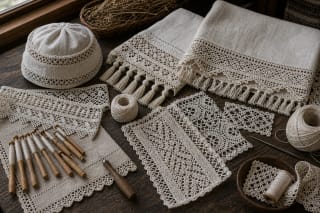
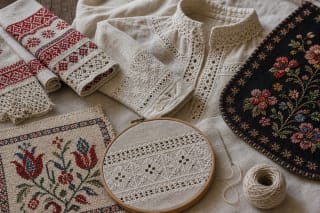
Later they were displaced by textile curtains, tulle, factory lace, changing window sizes, and modern interiors. Paper decoration seemed too fragile and temporary as homes gained more lasting fabrics.
Today cut paper curtains return through education, museum workshops, and ethnographic interior reconstructions. They need not return as everyday window treatment, but they explain household aesthetics very well.
How are they cut?
First, the paper width is chosen according to the window. The upper holding edge and the lower cut edge are marked. Paper may be folded so motifs repeat, or cut from a previously drawn pattern.
Scissors suit larger cuts; a knife suits finer openwork. Enough bridges must remain so the curtain does not fall apart. Window corners and lower-edge teeth are especially fragile.
The finished band should be unfolded carefully, flattened, and only then fastened. If paper is damp or too compressed, the pattern loses clarity.
Contemporary education
Cut paper curtains are excellent for education because they immediately show paper-cutting logic: symmetry, repetition, negative space, rhythm, and function. A participant not only cuts a pattern but understands where it would be used.
Children can begin with simple teeth and diamonds; older participants can work with plant or bird motifs. The window function should remain: the curtain is a band, not a random sheet ornament.
Museum and craft-center education helps preserve what rarely survives in collections because of fragility. Paper decays, but the technique can be restored from photographs, descriptions, and makers' memory.
Storage and reconstruction
An old paper cutting is highly sensitive to moisture, sunlight, acidic paper, dust, and folding. If a curtain is a museum object or family relic, it should not hang in daily sun.
When reconstructing a historical curtain, window size, paper type, fastening method, and motifs should be recorded. A copied pattern alone does not explain how the object worked in the room.
In a contemporary home, cut paper curtains may be temporary festive accents. They work best where light, wood, and simple material are visible, not as substitutes for plastic decoration.