- Field
- Lithuanian wooden wall-mounted towel holders and interior folk art
- Type
- folk art
- Heritage status
- well attested
- Context
- Rankšluostinė, towel holder, wooden wall rack, roller, side boards, shelf, krikštasuolė, decorative towel, Lithuanian folk furniture, Lithuania Minor
Rankšluostinė, Towel holder, Wall-mounted towel rack, Towel roller, Towel rack with shelf
Wooden Towel Racks forms and objects
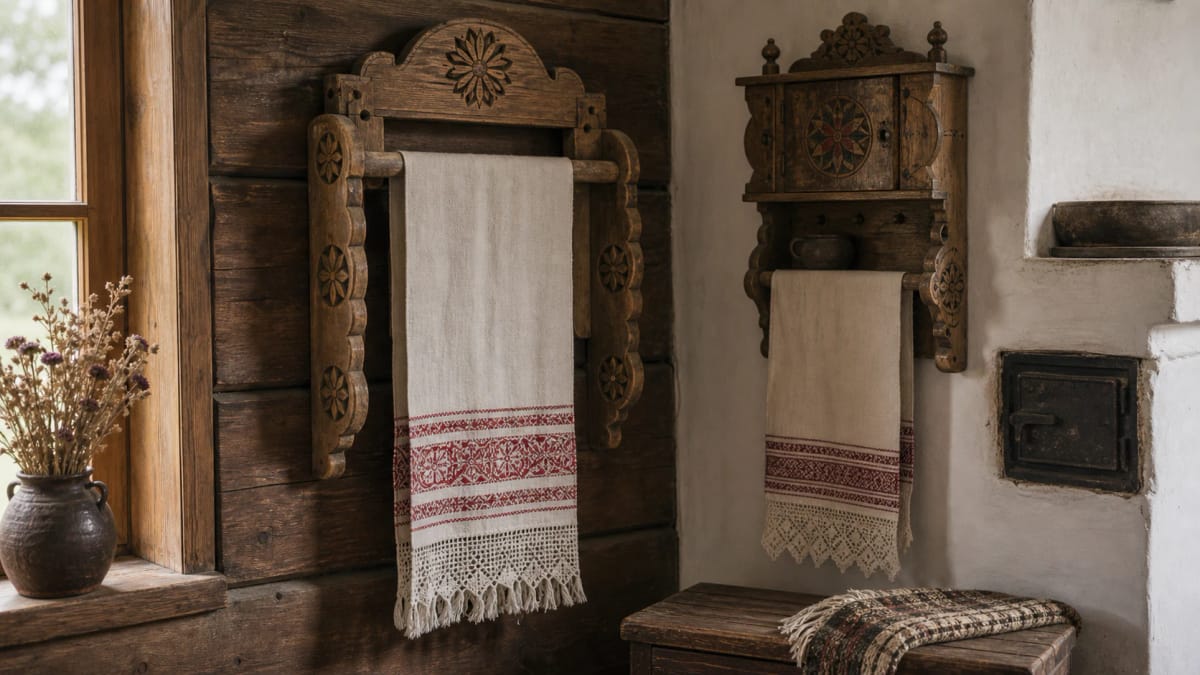
Towel rack with roller: A wall-mounted holder with a round wooden roller between two side boards, used to hang a decorative or practical towel.
Towel rack with shelf: A holder with a shelf above or beside it for small objects, vessels, festive items, or interior decoration.
Cupboard-like towel rack: A larger form of towel rack with a small cupboard or door section, close to folk furniture and wall-shelf traditions.
Lithuania Minor variant: In the interiors of the lagoon region and Lithuania Minor, towel racks could combine with shelves, dish storage, and decorative wall composition.
What Is a Rankšluostinė?
A rankšluostinė is a wooden wall-mounted holder for a towel. The simplest form has two side boards and a round roller or crossbar fixed between them, over which a woven towel is hung. More ornate towel racks include a shelf, a small cupboard, pierced work, or carved ornament.
This object stands between furniture, wood carving, and textile display. Without a towel it is a construction; with a towel it becomes a sign of farmstead interior, cleanliness, hospitality, ritual, and decoration.
Towel racks were hung in the main room, often in a visible and honorable place. They helped keep the textile orderly, but also showed the housewife's textile work and the family's taste.
Construction: Sides, Roller, Shelf
The basic construction is simple: two vertical or profiled side boards, a roller set between them, and sometimes a top board or shelf. The roller lets the towel hang freely, not pressed flat against the wall.
The side boards are often decorated with cut edges, sunbursts, flowers, geometric patterns, teeth, birds, or incised lines. The upper part may be wavy, cut out, shaped with a small pediment, or left in a simple profile.
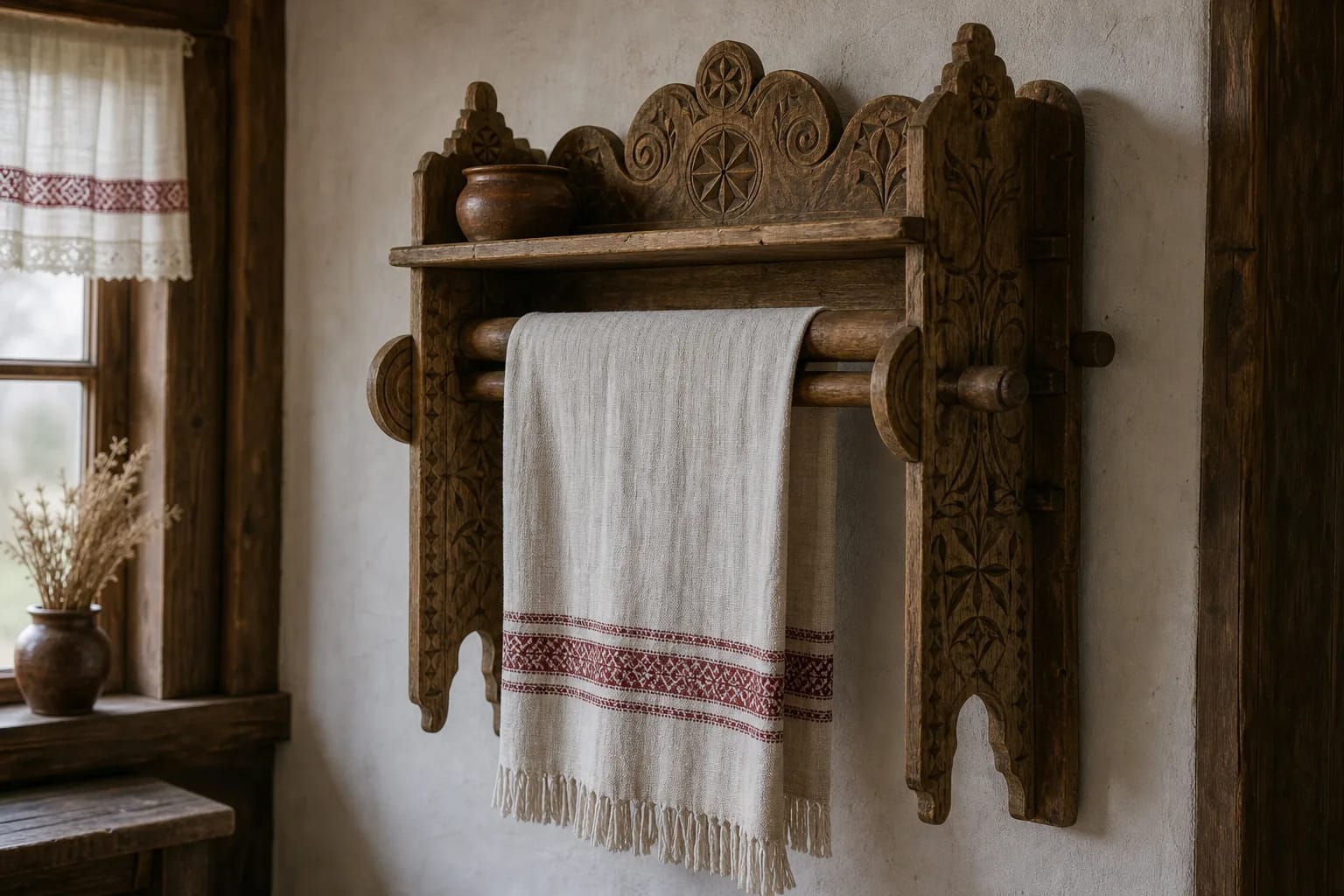
Some towel racks have a shelf or a small cupboard element. In that case they approach wall shelves, small dish cupboards, and other folk furniture. This shows that interior objects often combined several functions.
The Towel Rack and the Krikštasuolė
The towel rack is often associated with the more honorable place in the room, especially the krikštasuolė, the corner near the table, holy pictures, a cross, or family signs of importance. A towel hanging there was not an ordinary wiping cloth but representative textile.
In the setting of the krikštasuolė, the towel could signify cleanliness, hospitality, festivity, and respect. The towel rack helped it be visible, straight, orderly, and protected from everyday disorder.
Not every towel rack was purely sacred or decorative. Some were used daily, especially near washing or kitchen areas. Still, the examples best preserved and presented in museums often emphasize the representative function.
The Towel as the Center
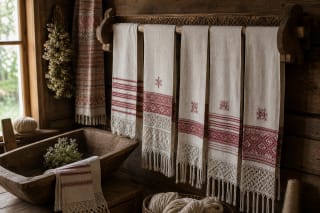
A towel rack cannot be separated from the textile. Lithuanian towels were woven from flax, white or natural in color, with red or other colored patterns at the ends, pinikai, lace, fringes, or embroidery. The wooden holder was therefore made to show the textile ends and pattern.
When a towel hung on a rankšluostinė, the ornamented edges were visible. This was a kind of textile display in the home: a person saw not folded cloth in a chest but work spread out and hung in order.
For that reason the form of the towel rack had to be restrained. A holder that was too heavy would overpower the textile, while one that was too plain would not show the beauty of the home. A good object balanced wood and cloth.
Gift and Social Sign
In some places towel racks are mentioned within the world of youth or engagement gifts. A young man might make or give a decorated wooden object that later hung in a girl's or new family's home. This layer should be understood as a local custom, not a universal rule.
Like a prieverpstė or other carved household object, a towel rack could show a maker's skill, attention, and relationship. The gift was practical but also visible in the home interior, so it carried social weight.
The towel hanging on the rack also functioned as a sign of the housewife's work. The textile showed weaving, sewing, crochet, or braiding skills, while the wooden holder showed household order and taste.
Lithuania Minor and Variety of Forms
Towel racks spread across Lithuanian regions, but in Lithuania Minor and lagoon-region interiors they could combine with shelves, dish storage elements, and small wall cupboards. These forms are close to the wider tradition of wooden wall furniture.
In some places the rack was very simple: two side boards and a roller. Elsewhere it became an expressive piece of furniture with profiled boards, shelves, doors, a carved top, and painted or incised ornaments.
Identifying region is not always simple, because museum objects could travel, be moved, restored, or taken from mixed home interiors. It is better to describe the form concretely: roller, shelf, cupboard, ornament, material.
Woodwork and Ornament
Making a towel rack required the precision of a carpenter or joiner: the sides had to be even, the roller had to hold the textile freely, the structure had to hang firmly on the wall, and a shelf or small cupboard could not wobble. Even a small piece of furniture had to be reliable.
Decoration used profiled edges, pierced work, incised lines, sunbursts, plants, teeth, wavy contours, and sometimes painting. Ornament is usually concentrated on the sides and upper part so it does not overwhelm the towel. According to the Universal Lithuanian Encyclopedia, towel racks form the most artistic and numerous group of Lithuanian decorative wooden objects; geometric elements and plant motifs predominate, especially small branches with leaves and tulip-like flower forms. Older towel racks were painted, and one dated example is J. Gelžinis's 1892 towel rack preserved at the Žemaičių Museum “Alka.”
The towel rack clearly shows a principle of Lithuanian household folk art: an everyday object must function, but it can also be beautiful. Beauty is not added after function; it orders and displays it.
Care and Preservation
An old towel rack should be protected from moisture, mold, direct sunlight, and mechanical pressure. The roller, thin side details, and pierced work can break easily, especially if the object spent a long time in a damp farmhouse.
An old towel rack should not be sanded or repainted casually, because that can destroy a darkened surface, old paint, tool marks, or authentic wear. These traces reveal the history of use.
If a towel rack is used today, it is best to hang light textiles, avoid loading the shelf with heavy objects, and make sure that mounting does not damage either the wall or the object itself.