- Field
- Lithuanian folk art of paper cutting
- Type
- folk art
- Heritage status
- well attested
- Context
- Openwork and silhouette paper cuttings, window curtains, shelf decorations, lamp shades, tree of life, birds, sunbursts, seasonal home decorations, and contemporary folk art
Paper cuttings, Lithuanian folk paper cuttings, Openwork paper cuttings, Silhouette cuttings
Paper Cuttings forms and objects
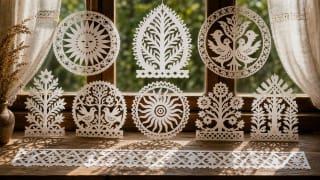
Openwork cuttings: Paper-lace-like works where the rhythm of empty and full form matters most.
Silhouette cuttings: Contour images cut from paper, where a figure is read through its outline and contrast with the background.
Window and shelf cuttings: Household decoration: curtains, shelf edges, festive bands, and paper ornaments for lamps or lights.
Wall and exhibition cuttings: More complex compositions with trees of life, birds, people, seasons, architecture, or narrative scenes.
What are paper cuttings?
Paper cuttings are folk art made by cutting patterns, silhouettes, or openwork compositions from folded or flat paper with scissors, a knife, or another sharp tool. Their beauty comes from the relationship between paper and emptiness.
Lithuanian paper cuttings most often show trees, birds, sun motifs, stars, plants, toothed borders, small squares, geometric rhythms, seasons, and home decoration. The material is fragile, but a good cutting requires an extremely precise hand.
Paper cuttings belong to graphic folk art, but their purpose was long domestic: they hung in windows, edged shelves, decorated festive rooms, lamps, walls, paper curtains, cards, and seasonal spaces.
When did paper cuttings spread in Lithuania?
VLE states that Lithuanian folk paper cuttings spread more widely in the late nineteenth century. Paper had become more accessible, and rural homes needed inexpensive, quickly made, but festive decorations. Globally, paper cutting began in ancient China, with the oldest surviving examples from the fourth century, and spread in Europe in the sixteenth-seventeenth centuries after paper production developed.
Although paper is fragile and rarely survives long, paper-cut ornament is close to older Lithuanian folk arts: knitting, woodcarving, Easter eggs, sashes, and woven fabrics. The same teeth, stars, birds, and tree motifs move from one material to another.
In the twentieth century paper cuttings moved from home decoration into exhibition folk art. Masters began creating larger compositions, complex trees of life, narrative scenes, and regional motifs meant not only for a shelf or window but for display.
Openwork and silhouette cuttings
Openwork cuttings are like paper lace. What is cut away and what is left both matter. Holes become pattern, and light through them creates shadow. Such works may be symmetrical, rhythmic, dense, or light.
Silhouette cuttings rely on the contour of a figure. A person, bird, tree, building, or animal is recognized from a black or white shape against a contrasting background. A silhouette may be simpler but requires a clear sense of composition.
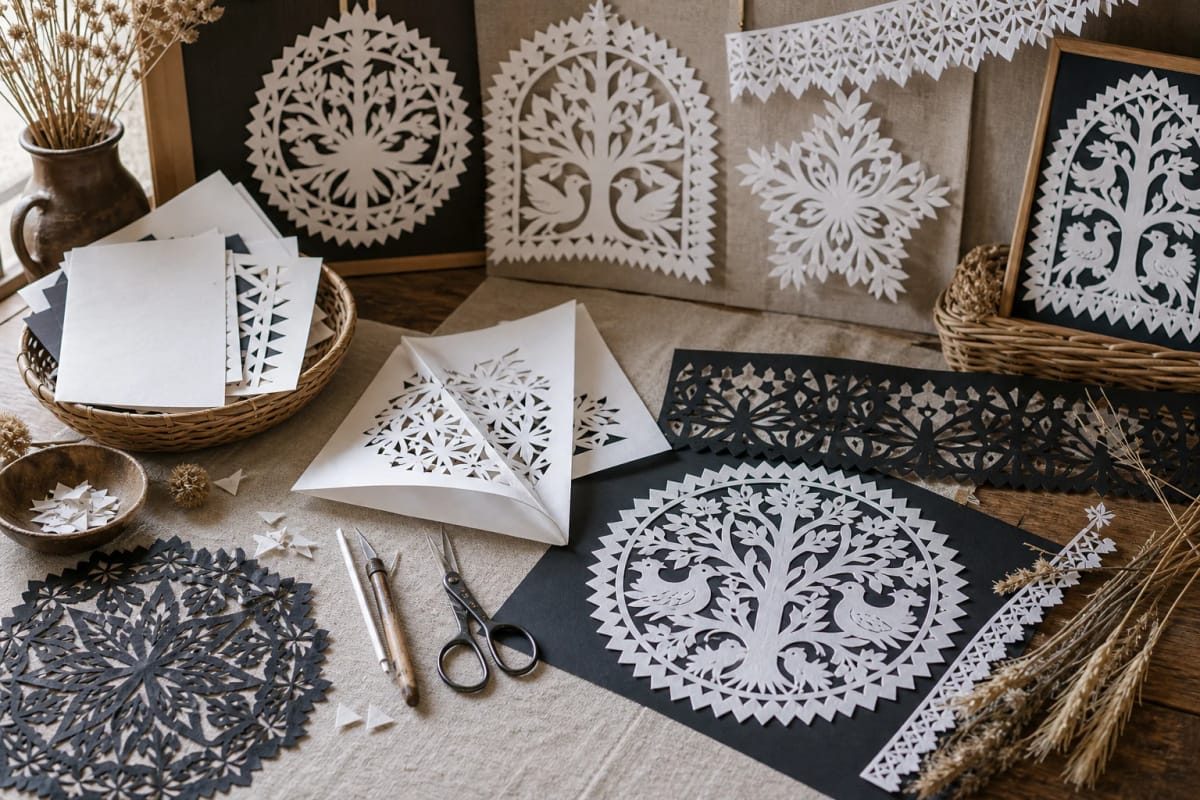
Many Lithuanian cuttings combine both principles: the overall silhouette may be a tree of life, while birds, leaves, sun motifs, teeth, and small ornaments are cut inside it. The work is both image and pattern.
Household decoration
One of the oldest layers of paper cutting is home decoration. Paper curtains hung in windows, shelf edges were covered with cut papers, and snowflakes, stars, garlands, and lamp decorations were made for feasts.
Such cuttings were temporary. They could be changed before a holiday, thrown away when worn, or cut anew by children or family members. Much did not survive, but the tradition remained in memory and education.
Temporariness is not a weakness. Paper cuttings show how rural and small-town homes could be decorated quickly, economically, and imaginatively. Folk art here grows from simple material and the hand's ability to make light.
Main motifs
The tree of life is one of the strongest paper-cut motifs. Birds, flowers, sun motifs, roots, and symmetrical leaves may rise from its branches. Such a cutting suggests not only a plant but an ordered structure of the world.
Birds are often composed in pairs or on both sides of a tree, giving a feeling of movement, sky, and song. Sun motifs, stars, snowflakes, and rays are easily born from folded-paper symmetry.
Teeth, triangles, diamonds, and squares help create borders, rhythm, and a protective frame. The edge of a cutting is as important as the center: it holds the composition and creates a decorative transition between paper and air.
Technique: from fold to cut
The simplest cutting begins with folded paper. Cutting several layers at once creates symmetry: snowflakes, stars, repeated leaves, and toothed borders. More complex works are made flat, with a knife and a planned drawing.
Scissors allow free control of line, while a knife suits fine openwork. Supporting points must not be cut through, because one wrong cut can destroy the whole composition. Paper-cut mastery is both drawing and construction.

A cutting must be planned as a network. How much paper can be removed before the work falls apart? Where must bridges remain? How will a white tree hold in a dark ground? These questions distinguish folk-art paper cutting from random paper slicing.
Regions, masters, and revival
Paper cuttings are found across Lithuania, but regional differences are best seen through motifs and individual masters. In the lagoon and Lithuania Minor area, krikštai, fishermen, nature, water, and local architecture appear more often.
Important twentieth-century figures in the revival and expansion of paper cutting include Julija Daniliauskienė, often named in discussions of the renewed Lithuanian tradition. A paper cutting called Monstrance by Jonas Basanavičius is also known, and international paper-cutting exhibitions were held in 1990 and 1995. Contemporary masters create both traditional and authorial works.
Regionality is best presented through concrete works, authors, and museum examples rather than general phrases. Paper cuttings are highly sensitive to the individual hand: the same motif looks different in different masters' work.
Paper cuttings and other folk arts
Paper-cut patterns are close to ornaments in Easter eggs, textile, sashes, lace, woodcarving, and blacksmithing. This does not mean every motif has the same meaning, but it shows a shared visual language of folk art.
Paper allows symmetry to be tested quickly. A motif that would require a loom in textile or carving in wood can appear in paper in minutes. Paper cuttings are therefore a good way to learn the logic of ornament.
At the same time, paper exposes mistakes. An uneven cut, weak bridge, or lost detail is immediately visible. Paper cuttings look fragile, but they teach strict composition.
How to preserve paper cuttings
Paper cuttings are sensitive to moisture, sunlight, folding, and dust. Old works are best kept dry, protected from direct light, in a frame or archival folder. Paper yellows and becomes brittle, so museum preservation matters.
When framing, avoid adhesives that damage paper over time. Neutral archival materials and a small distance from the glass are better. If a cutting was meant as temporary holiday decoration, a photograph can also become an important document.
A contemporary cutting can live in a home, but its fragility should be remembered. It is not plastic decoration; its value comes from hand, paper, and transience.