- Field
- Lithuanian cross-crafting pillar monuments with a chapel-shrine
- Type
- ritual craft
- Heritage status
- UNESCO heritage
- Context
- Koplytstulpis, chapel-shrine on a pillar, saints' sculptures, cross-crafting, Samogitia, wooden small sacred architecture, roadside monuments, cemetery and homestead signs
Koplytstulpis, Chapel-shrine on a pillar, Pillar monument with a chapel-shrine, Cross-crafting pillar-shrine
Pillar-Shrines forms and objects
Open pillar-shrine: A pillar with an open chapel-shrine or niche in which the sculpture is visible without doors, clearly showing the link between image and landscape.
Closed pillar-shrine: A chapel-shrine with doors, glass, or more enclosed walls, protecting the sculpture from weather, birds, dust, and touch.
Two-sided or multi-niche pillar-shrine: A monument in which saints' figures or religious images can be seen from several sides, so it works as a sign at a crossroads, road, or homestead center.
Masonry pillar-shrine: A stone or masonry pillar monument with a niche or chapel-shrine. Wooden examples are especially characteristic of folk cross-crafting, but masonry forms also occur.
What is a koplytstulpis?
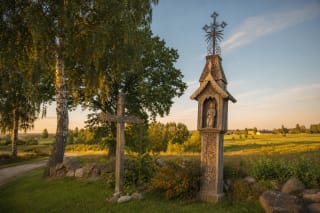
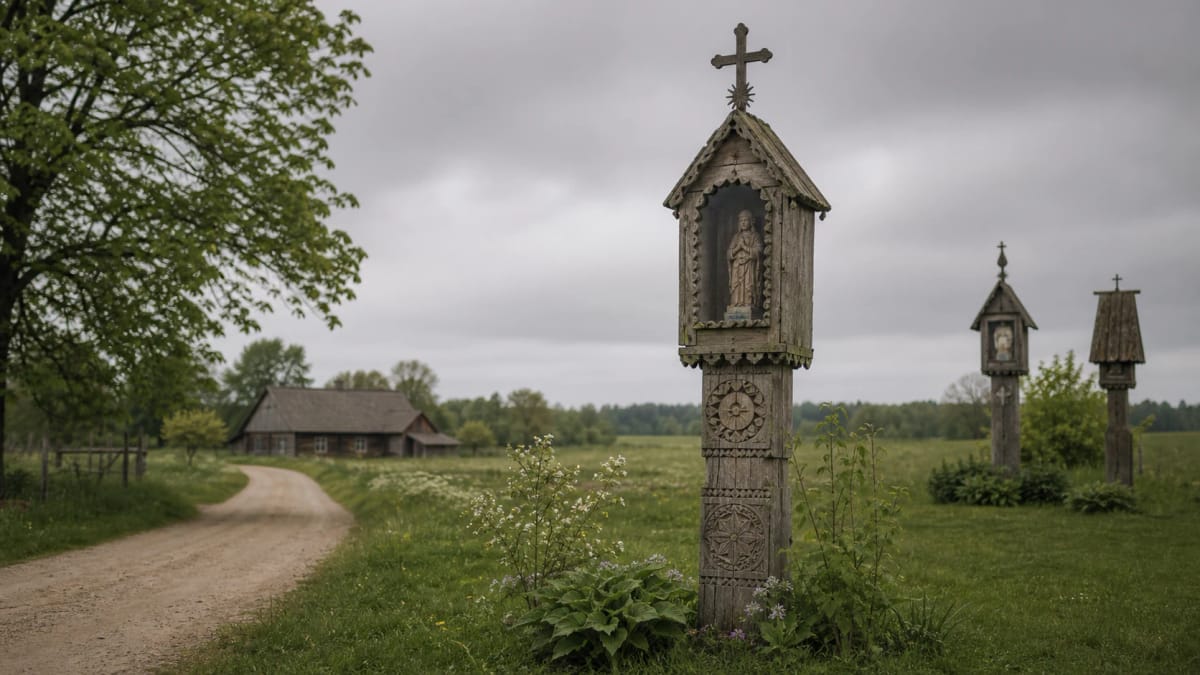
A koplytstulpis is a pillar-shaped sacred monument with a chapel-shrine, niche, or small house for saints' sculptures. Its essence is not only a tall pillar or a small cross at the top, but the chapel-shrine space that holds an image of Christ, Mary, Rūpintojėlis, Pietà, or a saint.
Because of that inner space, a pillar-shrine differs from a simple cross and from a roofed pole. A cross is recognized first by its crossbar, a roofed pole by its roof or roofs, and a pillar-shrine by the chapel-like box, niche, or little structure on the pillar.
Pillar-shrines are found in Catholic European lands such as Poland, Austria, France, and Lithuania, and in Lithuania they were mostly built from the 17th century to the first half of the 20th century. They belong to Lithuanian cross-crafting, which UNESCO recognizes as intangible cultural heritage of humanity. Each pillar-shrine, however, is best read concretely: who commissioned it, what figure was placed inside, where it stands, and what memory or protection it marks.
Structure: pillar, chapel-shrine, roof
The main parts of a pillar-shrine are the shaft, the chapel-shrine, the roof, and the finial. The shaft may be plain, profiled, carved, ornamented with bands, or incised with patterns. The chapel-shrine may be open, glazed, fitted with doors, one-sided, or visible from several sides.
A wooden pillar-shrine shaft, made from a tree trunk, is usually about 2-3 meters high and may be faceted, profiled, round, polygonal, or square in cross-section. To soften the transition from shaft to chapel, makers sometimes used upward-widening inserts shaped like inverted truncated pyramids. Masonry pillar-shrines are more massive, 4-9 meters high, usually plain, with a pedestal and niches; their forms show Baroque, Classicist, or Neo-Gothic influence.
The roof protects the sculpture from rain and gives the monument the character of small architecture. It may be gabled, hipped, covered with wooden shingles, edged with small teeth, decorated with fretwork, or topped with a modest cross. A wooden or blacksmith-made sunburst is sometimes fastened at the top.
The structure had to be practical. An outdoor monument must withstand wind, dampness, frost, and drying wood. A good pillar-shrine is therefore not only beautiful but structurally considered: a firm base, a rain-shedding cap, a protected sculpture, and a clear vertical axis.

Open and closed pillar-shrines
An open pillar-shrine lets the sculpture be seen immediately. This form creates a close relationship: the traveler or homestead resident sees the saint's face, hands, and attribute and can recognize to whom prayer or thanks is being directed.
A closed pillar-shrine protects the figure. Doors, glass, or a deeper niche help guard it from rain, snow, birds, and accidental touch. This form is especially important where an older polychrome sculpture or an object precious to a family is kept inside.
Sometimes a pillar-shrine has several niches or several viewing points. Such monuments suit crossroads, churchyards, village centers, or places where people approach from different directions.
Saints' sculptures in pillar-shrines
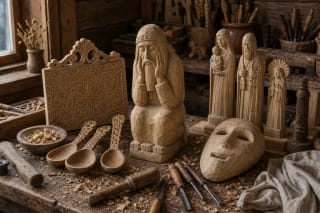
A pillar-shrine is usually inseparable from a dievdirbys sculpture. Inside there may be Rūpintojėlis, the Crucified Christ, Mary, Pietà, St. John Nepomuk, St. George, St. Isidore, St. Agatha, St. Roch, St. Anthony, or another saint important to local devotion.
The choice of figure was usually not accidental. St. Isidore suited agricultural settings; St. Agatha was connected with protection from fire and for the home; St. John Nepomuk appears often near water, bridges, or roads; Rūpintojėlis suited places of suffering, hardship, and quiet appeal.
The sculpture had to be legible from a short distance, so folk makers often emphasized a recognizable attribute, halo, clothing color, or facial expression. A pillar-shrine without a figure loses part of its meaning, because the chapel-shrine is made precisely to hold a sacred image.
Where are pillar-shrines built?
Pillar-shrines are raised along roads, by homesteads, at crossroads, in cemeteries, churchyards, village edges, near fields, by water, or at places of memory. Their location explains their purpose: one protects a home, another marks the memory of the dead, a third stands as thanksgiving, a vow, or communal prayer.
A homestead pillar-shrine often speaks of family protection. A cemetery or churchyard pillar-shrine joins prayer with remembrance of the dead. A roadside pillar-shrine accompanies the traveler and makes the landscape not only geographic but spiritual.
Such monuments can also be built anew: in memory of deportations, partisans, a village anniversary, a family event, or a restored homestead. The essential point is that the monument should not be merely a decorative style marker, but should have a clear intention and a respectful relationship with the place.
The importance of Samogitian pillar-shrines
Pillar-shrines are known across Lithuania, but Samogitia is one of their key regions: wooden pillar-shrines are most widespread there, while masonry examples were built throughout Lithuania. In Samogitian cross-crafting the tradition of chapel-shrines, ground chapel-shrines, and pillar-shrines is especially visible, and sacred wooden sculpture often forms a strong visual center. Original stone pillar-shrines, such as the one at Ukrinai from 1861, were carved by folk master S. J. Gailevičius, while oak examples in the late 19th and early 20th centuries were carved by Vincas Svirskis. During the period of national rebirth, many pillar-shrines were raised in memory of resistance participants and deportees.
Samogitian monuments give much attention to sculpture: Mary, Rūpintojėlis, Pietà, and local saints. The chapel may be ornate or modest, but the image living inside it is central. That is why the region's pillar-shrines often look like small sacred houses in the landscape.
Regional features should still be understood as tendencies, not strict rules. A village maker, parish tradition, patron's wish, or surviving older sculpture can be as important as the ethnographic region.
Pillar-shrine, roofed pole, and chapel-shrine: how to tell them apart
A pillar-shrine has a chapel-shrine on a pillar. A roofed pole has a roof or several roofs, under which small sculptures may be placed, but its main feature is the roof structure rather than an enclosed chapel box. A chapel-shrine may stand independently: in a tree, on the ground, or attached to a building.
In practice the forms sometimes overlap. One monument may have a chapel-shrine, roof, little cross, sunburst, and saints' figures. It is therefore useful to ask which element is primary: crossbar, roof, or chapel-shrine space.
This distinction keeps all of cross-crafting from being flattened into the single word cross. Lithuanian small sacred architecture is rich precisely because it has many forms, and each form has its own logic.
Care, restoration, and copies
A wooden pillar-shrine outdoors inevitably ages. It is affected by dampness, sun, cold, wood splitting, insects, and fungi. The sculptures inside can be even more sensitive, especially if they are old, polychrome, or have been repainted many times.
Responsible care begins with documentation: photographs, measurements, inscriptions, the history of the place, and the condition of the sculpture. Sometimes the original should be conserved; sometimes it should be moved to a safer place and a copy set outdoors. Such a decision should be made carefully, with heritage, museum, or conservation specialists.
New pillar-shrines should also be created responsibly. A clear structure, scale suited to the place, understandable iconography, and durable materials are better than mechanically multiplying ornament without content.