- Field
- Lithuanian small sacred architecture and chapel-shrines
- Type
- ritual craft
- Heritage status
- UNESCO heritage
- Context
- Koplytėlė, wooden chapel-shrine, Samogitian chapel-shrines, tree chapel-shrines, saints' sculptures, cross-crafting, homestead and roadside devotional signs
Koplytėlė, Wooden chapel-shrine, Tree chapel-shrine, Samogitian chapel-shrine, Saints' shrine
Chapel-Shrines forms and objects
Ground chapel-shrine: A small chapel-shaped space for holy images, placed on the ground, stones, or a wooden base, especially prominent in the Samogitian landscape.
Tree chapel-shrine: A small shrine fastened to a tree trunk with a figure of Christ, Mary, or a saint. These forms are important along roads, at homesteads, and in places of memory.
Building chapel-shrine: A chapel-shrine attached to a dwelling, granary, cowshed, gate, or another part of a homestead, marking household protection and family devotion.
Closed or open chapel-shrine: A chapel-shrine may be open, fitted with doors, glazed, one- or multi-tiered, and hold one or several saints' figures.
What is a koplytėlė?
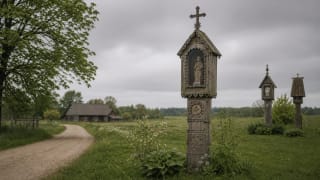
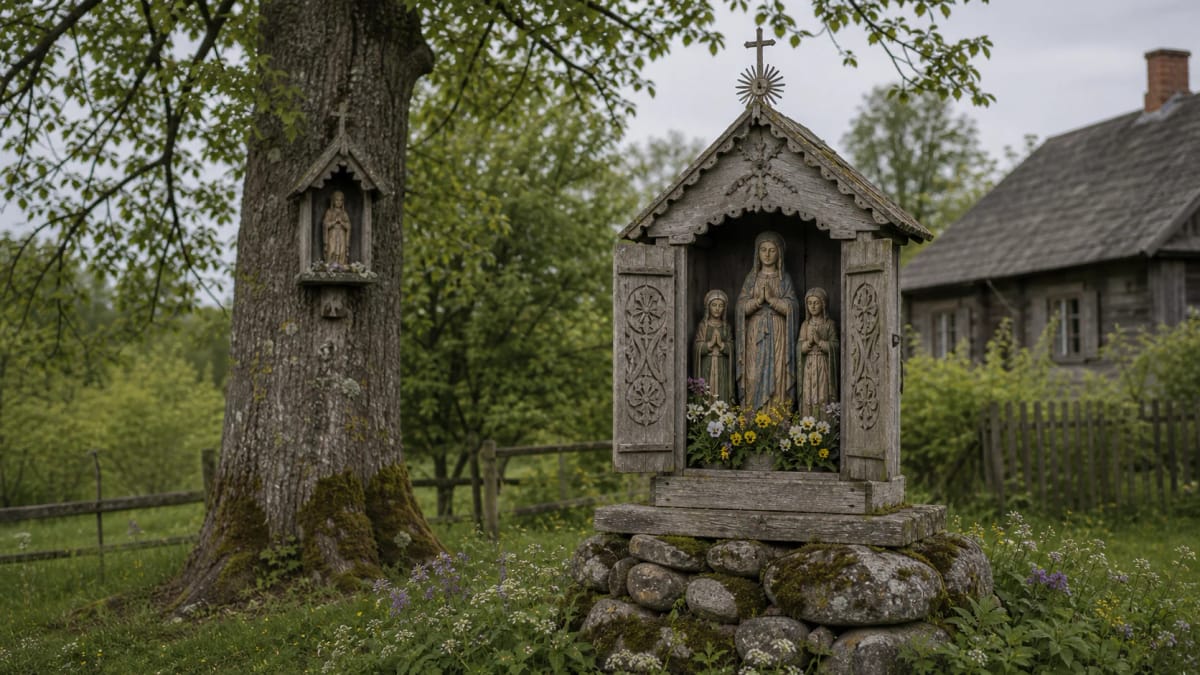
A koplytėlė is a small sacred space for holy images. It may look like a miniature house, a small wooden altar, a glazed niche, a box fastened to a tree, or a wooden chapel-shrine with a roof standing on the ground. The Universal Lithuanian Encyclopedia describes these as miniature church-, bell-tower-, or porch-like structures, usually one-storied, sometimes two-storied and rarely three-storied, with rectangular, sometimes cross-shaped or polygonal plans.
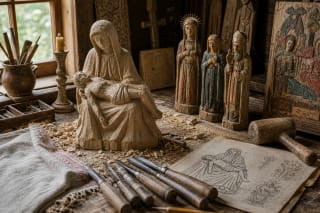
In Lithuanian cross-crafting, a chapel-shrine is not only a decorative case. It is the place where the figure of Christ, Mary, Rūpintojėlis, Pietà, or a saint dwells. It therefore joins woodwork, god-carving, local devotion, and landscape memory.
A chapel-shrine may stand independently or become part of another monument. It may be built into a pillar-shrine, hang on a tree, stand on a stone base, be fixed to a homestead wall, or hold a figure in a cemetery.
Main forms
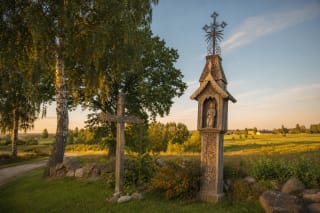
A ground chapel-shrine stands on the earth, stones, a wooden base, or a small foundation. It is especially associated with Samogitia, where chapel-shrines often resemble small sacred houses with gabled roofs, doors, little windows, and several figures inside.
A tree chapel-shrine is fastened to a trunk or a heavier branch. It may be very modest: a small roof, a board box, and one little figure. Yet the form has a strong effect on the landscape, because the tree becomes not only a support but part of the sacred place.
Building chapel-shrines are attached to houses, granaries, gates, or other homestead places. They mark family devotion, requested protection, memory, or thanksgiving. These forms show that a sacred sign was written into everyday domestic space.
Open, closed, and glazed chapel-shrines
An open chapel-shrine lets the figure be seen at once. This form feels immediate: a person can see the saint's face, hands, attribute, clothing, and posture. Openness strengthens the relationship but leaves the sculpture more vulnerable to rain, wind, and sunlight.
A closed chapel-shrine has doors, small windows, glass, or a deeper inner space. It protects figures better, especially old polychrome sculptures. Sometimes the doors are decorated with fretwork, plant patterns, dentate edges, or a simple little cross; small teeth, curls, and star motifs are common.
The oldest form of chapel-shrine is considered to be the so-called baublio type, hollowed from a tree trunk and covered with a conical roof. Hanging chapel-shrines may be rectangular box forms, while ground forms stand on stone, brick, or wooden foundations; their roofs are finished with a wooden or iron cross.
Glazing and enclosure can be later layers of care. That is not necessarily a problem: people protected what was precious to them. In restoration, however, it is important to distinguish the old construction, later repairs, and modern additions.
Which figures are kept in chapel-shrines?
Chapel-shrines often hold figures carved by dievdirbiai: Rūpintojėlis, the Crucified Christ, Mary, Pietà, St. John Nepomuk, St. George, St. Isidore, St. Agatha, St. Roch, St. Anthony, and other saints important to local devotion.
The choice of figure depended on intention. Near water, a bridge, or a road one might find St. John Nepomuk; in an agricultural setting, St. Isidore; in requests for protection from fire and for the home, St. Agatha; in places of suffering and mourning, Pietà or Rūpintojėlis.
Sometimes a chapel-shrine holds several figures. It then becomes a small sacred ensemble: Mary or Christ in the center, saints at the sides, and flowers, candles, ribbons, or small tokens of thanks below.
Samogitian chapel-shrines
Samogitia is one of the most important regions for chapel-shrines. Ground wooden chapel-shrines, tree chapel-shrines, and their connection with abundant folk sacred sculpture are especially visible there.
Samogitian chapel-shrines often have a strong house-like form: roof, side walls, doors, decorated edges, and sometimes several figures. They do not look like mere additions to a monument, but like independent sacred places.
Even so, chapel-shrines should not be assigned only to Samogitia. They are known in different Lithuanian regions, and tree-hung forms are mentioned in other areas as well. The region helps explain spread, but it does not replace the history of a specific place.
Place: tree, homestead, roadside, cemetery
The location of a chapel-shrine always matters. A shrine fixed to a tree connects the sacred sign with the living body of the landscape. A homestead chapel-shrine speaks of household protection. A roadside shrine accompanies the traveler. A cemetery chapel-shrine joins prayer with the memory of the dead.
Chapel-shrines could mark gratitude, a vow, the memory of illness or misfortune, family history, a village boundary, communal prayer, or a place that people felt was special. They are inseparable from stories, even when those stories are no longer written down.

It is thought that chapel-shrines developed from grave posts raised according to pre-Christian funerary cult, and in the 17th and 18th centuries took on features characteristic of Catholic culture; among the oldest dated examples is the Barbara chapel-shrine in Musninkai from the 18th century. Older local layers should be discussed carefully: tree, water, stone, or crossroads may carry older symbolism, but the koplytėlė is first of all an object of Catholic folk devotion grown into the Lithuanian landscape.
How does a chapel-shrine differ from a pillar-shrine?
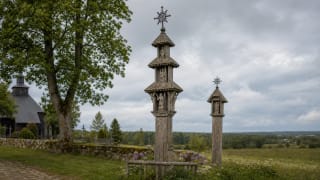
A chapel-shrine is the small sacred space itself. It may stand independently, hang in a tree, or be attached to a building. A pillar-shrine, or koplytstulpis, is a pillar monument whose top or body contains a chapel-shrine.
A koplytstulpis therefore has the pillar as its main structural axis, while a chapel-shrine may have no pillar. When a small house with a saint stands on stones, is fixed to a tree, or hangs on a wall, it is more precise to speak of a koplytėlė.
The forms can overlap. If a chapel-shrine is placed on a tall pillar, it becomes part of a koplytstulpis. If a pillar-shrine contains a very prominent chapel-shrine, both features are worth describing instead of forcing only one name.
Care and preservation
Outdoor chapel-shrines are vulnerable. Water enters through roofs, wood cracks, paint flakes, little sculptures decay, glass breaks, and shrines hung in trees may be damaged as trunks grow or during storms.
Before repairing an old chapel-shrine, it is worth photographing it and recording the place, measurements, figures, inscriptions, and known history. Old figures should not be cleaned, repainted, or replaced without documentation, because an authentic layer may be lost.
When the original is badly decayed, a copy is sometimes made and the old figure moved to a museum, church, or safer location. This can be a respectful solution if it is clearly marked what is old, what has been reconstructed, and why.