- Field
- Lithuanian blacksmith-made finials for crosses, chapel-posts, and roofed posts
- Type
- traditional craft
- Heritage status
- UNESCO heritage
- Context
- Forged sunbursts, iron cross finials, radiating crosses, cross-crafting, blacksmithing, chapel-posts, roofed posts, church and chapel finials, crescents, wavy rays
Blacksmith-made cross finials, Iron sunbursts, Cross sunbursts, Radiating crosses, Blacksmith finials
Forged Sunbursts forms and objects
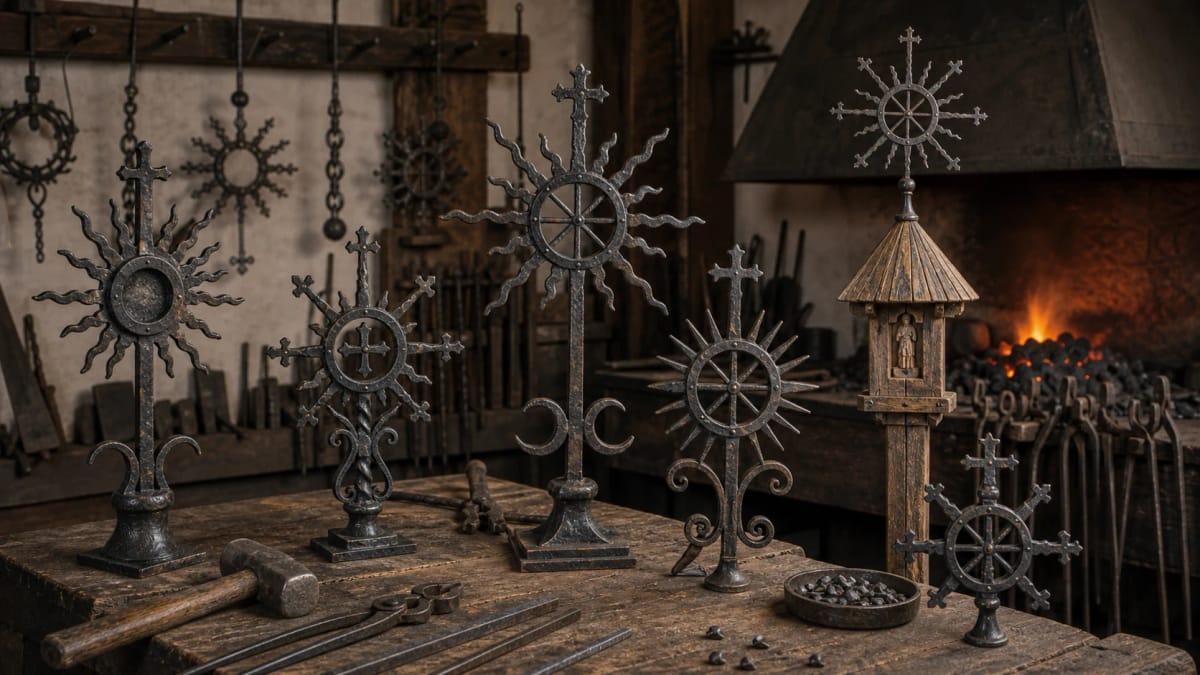
Radiating cross finial: An iron cross with straight, wavy, or broken rays, often mounted on a wooden cross, roofed post, or chapel-post.
Sunburst with circle: A finial with a ring, disk, or circle in the center and rays, small crosses, or plant motifs arranged around it.
Finial with crescents: A blacksmith-made composition in which rays and crosses are combined with crescent forms, curls, or plant curves.
Church and chapel finials: Larger or more complex blacksmith-made crosses used on churches, chapels, churchyard gates, and other sacred structures.
What are forged sunbursts?
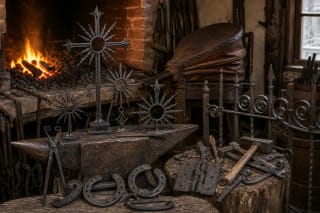
Forged sunbursts are iron finials for crosses, chapel-posts, roofed posts, small chapels, churches, and chapels. They usually include a cross, circle, rays, small crosses, crescents, curls, or plant motifs. VLE notes that forged iron sunbursts form the largest part of memorial cross-crafting: a sunburst is usually made of flat iron cross-arms joined in the center by a disk or ring, sometimes heart- or leaf-shaped, with straight or wavy rays whose ends often finish in small crosses.
The name 'sunburst' emphasizes the radiating form, but it is not only a solar sign. In cross-crafting it usually combines the Christian cross, symbolism of light, blacksmith skill, and folk ornamental rhythm.
These finials matter because they join a wooden monument with metal. Wood gives cross-crafting warmth and verticality, while iron gives a silhouette against the sky, openwork rays, and longer survival.
Where are they used?
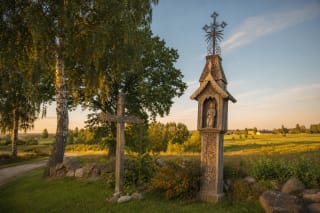
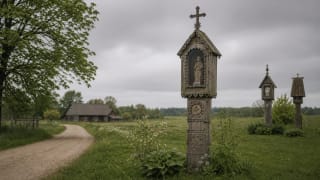
Forged sunbursts are mounted on wooden crosses, chapel-posts, roofed posts, cemetery crosses, churchyard gates, chapels, and church roofs. They can be small and modest or very complex, with several layers of ornament.
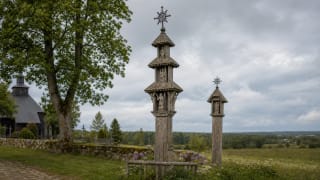
On a roofed post, the sunburst completes the vertical composition and is visible from afar against the sky. On a chapel-post it complements the shrine and saints' sculptures. On a church or chapel it becomes a sacred accent of the building.
On an outdoor monument the finial must withstand wind, moisture, corrosion, and the movement of wood. It must therefore be not only beautiful but strongly built and well fixed.
Form: circle, cross, rays
The center of a sunburst is often a cross or circle. Straight, wavy, broken, or fine rays are arranged around it. The composition may be highly symmetrical or livelier, with curls, leaves, and small crosses.
Rays may suggest the sun, light, heavenly order, or the light of Christ's victory. The circle may be both a structural ring and a visual center. The cross usually remains the main sacred axis.
Crescents, small stars, plant curves, and curls enrich the form. In tradition, rays were popularly called little grass snakes, while horizontal crescents were called horns; ends of rays and cross-arms were often ornamented with geometric, star, or plant motifs. Sometimes a weather vane or wind indicator was attached. These elements may come from a blacksmith's repertoire, regional taste, or a particular commission, so they should not be reduced to one code.
How does a blacksmith make a sunburst?
A forged sunburst requires iron rods, strips, wire, rivets, sometimes a ring or plate. Metal is heated, forged, bent, twisted, riveted, welded by older or newer methods, and then adapted for fixing to wood or roof.
The silhouette matters. A sunburst is often seen from a distance against the sky, so small details must be clear enough. Ornament that is too dense merges; a weak construction bends or breaks.
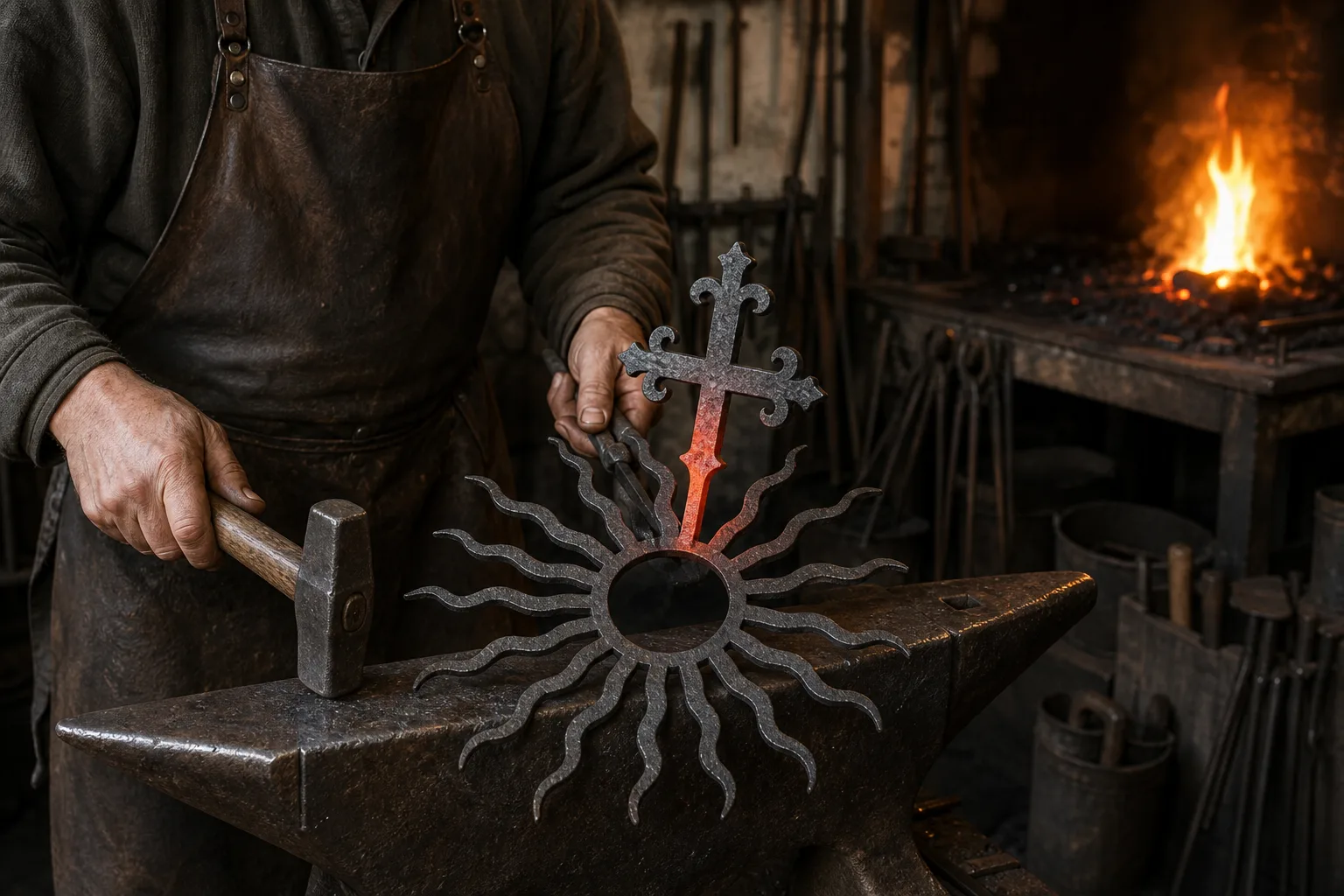
The blacksmith must also think about balance. The finial must not overload the wooden post, must remain vertical, and must resist wind. A good sunburst is both ornament and engineering.
Church and village sunbursts
Larger church, chapel, or churchyard finials were often made by professional blacksmiths and had more complex structures. They were visible from afar, so they had to be strong, clear in outline, and liturgically recognizable. In the eighteenth century urban blacksmiths forged sunbursts for church towers; from the second half of the eighteenth century, mostly in the nineteenth and early twentieth centuries, village blacksmiths, especially in Samogitia, forged iron sunbursts for wooden monuments, bell towers, churchyards, and cemetery gates. In late nineteenth- and early twentieth-century Aukštaitija, especially Kupiškis, Rokiškis, and Utena counties, tall stone pillars were built with sunburst-shaped or double-stem iron crosses.
Village cross and roofed-post sunbursts could be simpler but very expressive. The master's individuality is often visible: one favors wavy rays, another small crosses, a third crescents and curls.
Both forms belong to the same language of metal and sacred landscape. The differences are scale, commission, place, and the level of the master's tools and experience.
Regions and cross-crafting context
Forged sunbursts are found across Lithuania, but their forms vary by region, master, and monument type. In Aukštaitian roofed posts, radiating finials fit tall multi-tiered wooden forms. In Samogitia, they complement chapel-posts and chapel-shrines. Known sunburst blacksmiths include A. Gailiauskas, V. Jarutis, K. Jocius, J. Jukėnas, J. Praninskas, and V. Vytas; the heritage of blacksmithing, including the Vilnius blacksmiths' guild founded in 1560, is presented by the Blacksmithing Museum opened in Klaipėda in 1979.
In cross-crafting, the sunburst is not a separate decoration added at the last moment. It completes the hierarchy of the monument: earth, post, sculpture, roof, finial, sky.
The sunburst is therefore best read together with the whole monument. The same iron motif will act differently on a cemetery cross, roadside roofed post, or church tower.
Symbolism: avoiding simplification
Forged sunbursts are often called solar symbols, but that explanation needs care. They certainly have a radiating image of light and sky, yet they almost always operate in the context of the Christian cross and sacred architecture.
It is best to speak about intertwined layers: the cross, sun and light sign, image of Christ's victory, blacksmith metal aesthetics, folk ornamental rhythm, and regional master's style.
Reducing the sunburst only to a 'pagan sun' would be inaccurate. It is also inaccurate to treat it only as technical metal decoration. Its strength lies precisely in the unity of several cultural layers.
Corrosion, restoration, and copies
Iron sunbursts rust outdoors. Corrosion may be superficial and aesthetically acceptable, but it may also weaken the structure, especially at rivets, joints, and attachment points to wood. Wood and metal move differently, so fixing points are especially sensitive.
During restoration, the metal should not be overcleaned to a shine. Old oxidation, forging marks, and surface irregularities are part of the object's history. Aggressive grinding may destroy the authentic surface.
When the original is badly decayed, a copy may be made while the old sunburst is kept in a museum or other protected setting. In such cases original, copy, and new interpretation must be clearly distinguished.