- Field
- Lithuanian textile decoration with the needle: whitework, drawn-thread work, cross-stitch, and plant motifs
- Type
- textiles
- Heritage status
- well attested
- Context
- Embroidery, whitework, drawn-thread work, adinukė, cross-stitch, satin stitch, openwork, richelieu, shirts, aprons, delmonai, Lithuania Minor
Whitework embroidery, Drawn-thread work, Cross-stitch embroidery, Openwork, Adinukė
Embroidery forms and objects
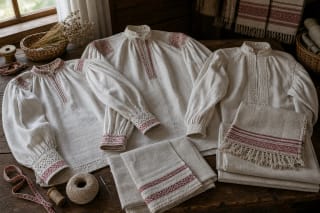
Shirt Embroidery: Decoration of collars, front openings, cuffs, sleeves, and shoulder pieces with white, red, or regional stitches.
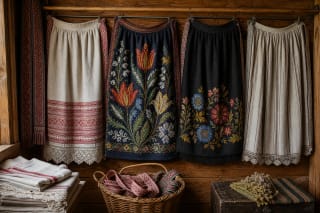
Apron and Skirt Decoration: Floral, geometric, openwork, drawn-thread, or colored motifs, especially visible on festive aprons.
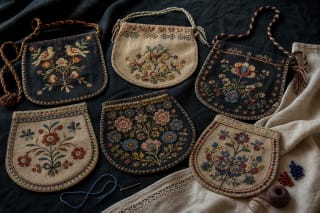
Delmonas Embroidery: Lithuania Minor textile pouches embroidered with flowers, birds, initials, dates, and beads.
Household Textile Embroidery: Decoration of towel ends, tablecloth edges, pillowcases, caps, scarves, and other textile borders, corners, or ends.
What Is Embroidery?
Embroidery is the decoration of fabric with needle and thread. In Lithuanian traditional textiles it complemented weaving, crochet, and sewing: linen, wool, and other fabrics carried stitches, openwork, red crosses, white relief, and colored plant motifs.
Embroidery usually concentrates on visible places: shirt collars, front openings, cuffs, shoulder pieces, apron hems, scarf and towel ends, delmonas fronts, kykas caps, and the edges of household textiles.
It is not only decoration. A stitch can strengthen an edge, mark an owner, make a textile festive, show a region, and turn plain linen into a valued object.
White Embroidery
White embroidery uses white stitches on white or light linen. From a distance it looks restrained; close up, relief, light, shadow, dots, lines, and openwork become visible.
The technique suits linen shirts, towels, kykas caps, and scarf edges. It emphasizes cleanliness of fabric, thread direction, and stitch precision rather than color. In the second half of the 19th century, white-thread adinukė became widespread, decorating women's kerchiefs, caps, underskirts, and shirts; in the late 19th century, in southeastern Lithuania, shirt sleeves and collars were also embroidered with black and red plant or geometric patterns.
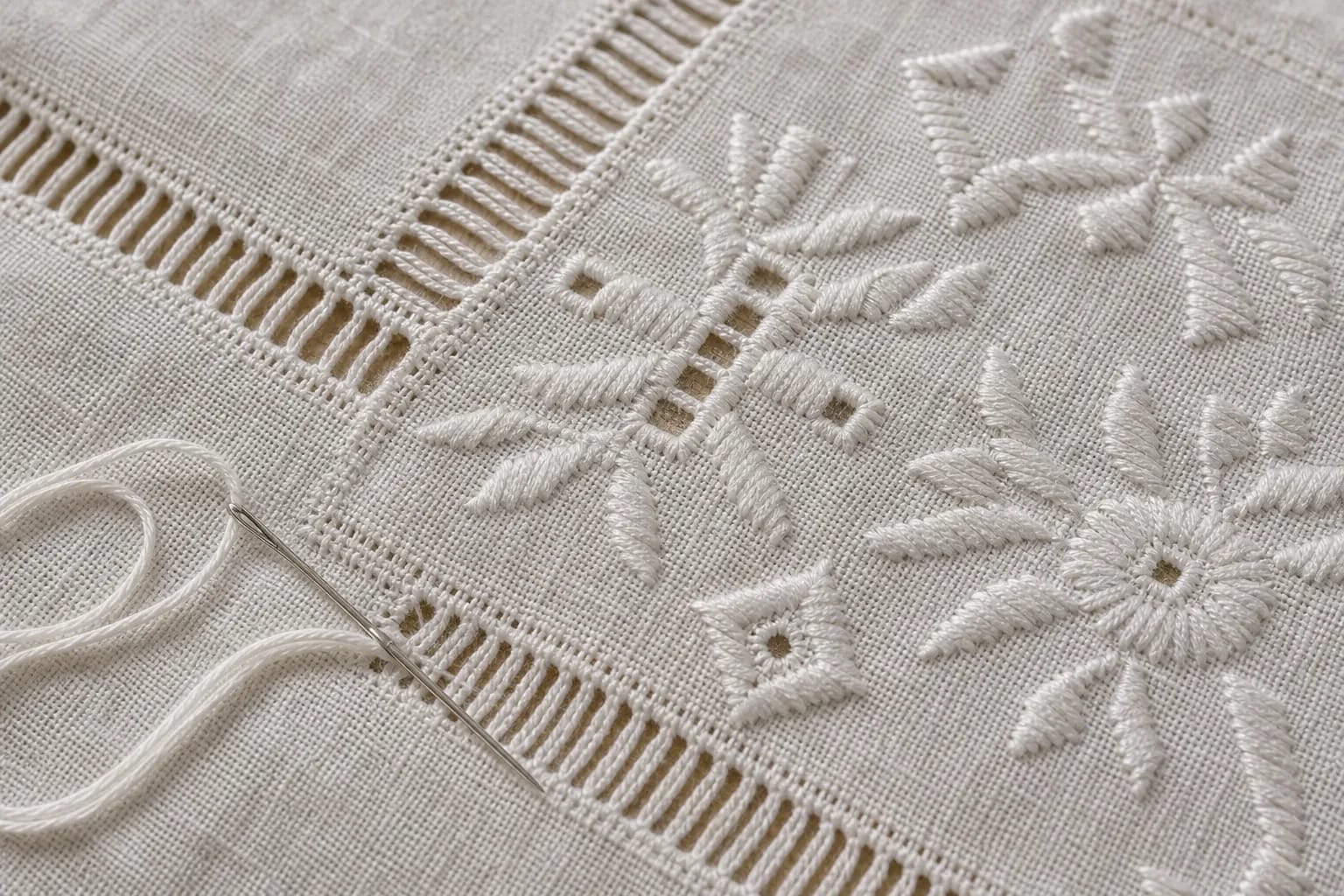
White embroidery demands good fabric and careful handling. On poor linen or badly stretched cloth, even a strong motif loses clarity.
Peltakiavimas and Openwork
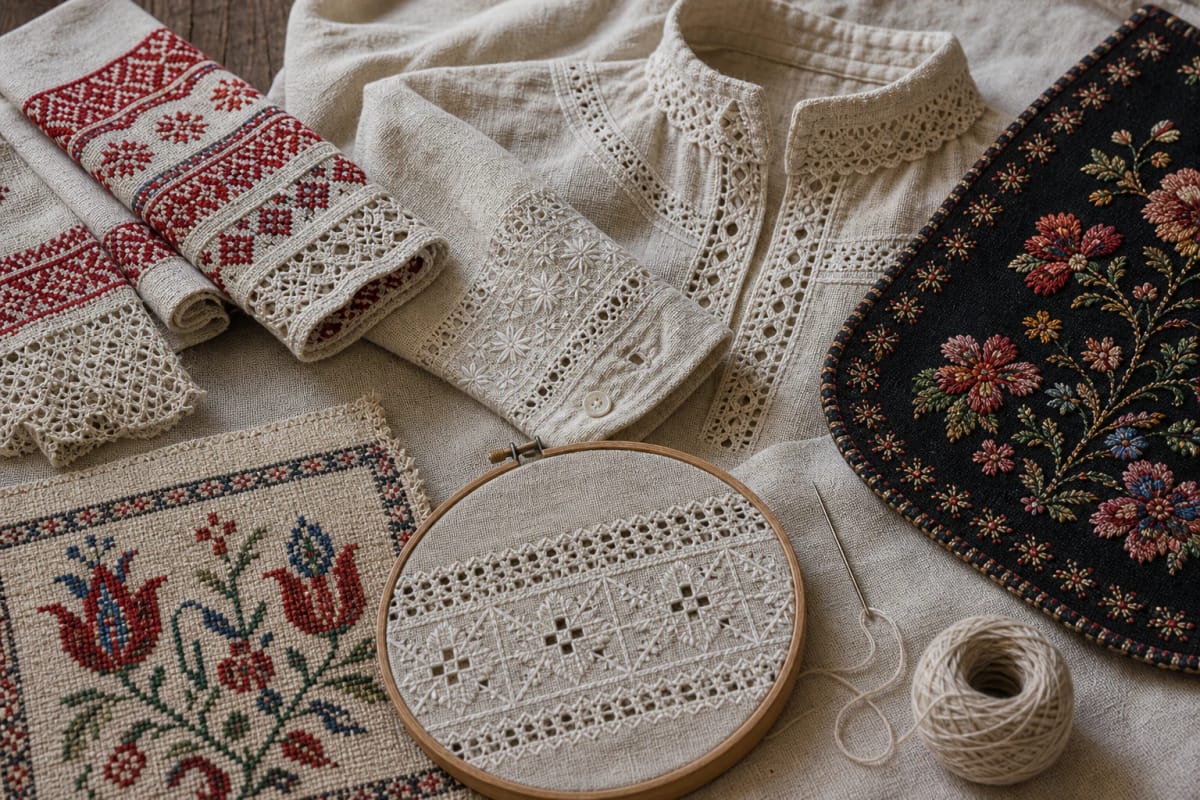
Peltakiavimas and openwork create a pierced or lace-like textile surface. Threads may be drawn out or stitched together so rhythmic gaps, grids, and geometric bands appear.
These techniques are common on towel ends, tablecloths, shirts, and head coverings. They connect embroidery with structure because the ornament is formed in the fabric itself, not merely placed on top.
Peltakiavimas expresses the Lithuanian white-textile aesthetic: much labor, little noise, a subtle surface, and a very clear rhythm.
Cross-Stitch and Colored Embroidery
Cross-stitch is made by counting the fabric threads and placing small X-shaped stitches. It can build geometric, floral, or lettered motifs with firm structure.
Red, black, blue, green, and multicolored stitches appear on shirts, aprons, household textiles, delmonai, and Lithuania Minor clothing details. Color gives the textile a stronger regional and personal voice.
In Lithuania Minor, colored embroidery, delmonai, German cultural context, and Lietuvininkai dress form a distinctive textile world that should not be blended into a generic Lithuanian regional model.
Stitches and Terms
Embroidery vocabulary matters: stitch, adinukė, satin stitch, cross-stitch, peltakiavimas, openwork, Richelieu, white embroidery, skaistgijos, and šilkavilnė describe both image and method.
Adinukė and other fine stitches make contours, fillings, dots, and lines. Satin stitch suits floral motifs, while cross-stitch fits stricter geometric patterns.
A skilled embroiderer chooses the technique for the fabric. Not every stitch suits every linen, wool, or costume part.
Where Was Embroidery Placed?
On shirts, embroidery appears on visible zones: collar, front opening, cuffs, sleeves, shoulder pieces, and sometimes the chest. These are the places where white linen remains visible under a bodice or outer garment.
On aprons, embroidery may appear at the hem, sides, corners, or across the front. Kykai, scarves, towels, tablecloths, and pillowcases are usually decorated along edges, ends, or corners.
On delmonai the embroidery is densely concentrated: flowers, birds, initials, dates, and beads make a small personal textile surface.
Regional Differences
Regional differences appear not only in motifs but also in placement. Aukštaitija and Dzūkija shirts, Suvalkija aprons, Žemaitija color combinations, and Lithuania Minor delmonai each follow different decorative logic.
Southeastern Lithuania and Dzūkija are often associated with red or darker accents on white cloth. In Lithuania Minor, colored cross-stitch, text, initials, and delmonas surfaces are especially important.
A region cannot be identified safely from one stitch alone. Fabric, garment type, placement, colors, cut, and museum description all matter.
Embroidery and Social Memory
Embroidery often writes a person into cloth through initials, a date, a specific motif, or family textile history. This is especially visible in delmonai, towels, pillowcases, and dowry textiles.
In a dowry, embroidered textiles showed not only quantity but also the ability to work carefully. Stitch quality carried social information.
Embroidery is therefore both ornament and document. It tells what a person knew how to make, what she considered beautiful, where she wanted to leave a name, and how the textile moved through a family.
Alongside village embroidery, manor and monastery embroidery also flourished in Lithuania. Vilnius became an important embroidery center in the Polish-Lithuanian Commonwealth after the arrival of the embroiderer Z. Linck in 1545; A. Mozeris's lace and mechanical embroidery workshop established in Naujoji Vilnia in 1835 employed 92 workers by 1900. In the 1920s and 1930s, a national style was promoted through handwork albums such as Sodžiaus menas.
How to Recognize Good Embroidery
Good embroidery has orderly stitch rhythm, a clean reverse side, clear edges, and a motif that suits the fabric. Stitches should not pull or distort the linen.
It is worth distinguishing handwork from machine effect. A machine can be neat, but in traditional heritage the relationship between hand, fabric, and stitch is what matters.
For reconstruction, region, garment type, and source must be known. A beautiful ornament is not enough if it appears in the wrong place or on the wrong fabric.