- Type
- God
- Domain
- Divine smith, forging of the Sun, earth and underworld, magic
- Source status
- well attested
Kalvelis
Who is Teliavelis?
Teliavelis is an old Lithuanian god mentioned in two early sources. In the Hypatian Chronicle he is listed second, after Nunadievis, among the gods secretly worshipped by King Mindaugas, though his functions are not described there.
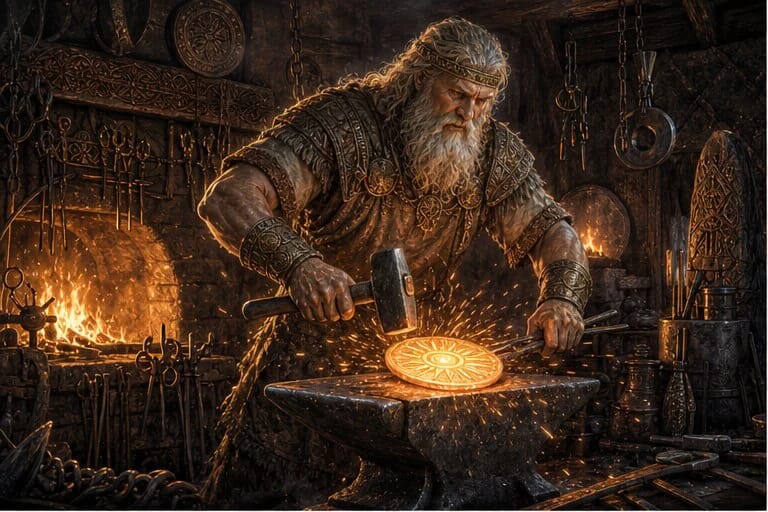
In the 1261 insertion in the Slavic translation of John Malalas' Chronicle, Teliavelis is mentioned fourth and last, and is called a smith who forged the Sun and threw it into the sky. This motif of smithing and forging the Sun is the most vivid feature of his image.
The divine smith who forged the Sun
The myth of Teliavelis belongs to a broad Indo-European tradition of the divine smith, in which a smith god creates or sets in place a heavenly light. In the Lithuanian version, Teliavelis forges the Sun and throws it into the sky, explaining the origin of the Sun itself.
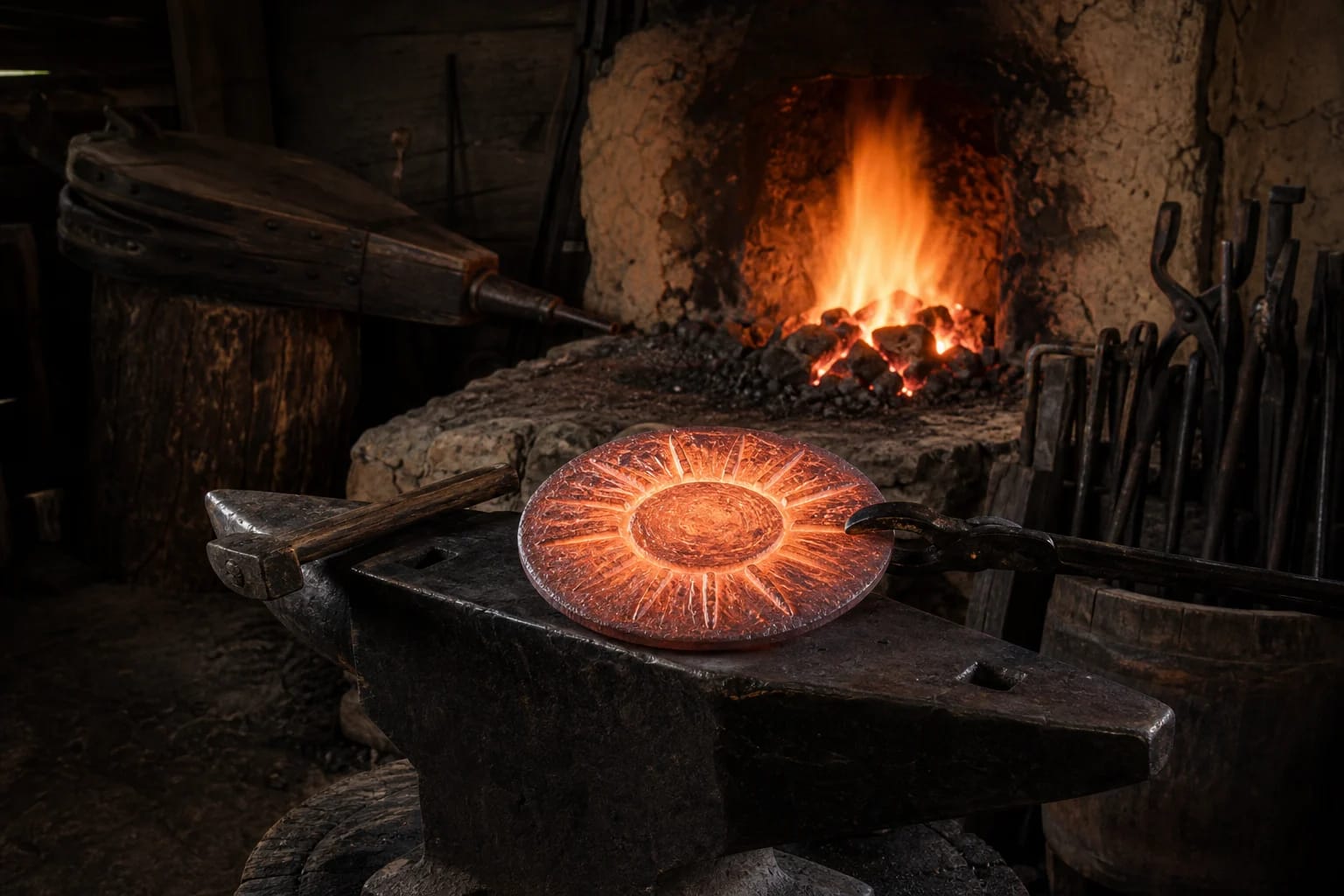
The image joins fire, metal, and heavenly light. In antiquity smithing was an almost supernatural craft, so it is natural that mythology makes the smith the one who creates the shining disk of the sky.
Teliavelis' name and functions
The name Teliavelis is explained in different ways. Aleksander Brückner said it meant a god of the road; Norbertas Vėlius connected it with an earth god; and Vladimir Toporov considered it a borrowing from Scandinavian mythology. There is no single agreed view.
Vėlius noted that Teliavelis' place in divine lists changes his function: when he is mentioned between Nunadievis and Diviriksas, meaning Perkūnas, he performs a magical function, while when he is mentioned after Perkūnas, he has an economic one. This suggests links with earth, the underworld, and magical creative power.
Teliavelis and the devil-smith
Some researchers connect Teliavelis with the Lithuanian folklore devil. In folklore, it was believed that devils first invented smithing and that humans learned it from them. In this way the divine smith draws close to the chthonic underworld.
This connection matters because it shows how an old smith god, after losing official cult status, may have moved into folklore and acquired traits of the devil. Teliavelis becomes a link between high mythology and later legends about the devil as smith.
Teliavelis today
Teliavelis is important as one of the few Lithuanian gods about whom not only a name but also a concrete myth has survived: the forging of the Sun. It is a rare case where an early source transmits a story, not just a divine name.
Teliavelis is best read together with Saulė, his creation, Nunadievis, the god named beside him, and the folklore devil-smith. Together they show the image of the divine smith from creator of a heavenly light to later underworld craftsman.