- Category
- Lost settlement histories
- Reading time
- 3 min.
- Sources
- Local history interpreted from cited sources
1447: an early reference in one historical account
The Curonian Spit National Park presents more than one account of Nagliai. Friedrich Mager's account includes a reference to an innkeeper dated 25 January 1447. It is a reference within that historical interpretation, not a foundation date unanimously established by every source.
Accounts presented side by side are not independently verified archaeological plans. They reveal how different authors connected documents, place names and surviving landscape traces.
1673–1728: an interval, not a single year
Adalbert Bezzenberger's account places the disappearance of Old Nagliai between 1673 and 1728. Elsewhere, the overview describes a lengthy movement of the settlement southwards. Replacing the interval with a single year would create false precision.
Old Nagliai and a later settlement with the same name need not mean the same group of homes. A historical map needs a period as well as a place name.
1779 and 1836: a school and another departure
Bezzenberger's account associates 1779 with a school and 1836 with the beginning of another departure. These points reveal a history that the phrase “buried by sand” would conceal.
A school indicates community life at a particular time. The beginning of relocation describes a process: families need not have left together or chosen the same destination.
1846 or 1854: retaining the disagreement
The park's historical account states that the village was gone in 1846, but also mentions an alternative report of three families remaining in 1854. This timeline does not merge them into one supposedly exact end date.
The end of a settlement as a whole and the survival of individual households could be different criteria. Without further documents, however, that remains a way to interpret the discrepancy rather than a proven resolution.
Mapping a village that moved
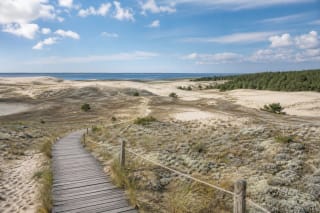
One map pin cannot precisely represent centuries of relocation. A timeline with periods, descriptions and sources is more useful. Today's Nagliai reserve trail provides a place to visit; it does not establish the coordinates of every earlier home.