- Category
- Practical craft lessons
- Reading time
- 7 min.
- Sources
- Source-based lesson with original teaching diagrams
Open a specific museum record
Use the National Museum of Lithuania’s public record for a woman’s bodice. Open it through the source link and keep a blank sheet beside you. First confirm that you are reading the institution’s page rather than a social-media copy. The exercise teaches accurate transcription, separation of historical layers and recognition of what the museum does not state.
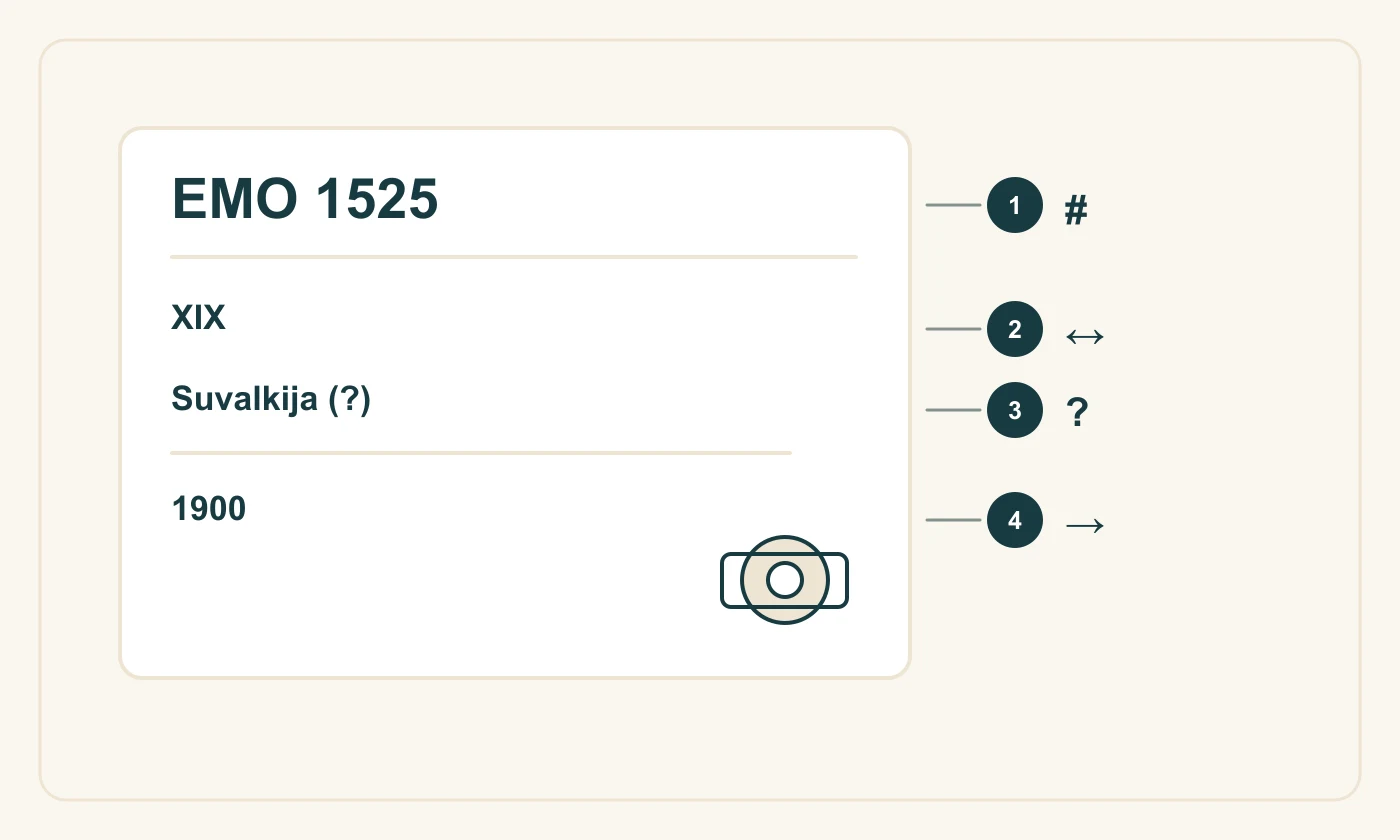
Create separate areas for the object, its history, the source and the image. Avoid copying everything into one paragraph: dates may concern manufacture, acquisition, exhibition, photography or publication. Our label diagram is original and does not reproduce the museum website’s design. It organises information; factual verification takes place in the actual record.
In the diagram, 1 marks identification, 2 dating, 3 place with its question mark and 4 an event in the object’s history. The camera symbol reminds you of separate photographic authorship. Suvalkija (?) retains the original source spelling for comparison.
The inventory number anchors your search
The museum gives the inventory number EMO 1525. Copy its letters and digits accurately and add the institution’s name. The generic title “woman’s bodice” cannot distinguish it from many other objects. Number and institution together let you check that the catalogue, photograph and your notes refer to the same thing.
Next distinguish the maker field from the photographer field. If the maker is unknown, retain that status. A photographer’s name tells you nothing about who sewed the garment. As a self-check, ask whether someone could mistake the photographer for the historic maker in your caption. If so, rewrite it more clearly.
Date and place: preserve the limits of precision
The creation date is given as the 19th century and the location as Suvalkija (?). Preserve the question mark: it is part of the museum’s information. Do not turn it into a confirmed village of origin. A century is also not a single year; colour or a more appealing story cannot justify narrowing the date.
Write two versions of a sentence, one preserving uncertainty and one silently removing it. Compare the certainty each promises the reader. Keep the first and note what additional document would be needed to support the second. This exercise reveals accidental “precision” often introduced when labels are shortened.
An object’s journey is not its place of manufacture
The record links the bodice to the Lithuanian Scientific Society collection and states that it appeared at the 1900 World Exhibition in Paris. These are distinct historical facts. Exhibition in Paris does not make it French, and collection membership does not identify its wearer. Place such facts in a provenance record as separate confirmed points, not a complete biography.
Draw a simple timeline containing only known events. Leave gaps between them. Do not invent sale, donation or travel circumstances to make the story continuous. Beside an unanswered question, note a possible research route: collection catalogue, transfer document, exhibition list or clarification from museum staff.
Separate material, image and reuse rights
The museum separates materials and techniques from dimensions and photographic credit. Keep that distinction: visible colour does not replace a material identification, and screen size does not replace object dimensions. If only one measurement is given, do not use it to calculate an exact cutting pattern; perspective and garment positioning may mislead.
Finish with an exact link and access date, object number, preserved uncertainty of date and place, and one open question. Check image-reuse rights separately; an old object and a recent photograph are not the same rights subject. Your record succeeds when another reader can return to the source and distinguish its data from your conclusions.