- Category
- Practical craft lessons
- Reading time
- 7 min.
- Sources
- Source-based lesson with original teaching diagrams
Record features before guessing
Choose a museum photograph or an object its owner allows you to examine. First record visible shape, material, handle, holes, grooves, moving joints and scale. Do not force an old object or try to make it run. Study museum exhibits through available images; only a working teaching example is suitable for mechanism demonstrations.
Keep three fields: feature, possible function and confirming source. A cavity is a feature; the claim that it held a yarn bobbin is a functional hypothesis. This prevents your first association with a kitchen implement, toy or ornament from becoming a fact. Wood colour and an aged-looking surface do not reliably establish function or date.
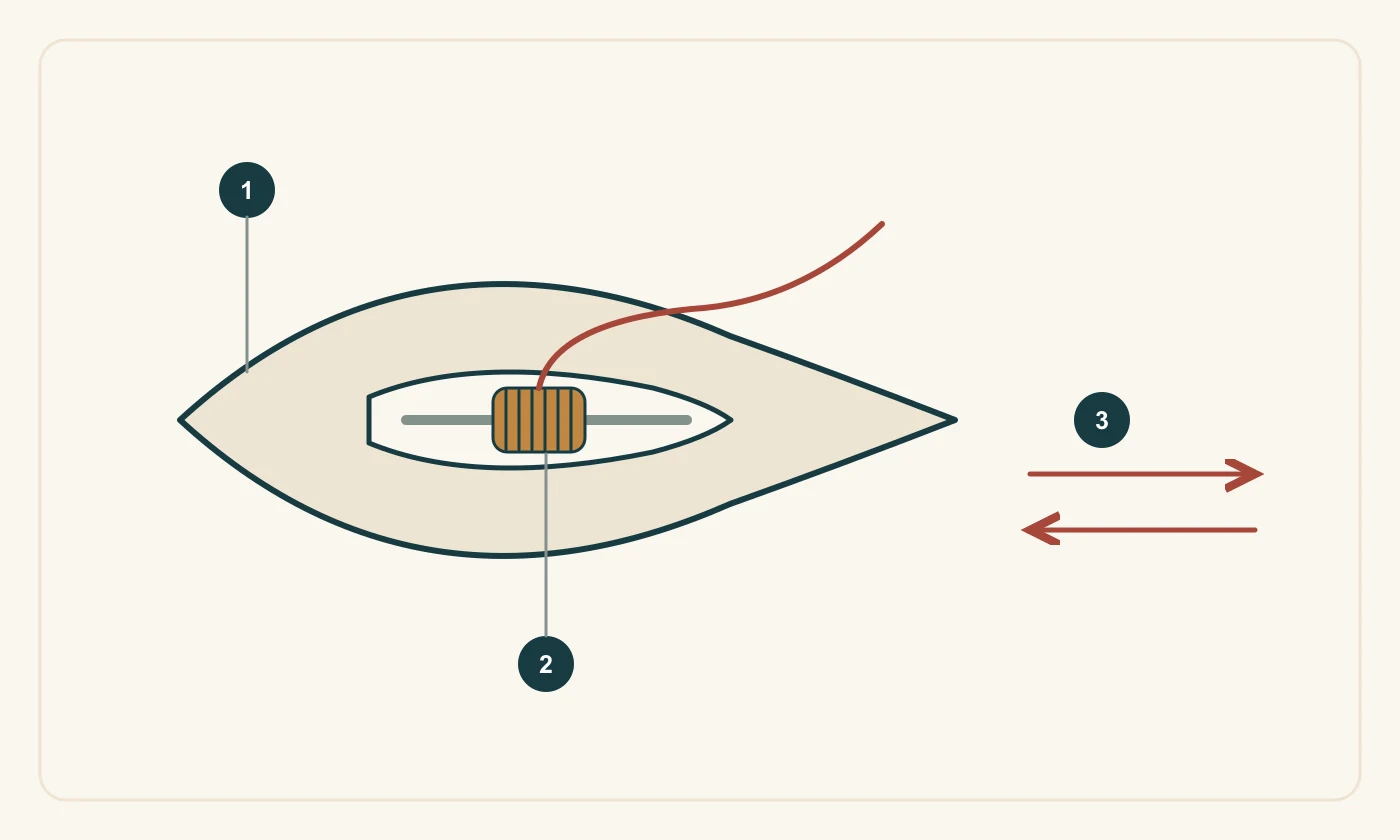
The diagram uses a generic boat-shuttle model: 1 marks the outline, 2 the bobbin recess and 3 back-and-forth travel. It is our functional explanation without scale, not a documentary image of a particular museum object.
Locate the part that did the work
Consider where the object contacted cloth, yarn, food or another tool. A broad surface, ridged underside, pointed ends and internal paddle perform different work. The ARS teaching resource describes loom temples with end pins holding cloth to width. Their ends and adjustable structure explain their action, rather than surface ornament.
Interpret wear cautiously. Polish may result from use, later cleaning or restoration; a photograph often cannot distinguish these. Write “the surface appears smoother here” if that is all you can observe. Tie a proposed use to museum data, a documented comparable mechanism or a reliable process demonstration.
Compare similar outlines
A boat shuttle has space for a bobbin and carries weft through the shed. Another elongated object with a handle might resemble it from a distance yet work completely differently. Look for its recess, yarn path and end shape. If the photograph shows only the top, list side and underside views as missing evidence.
For laundry and cloth-smoothing tools, the complete set matters. The ARS account describes rolling with a round roller and a ridged board. A lone component may be misnamed after a modern kitchen tool. Record whether the description concerns a single object or a pair, and what the other element contributed to the work.
Identify the movement
Examine a churn as both vessel and mechanism. Vacys Milius’s account in the Encyclopedia of Lithuania Minor distinguishes dasher-operated and rotary constructions. For the former, look for a lid opening and dasher; for the latter, a crank and associated internal mechanism. A tall wooden container alone is insufficient identification.
Draw a movement arrow: back and forth, up and down, rotation or stationary holding. It must relate to a visible component or documented function. If evidence is lacking, use a dotted arrow and mark it as a hypothesis. Do not invent missing components to make the object fit your preferred name.
Write a verifiable conclusion
A good conclusion contains a name, two supporting construction features, a source and a remaining question. If the object differs from the comparison, state how: missing cavity, different working surface or incompatible scale. Identification is not a race to recall an old word. Sometimes the best result is several candidates and a clear way to distinguish them.
Add the source link and available identifying data. Do not invent a maker, village or date from decoration. For a family object, keep the owner’s account separate from visible observations and label it as testimony. Your record will then remain useful to another researcher with more comparative material.