- Place
- Šilutė District Municipality
- Region
- Nemunas Delta Regional Park
- Type
- interpretive trail through a wetland-settler landscape in the Nemunas Delta
- Address
- Žalgiriai village, off road 206 (Šilutė-Rusnė), Šilutė District
- Coordinates
- 55.31497, 21.43418
Žalgiriai Forest Trail, Bismarck Colony site
Žalgiriai Interpretive Trail in the Nemunas Delta - a trail through a wetland-settler landscape
Žalgiriai Interpretive Trail is in Nemunas Delta Regional Park, by road 206 (Šilutė-Rusnė), about 5 km southwest of Šilutė. Turning off the road toward Žalgiriai village, you reach a parking area with the trail sign, so this is a real, marked park route.
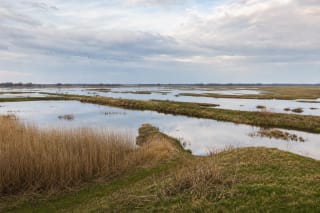
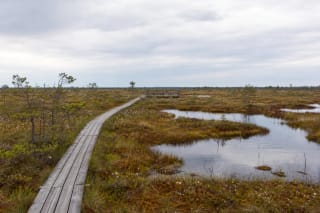
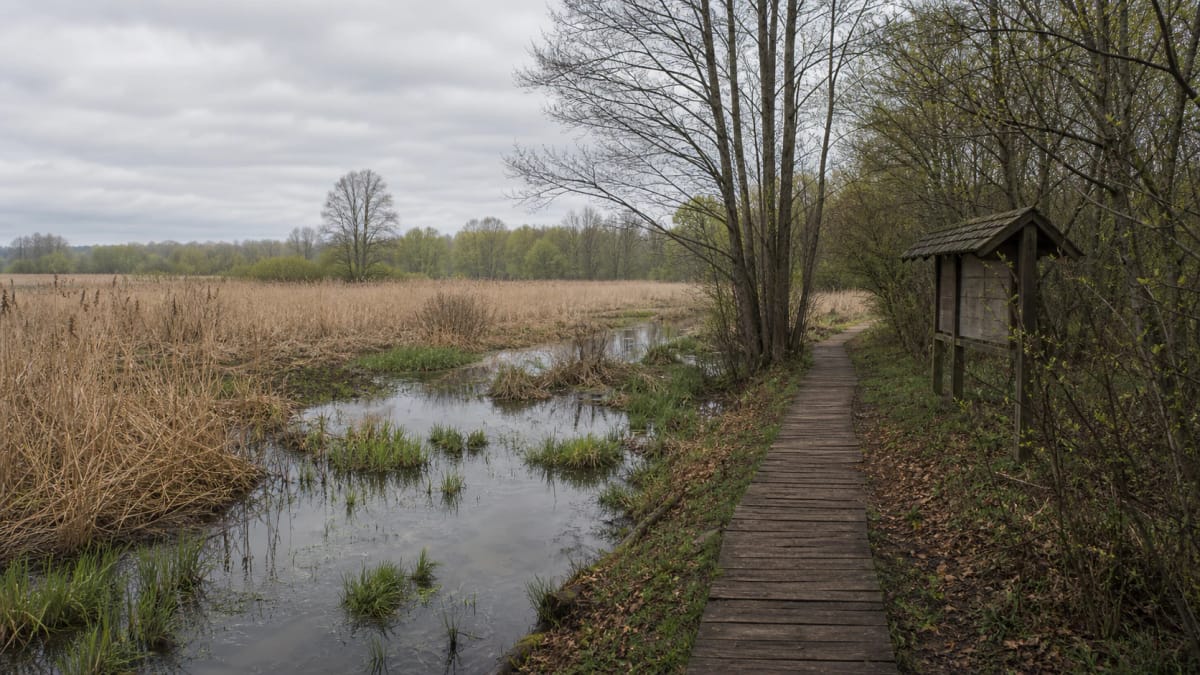
It is not a hilly viewpoint route, but a low Pamarys landscape shaped by water and forest. The roughly 1.8 km linear trail follows an old embankment through Žalgiriai Forest toward the Rupkalviai bog - where a wetland-settler colony spread out in the nineteenth century.
The Rupkalviai bog, Bismarck Colony, and wetland settlers
In the first half of the nineteenth century, people began settling the Rupkalviai bog. They drained it and grew potatoes in the fertile peat; in the second half of the century the so-called Bismarck Colony was founded here. Roads were built, schools were established, and the number of wetland settlers reached about 1,700.
The trail's embankment is in fact a road raised across the bog in the German era. This place is therefore not just a forest trail: its meaning appears when, while walking, you remember that floods and drainage work changed not only nature but also people's daily lives, the layout of homesteads, and the local economy.
Hermann Sudermann and 'The Excursion to Tilsit'
The region is linked with the German writer Hermann Sudermann (1857-1928), born in Macikai (Matzicken) near Šilutė. The Pamarys and its wetland settlers echo through his Lithuanian Stories, and in Žalgiriai Forest the Nemunas Delta park protects a natural-heritage object - the centenarian Sudermann oak.
One of his stories, 'The Excursion to Tilsit', became the basis for F. W. Murnau's film 'Sunrise' (1927), which won three Academy Awards at the very first Oscars. In this way a modest wetland-settler region also found its way into world cinema history.
Nemunas Delta Regional Park: floods and birds
Žalgiriai Trail lies in Nemunas Delta Regional Park - a protected area of about 29,013 ha established in 1997 that includes the Nemunas Delta with Ventė Cape, Rusnė Island, and large bogs, among them the 3,410 ha Rupkalviai bog. Since 1993 the Nemunas Delta has been protected as a wetland of international importance under the Ramsar Convention.
It is one of Lithuania's most important bird-migration and flood landscapes: more than 300 bird species have been recorded in the park. In spring, and sometimes in autumn or winter, most of the park is covered by floodwater, so around Žalgiriai it is worth watching not only the trail underfoot but also water marks, reedbeds, and bird sounds.
How to reach the trail and visiting safely
The trail is reached via road 206 from Šilutė toward Rusnė; at the relevant turn you head toward Žalgiriai village, where there is space to park. Because this is a low, flood-prone landscape, it is worth checking road and flood conditions before going and wearing waterproof footwear.
The trail is best for a quiet reading of nature and cultural landscape, not for a sports hike. When walking independently, leave no litter, do not disturb birds, and follow protected-area rules; for a deeper story about the wetland settlers, look for a regional-park guide or programmes.
What to combine with Žalgiriai Trail
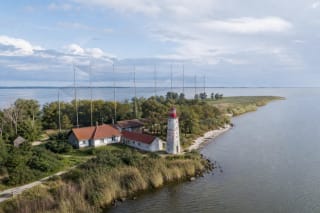
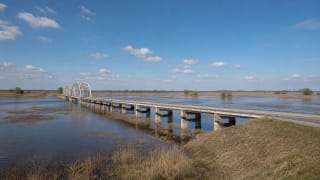
Žalgiriai Trail is easy to combine with other Nemunas Delta places: Aukštumala Raised Bog, Ventė Cape with its bird-ringing station, the Rusnė bridge and viaduct, and the wider Nemunas Delta route.
This combination reveals several layers of the delta: the wetland-settler history at Žalgiriai, the wild raised bog at Aukštumala, bird migration at Ventė, and flood engineering by Rusnė. Together they show how water shaped life in the Pamarys of Lesser Lithuania.