- Place
- Šilutė District Municipality
- Region
- Šilutė District
- Type
- raised bog and educational trail in Nemunas Delta Regional Park
- Address
- Aukštumalos pažintinis takas, Šilutės r.
- Coordinates
- 55.39100, 21.35600
Aukštumala, Aukštumala educational trail
Aukštumala Raised Bog in the Pamarys region
Aukštumala is one of the best-known bogs of the Pamarys region. VLE describes it as a raised bog and peatland in Šilutė District, about 2 km north-west of Šilutė, and gives its area as 3,018 ha. VLE notes that the bog began forming more than 9,000 years ago, that the peat layer reaches up to 9 m in places, and that its surface consists of two open raised-bog plains, 5-6 m in relative height, with more than 380 secondary bog pools.
For visitors, the whole bog massif is less relevant than the Aukštumala educational trail in Nemunas Delta Regional Park. Saugoma.lt gives the trail location at coordinates 55.391, 21.356.
Aukštumala trail along an old kūlgrinda
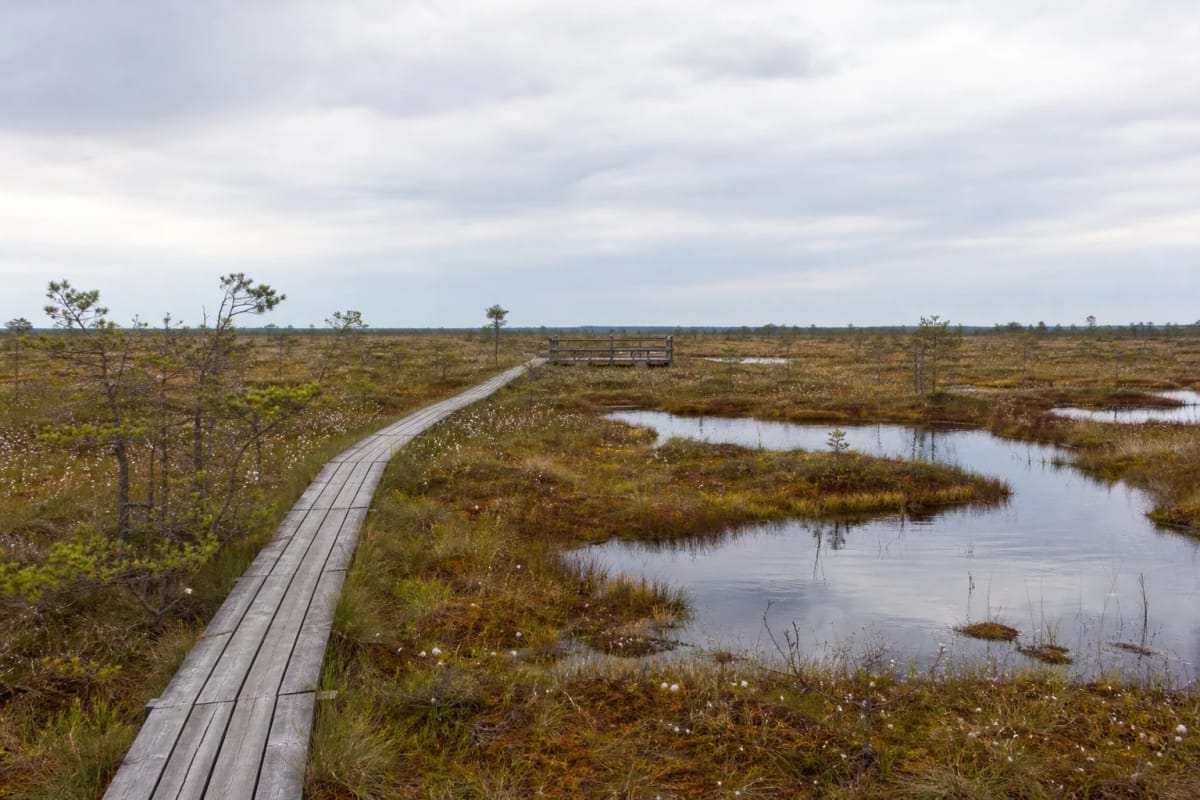
Saugoma.lt states that the educational trail follows an old kūlgrinda, a historic route across the bog. That detail matters: when walking the boardwalk, the visitor is not moving along a random modern line but through a place where people once searched for a safe crossing through wetland.
After reconstruction, the trail is most often described as about 1.2 km one way. Because the route is linear, you also need to plan the return along the same path.
Bog pools, sphagnum, and the raised-bog surface
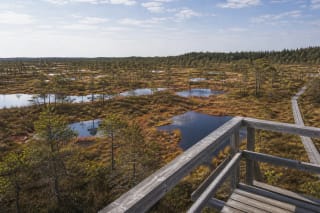
VLE writes that Aukštumala has more than 380 bog pools and that the peat layer reaches up to 9 m in places. This helps explain why the bog surface feels like a separate world: sphagnum, dark pools, dwarf pines, and open areas change within a very short distance.
A raised bog is fed mainly by precipitation, so its plants are adapted to an acidic environment poor in nutrients. The landscape is restrained but highly distinctive: its beauty lies in small colours, water reflections, and the slow rhythm of the wetland.
Aukštumala as a classic site of bog science
Aukštumala matters not only to travellers. VLE notes that in 1898-1900 the German botanist Carl Albert Weber studied it comprehensively and in 1902 published the world's first book of peatland science about the vegetation and development of Aukštumala Raised Bog; a Lithuanian edition appeared in 2016. Aukštumala thus became one of Europe's classic raised-bog research sites.
This scientific layer makes Aukštumala different from many other nature trails. Here the subject is not only a beautiful walk but also how bogs became research objects, how their structure was understood, and why they need protection today.
Reserve and restoration
Saugoma.lt presents Aukštumalė as a telmological reserve protecting bog habitats and species. VLE states that the reserve was established in the less damaged western part of the bog in 1995, initially covering 1,017 ha and enlarged in 2014 to 1,285 ha; it is part of the Nemunas Delta, entered under the Ramsar Convention in 1993 and in the Natura 2000 network from 2004. Such areas are protected for the whole bog system: water regime, sphagnum cover, bog pools, and rare species.
VLE also mentions the bog's wounds and their treatment. Drainage of Aukštumala's edges began in the late nineteenth century, and industrial peat extraction started in 1882 when the Šilutė merchant Otto Hoffmann founded a peat-litter company; in Soviet times about two thirds of the bog was prepared for exploitation. In 2011 the north-eastern part of the reserve was damaged by fire, burning 180 ha. Since 2013, bog-restoration work has stabilized the water regime and helped natural raised-bog processes return.
How to visit Aukštumala Raised Bog
Aukštumala is best visited slowly. Even if the trail is short, stop by the bog pools, look at the colours of sphagnum, compare the open bog with pines at the edge, and listen for birds.
You must stay on the trail. The bog surface is sensitive, and wetter places may look firmer than they really are. In summer, insect protection and water are useful; after rain, choose footwear you do not mind getting wet.