- Place
- Marijampolė Municipality
- Region
- Suvalkija
- Type
- 2.7821 ha historic urban park with the Jevonis stream, a fountain, three memorials, a play area, and roots reaching into the 19th century
- Address
- 26 P. Kriaučiūno Street, Marijampolė
- Coordinates
- 54.55284, 23.34573
Marijampolės Vytauto Didžiojo parkas, Vytauto Didžiojo parkas, Marijampolė City Garden, Miesto sodnas
The 2.7821 ha park has distinct formal and recreational halves
The park fills a central block bounded by Vytauto, Sodo, P. Armino, Šv. Margaritos, and P. Kriaučiūno streets. Its Google Maps address, 26 P. Kriaučiūno Street, and coordinates 54.5528396, 23.3457346 mark the listing, but entrances open from every surrounding street. The municipal green-space inventory gives an exact area of 2.7821 ha, making the whole park manageable within one short city walk.
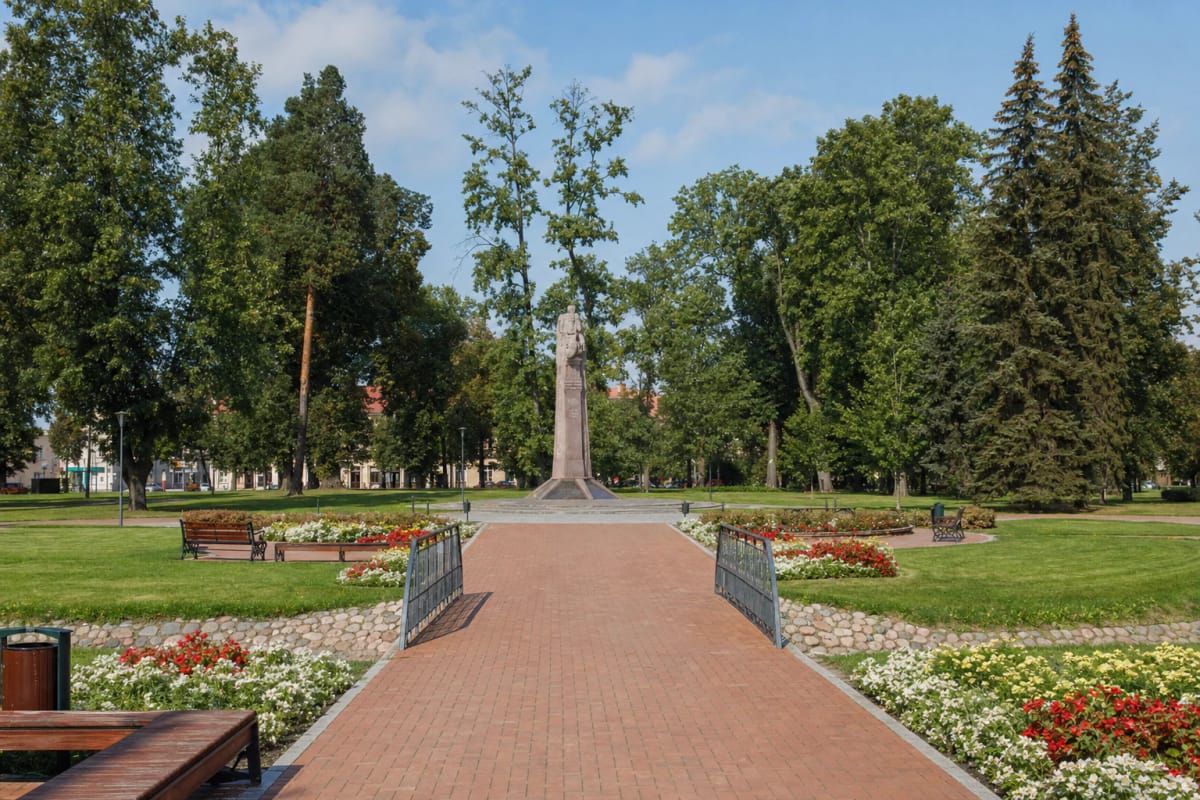
The 2012 reconstruction deliberately organised the space into two contrasting zones. Memorials and flower beds occupy straight axes in the formal section, while the western recreational half has looser paths, more lawn, rest space, and children's activities. Decorative features at the approaches mark the sites of former park gates; they are not surviving original gates.
This is neither a large natural park nor a hiking route. Its value becomes apparent by reading the memorials slowly, crossing the small bridge, watching the fountain, and comparing the geometric ceremonial composition with the quieter western half. For a longer walk, connect it with Poetry Park and the banks of the Jevonis and Šešupė.
The park has several founding dates because the City Garden developed in stages
Marijampolė Municipality dates the beginning of the City Garden to 1868. The Petras Kriaučiūnas Public Library's archival synthesis provides the wider context: after a major fire devastated Marijampolė in 1869, a regulation plan expanded the town by 40 morgens, or 28.4 ha, and reserved a park on its southern edge. The dates need not conflict if 1868 denotes the initiative and the later years the planning and construction phases.
The site was an unlikely choice for a formal garden. It was wet and marshy, the Jevonis crossed it, and a pond is recorded here in 1810-1812. A 1930 newspaper repeated a story about an unnamed Russian official who supposedly devoted his life to planting the marsh, but this is a period account rather than documentary proof of a single founder. More securely, a classically ordered, geometric town park took shape around 1875-1890.
During the 1920s the garden was improved and fenced, becoming a meeting place for different generations of townspeople. It received the name of Vytautas the Great in 1930, the year Lithuania commemorated the 500th anniversary of the ruler's death. The present name is therefore an interwar layer of memory, while the green space itself is more than half a century older.
Petras Rimša designed a bridge in 1935 that Soviet remodelling destroyed
Sculptor Petras Rimša designed and built an ornate bridge over the Jevonis in 1935. Archival photographs show an expressive piece of park architecture rather than a merely utilitarian path crossing; the municipality's English history also attributes formal gates bearing a relief of Vytautas the Great to Rimša. The bridge stood for about 45 years.
It was demolished in 1980 when a monument to Vincas Mickevičius-Kapsukas was installed, and the Jevonis channel through the park was enclosed in underground pipes. Sculptor Julius Narušis created that monument. The Soviet work was removed in 1990, yet the stream remained underground for more than another two decades, demonstrating that removing a political marker did not automatically restore the earlier landscape.
The 2012 reconstruction returned only a stretch of several dozen metres to the surface and built a new bridge. It recalls a lost element but is neither Petras Rimša's surviving work nor a faithful reconstruction. That distinction matters when comparing the park with old photographs: the bridge idea and the stream's location returned, not the material and form created in 1935.
Three memorials interpret different layers of Lithuania's 20th-century memory
Architect Zenonas Galadauskas designed the Chapel of Suffering in 1999. It commemorates victims of Soviet genocide, imprisonment, and deportation, so it should not be mistaken for a parish church serving regular liturgy. Commemorations including the Day of Mourning and Hope take place beside it and may temporarily occupy the surrounding space.
The memorial to Tauro partisan district fighters, supporters, and couriers followed in 2003. Sculptor Alfonsas Ambraziūnas and architect A. Lukoševičius shaped a leaning, stylised Cross of Vytis that repeats across the base like a cast shadow. The Tauro district was founded at Skardupiai on 15 August 1945 and operated across the counties of Marijampolė, Šakiai, Vilkaviškis, and Kaunas, giving this regional memorial a direct geographical context.
The granite monument to Vytautas the Great was unveiled on 22 May 2010 after an initiative begun by Marijampolė's Vytautas Club in 2003. Sculptor Julius Narušis represented the ruler on horseback in a composition approximately 9 m high including its pedestal. The same artist had created the Kapsukas monument removed in 1990, so works by one sculptor mark two radically different eras of political memory in this single park.
The 2012 reconstruction restored water and strengthened the park's everyday role
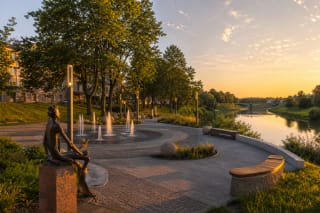
The project renewed the tree stock, removed low-value growth, laid new paths, and added lighting, a fountain, benches, and a children's playground. Flower beds arranged around motifs of Suvalkija cultural heritage and straight red-paved axes give the formal half a pronounced civic character, while the exposed Jevonis provides a small element of natural water.
The fountain is seasonal, so visitors should not expect it to run in late autumn or winter. Flower displays likewise change through the year, with blossoming trees adding colour in spring. Mature canopies, lighting, and open lawns allow the space to work on a hot day or in the evening, although the ground beside the stream may be damper after heavy rain.
In 2024 the municipality installed interactive game tables for one or two players in Vytautas the Great and Pašešupis parks. They supplement rather than redefine the place: its essential features remain the City Garden plan, the history of the Jevonis, and the memorial ensemble. Check outdoor equipment on arrival because maintenance or temporary faults can affect availability.
The park is free and open around the clock, with no timetable for its individual outdoor features
There is no admission charge, and Google Maps lists the park as open 24 hours. It is a public outdoor space without a single ticket desk, closing gate, or guided-tour start time. On 13 July 2026, the Google entry Marijampole Vytautas the Great Park had 916 reviews averaging 4.8 out of 5. Ratings and review totals change over time.
The main paved paths are broad and most of the central terrain is level, making the park practical for pushchairs and many mobility aids. Bridge approaches, edge gradients, moisture, and seasonal path conditions can still vary, so it would be misleading to describe every corner as universally accessible without qualification. The official park description lists no dedicated visitor toilet or cafe; plan those services elsewhere in the city centre.
Driving directions lead towards P. Kriaučiūno Street, but the park has no single car park reserved for visitors. Park only where street signs permit and avoid blocking residents' access; spaces can be scarce during commemorations. Because the centre is compact, walking here from Marijampolė Regional Museum, the basilica, or Poetry Park is often simpler.