- Place
- Vilnius City Municipality
- Region
- Vilnius
- Type
- late Baroque twin-towered church with former monastery ensemble
- Address
- Subačiaus g. 26, Vilnius
- Coordinates
- 54.67680, 25.29610
Missionaries Church, Church of the Ascension of the Lord, Church on Saviour Hill
A landmark in the Vilnius skyline
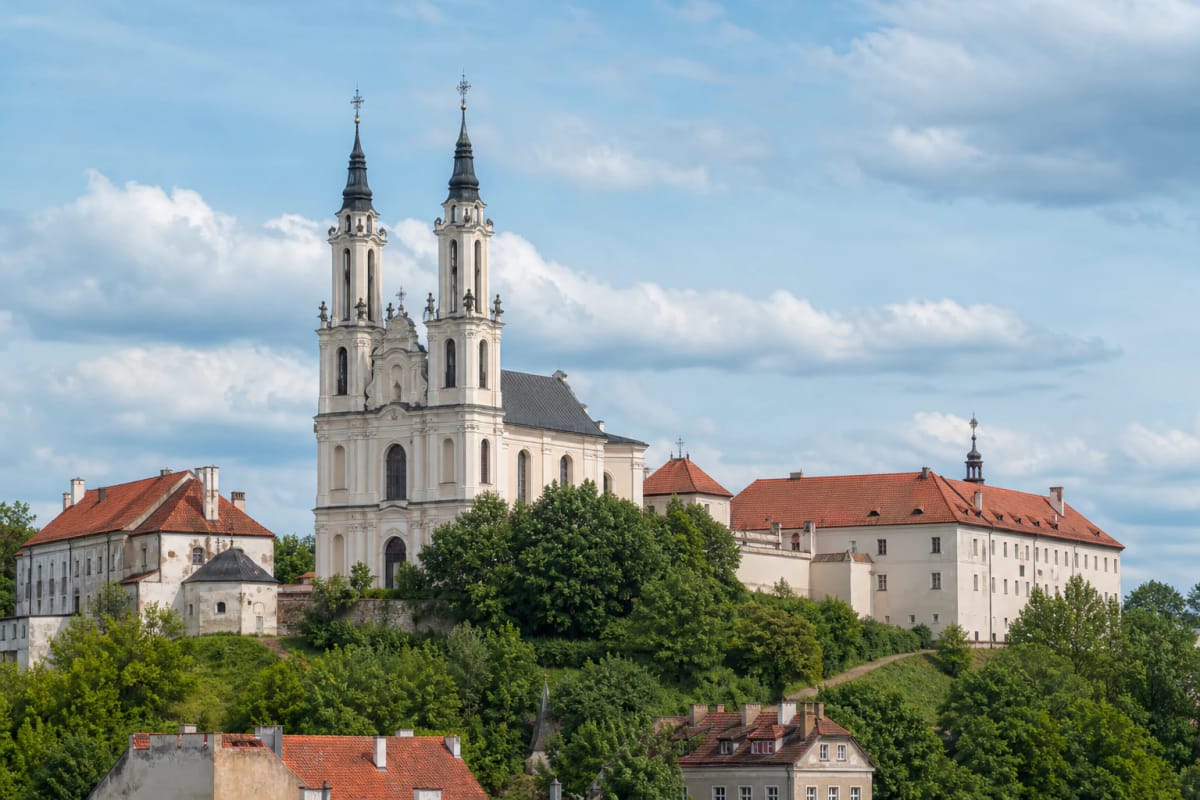
The Missionaries Church stands on the hill known as Saviour Hill, above Subačiaus Street on the southeastern edge of Vilnius Old Town, near the former defensive wall. Its two slender upward-reaching towers are among the most recognizable accents of the old-town panorama, especially when seen from Užupis and surrounding hills.
The church's exact title is the Church of the Ascension of the Lord, so it is naturally linked with Ascension Day. Do not confuse it with the Church of the Lord Jesus of the Trinitarians in Antakalnis, which is a different building. The Missionaries name comes from the religious community that owned it: the Missionaries, or Congregation of the Mission, also known as Vincentians.
Construction and Glaubicas's towers
The Missionaries were invited to Vilnius in 1685 and settled in 1687 in the donated Sanguška Palace in the Subačius suburb. The church was built in 1695-1730. Work lasted about three decades because of lack of funds, the 1706 city fire, the Swedish incursion of 1708, and the plague of 1709-1710. The construction was funded by Jonas Teofilis Plater and his wife Aleksandra, and a Latin memorial plaque to the founder survives on the south porch facade.
The church took on its present Baroque form in 1749-1757, when architect Jonas Kristupas Glaubicas raised the towers and designed the gables; the domed porch was created in 1755-1756. Glaubicas was the most important architect of the Vilnius Baroque school, so the church is considered one of that school's late high points. Other names sometimes mentioned in connection with the building, such as P. Perti, are not connected with this church by the heritage register.
Monastery, seminary, and prison
The Missionaries monastery was an important city institution. A poorhouse was established there in 1745; in 1788-1791, a children's home; in 1773-1844, the Vilnius diocesan seminary; in 1799-1832, a printing house; and in 1810, an institute for the deaf and mute. The future architect Laurynas Gucevičius studied at the seminary in 1773-1775 and taught mathematics there in 1775.
In 1831-1839, part of the monastery was turned into a prison for participants in the 1830-1831 uprising. In 1844 the tsarist authorities closed the church and monastery; the church was returned to believers in 1859, while later the monastery buildings housed a military hospital, Orthodox consistory, nobles' institute, and psychiatric hospital.
What to see today
The church is a twin-towered basilican, three-aisled building, with a porch on the south side and a semicircular presbytery apse; cellars with a columbarium run beneath the whole building. The main facade has four-tier towers, ornamental crosses and vases, and between the towers two sculptures about 220 cm high: King David and the prophet Moses. The clock in the eastern tower has an old eighteenth-century mechanism. The Cultural Heritage Register evaluates the church's architectural value as unique.
In recent years the Vilnius Archdiocese carried out major conservation and repair works on the church and monastery, restoring facade colours and towers. Plans have included pilgrim accommodation in the monastery and use of the church as a concert and event space. Because of this transitional state, the interior is not always accessible, so the exterior and panorama are the main reliable visit.
How to visit
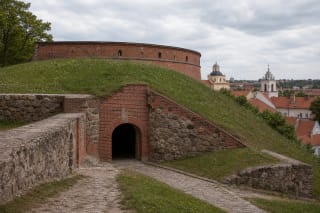
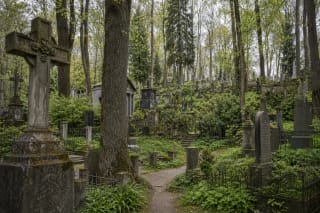
The Missionaries Church fits naturally into a route through the southeastern part of the old town, together with Rasos Cemetery, the defensive-wall bastion, and Užupis. For the exterior and panorama, 30-45 minutes is usually enough: walk around the church, look at it from Subačiaus Street, and view it from nearby hills.
Because the church and monastery have been undergoing renewal and a change of use, there may be no stable public visiting schedule. If you want to enter, check the current information on the official Vilnius Archdiocese page before going.