- Place
- Nida area, Neringa Municipality
- Region
- Curonian Spit
- Type
- dune and historic gliding site
- Coordinates
- 55.28170, 20.97940
Great Dune, Sklandytojų kopa
Gliders' Dune in Nida: why this dune matters
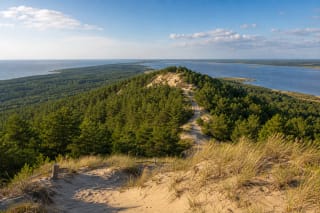
Gliders' Dune is one of the Curonian Spit places where natural landscape and twentieth-century history meet very directly. Encyclopedic sources often also call it the Great Dune: it is a dune in the great ridge of drifting dunes at Grobštas Cape, south of Nida, near the Curonian Lagoon shore.
For a long time this was the highest dune on the Curonian Spit. VLE states that in 1938 its height was about 68 m, according to other data 70 m; in 1984 it was 60.5 m, and at the beginning of the twenty-first century about 50 m. These figures show that a drifting dune is not a fixed hill: wind, visiting, and protection regimes all change it.
Gliders' Dune and the Nida Gliding School
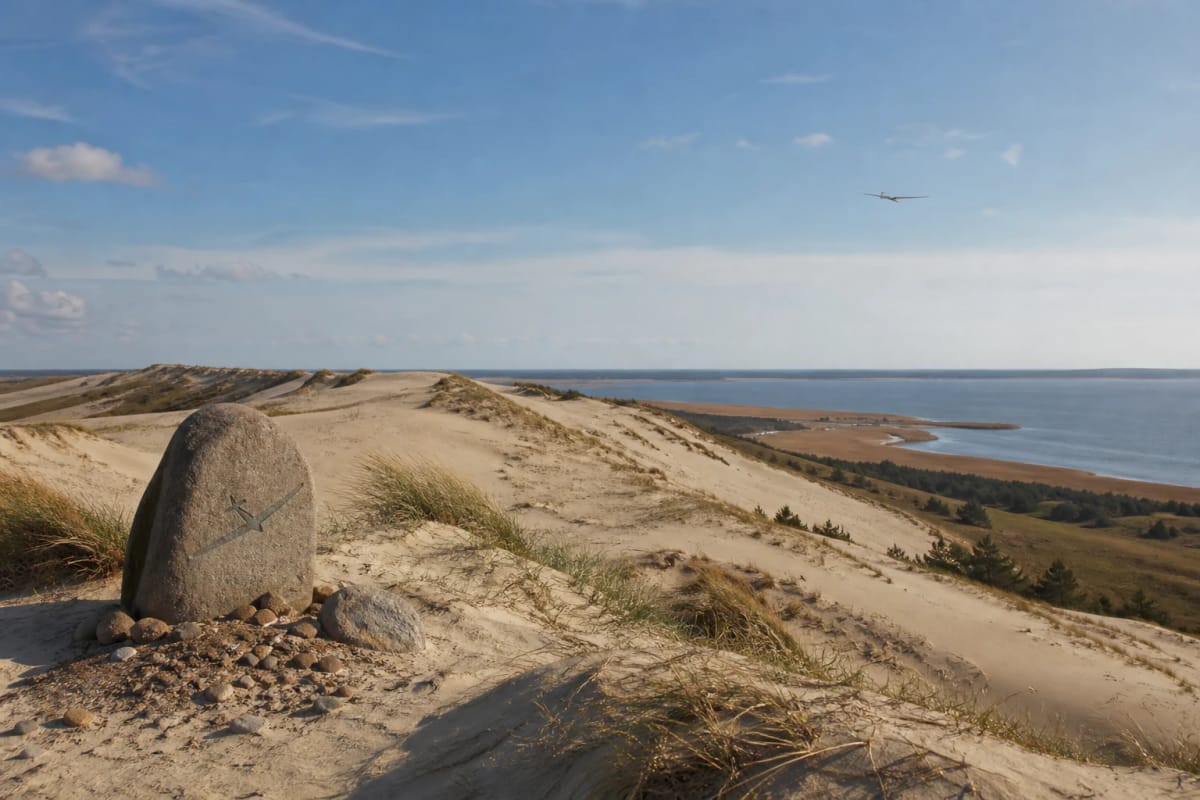
The name Gliders' Dune is not accidental. The gliding school founded in Pažaislis in 1932 moved to Nida in 1933, and the Nida dunes became the Lithuanian Aero Club's summer gliding camp. The school operated until 1939 and remains one of the clearest interwar Lithuanian aviation episodes on the coast.
The dune and sea-wind conditions gave gliders a natural training space. For that reason the place has two memories: one of landscape shaped by sand and wind, and another of people who learned to read that wind for flight.
Gliders' Dune, the Great Dune, and the border context
Gliders' Dune lies in the southern Curonian Spit landscape, where the area approaches the border between Lithuania and the Kaliningrad Region of the Russian Federation. VLE states clearly that the Lithuania-Russia border crosses Gliders' Dune and that the part in Lithuania belongs to Grobštas Nature Reserve of Curonian Spit National Park. When visiting, follow not only park rules but also border-regime signs.
That matters for practical planning: not every open dune visible from Nida or Parnidis is meant for free walking. Strict nature-reserve boundaries and border rules combine here, so the dune itself is not a freely accessible attraction.
How to visit Gliders' Dune responsibly
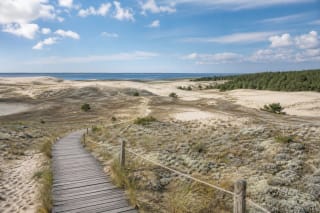
The best way to understand Gliders' Dune is through official Neringa routes connected with traces of the Nida Gliding School. They explain the historical context without leading visitors into places where access is restricted. If you see prohibition signs, dune slopes, or unmarked sand tracks, avoid them.
For photography, do not look for the shortest route over sand. The history of Gliders' Dune is a reminder that wind and people act strongly here: footprints, slope erosion, and careless movement all contribute to the loss of relief.
What to see near Gliders' Dune
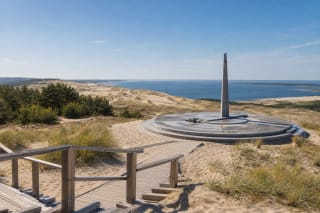
If this is your first visit to Nida, combine the Gliders' Dune theme with Parnidis Dune, the Sundial, and the memorial stone of the Nida Gliding School. That route lets you see both landscape and history.
For travellers who want more nature, add the Nagliai Nature Reserve trail or Vecekrugas Dune. Then the comparison of dune types becomes clearer: open southern dune, regulated reserve trail, and high forested dune.