- Place
- Kaunas City Municipality
- Region
- Kaunas
- Type
- interwar university medical-science palace and active LSMU central building
- Address
- A. Mickevičiaus g. 9, Kaunas
- Coordinates
- 54.89424, 23.91673
VDU Medical Faculty Palace, Former VDU Medical Faculty Palace, LSMU central building, Medical Academy Central Palace, Lithuanian University of Health Sciences at A. Mickevičiaus g. 9
Medical science palace at the edge of Naujamiestis
The Vytautas Magnus University Medical Faculty Palace stands at A. Mickevičiaus g. 9, between Naujamiestis streets and the slope toward the Nemunas. Today OSM and official LSMU contacts connect this address with the Lithuanian University of Health Sciences, and the building works as the central palace of the Medical Academy.
In the Cultural Heritage Register the building's unique code is 15970. It is listed as a registered, regional-significance single immovable cultural heritage object. KVR identifies architectural, engineering, and historical values, and names architect Vladimiras Dubeneckis as the project author.
From the old anatomy building to European-level conditions
KVR's historical description links the origins of the Medical Faculty with the Medical Department of the Lithuanian Higher Courses in 1920. When the University of Lithuania opened on February 16, 1922, physician Petras Avižonis became the first dean of the Medical Faculty. In 1930 the university was given the name of Vytautas the Great.
AUTC explains that the new palace fundamentally changed earlier conditions. The anatomy building that had operated on this site was housed in neglected pre-war shelter premises, while the new palace was designed as a modern university teaching and research institution.
Dubeneckis: modernity and tradition
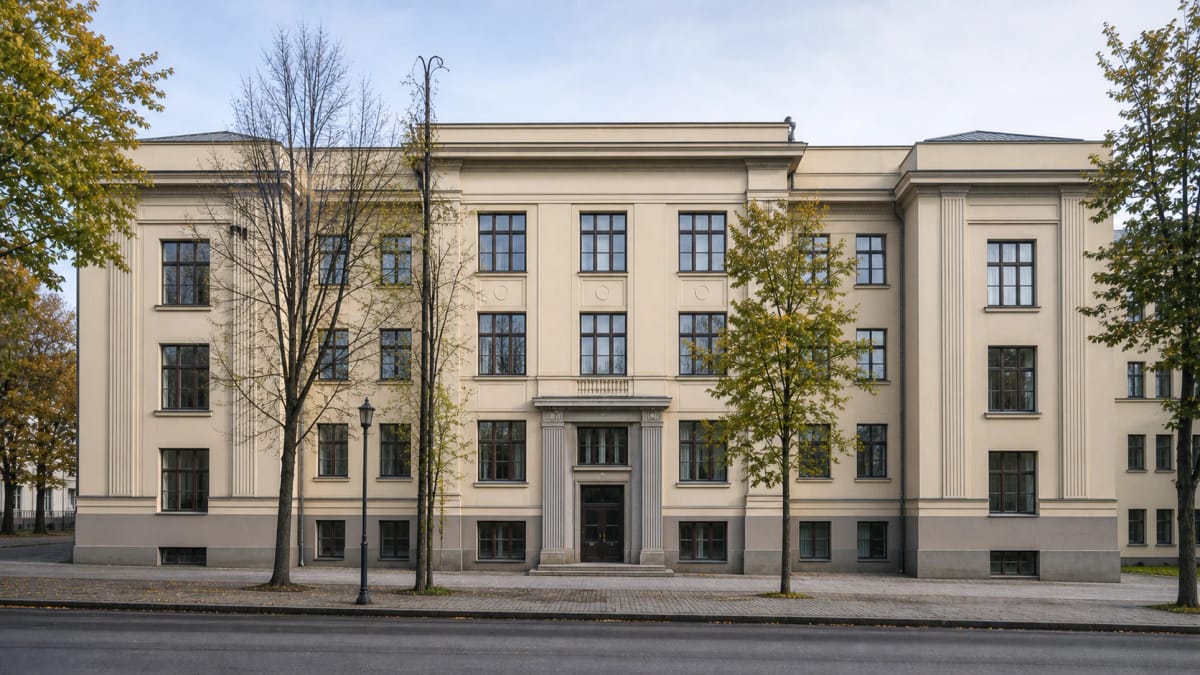
AUTC presents the VDU Medical Faculty Palace as an example of Vladimiras Dubeneckis's ability to combine tradition and modernity. The A. Mickevičiaus Street facade is symmetrical, monumental, and marked by simplified classicism: a central portal, side projections, and a clear window rhythm.
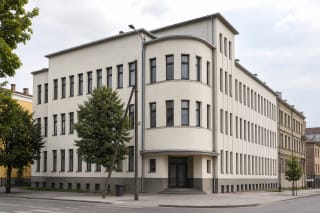
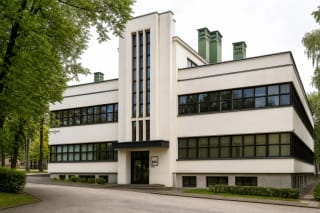
Yet the building is not only a representative mask. AUTC stresses that the Spaustuvininkų Street side is more modern, with a curved and extensively glazed projection. This dual language lets the building function both as an urban palace and as a rational scientific institution.
Construction in 1931-1933
AUTC states that the foundations and cornerstone of the Medical Faculty Palace were consecrated on July 3, 1931, and the new palace was consecrated on February 15, 1933. Construction took less than two years, but the programme was ambitious.
The period press quoted by AUTC compared the building with the medical faculty palace of the University of Brussels. The Kaunas palace was more modest and economical, but it was oriented toward practical convenience: laboratories, auditoriums, institutes, teaching, and research.
What worked in the palace
A 1933 description cited by AUTC states that one wing housed the institutes of anatomy, forensic and social medicine, general pathology, and pathological anatomy. The A. Mickevičiaus Street wing contained spaces for physiology, physiological chemistry, pharmacology, histology with embryology, and pharmacy with pharmacognosy.
KVR's valuable features still preserve the memory of these functions: laboratory fume hoods, laboratory tables, sinks, enamel plates with institute names, authentic handles, doors, and parquet, mosaic-concrete, and ceramic-tile flooring.
The first crematorium
One of the most unexpected layers of the building's history is the crematorium installed in 1936. KVR states that cremation of human remains was legalized in Lithuania in 1932, and four years later, on the initiative of VDU Anatomy Department professor Jurgis Žilinskas, the country's first and for a long time only crematorium began operating here.
KVR also explains its specific function: body parts of unidentified deceased people used for student teaching were cremated there, along with the remains of some known people. Two cast-iron doors at the former crematorium site are still listed among the valuable features.
Darius and Girėnas in the cellar
Another powerful story is connected with the remains of Steponas Darius and Stasys Girėnas. KVR states that on November 1, 1937, their remains were transferred to the mausoleum built on Vytauto prospektas, and in 1944, as the front approached Lithuania, the bodies were hidden in the cellars of the VDU Medical Faculty Palace.
In 1964 the remains of Darius and Girėnas were reburied in the military cemetery in Aukštieji Šančiai. The valuable-features description mentions a niche and metal grilles connected with this concealment, giving the palace not only a medical but also a state-memory layer.
From VDU to LSMU
KVR's description of later institutional development runs through the 1950 reorganization of Kaunas State University into the Kaunas Medical Institute and Kaunas Polytechnic Institute, later faculty changes, the Kaunas Medical Academy, Kaunas Medical University, and from 2010 the Lithuanian University of Health Sciences.
The official LSMU history emphasizes that the current university continues the traditions of Kaunas Medical University and the Lithuanian Veterinary Academy. For that reason the A. Mickevičiaus g. 9 building is not a shell of the past, but a medical-science administrative and academic address still in use.
UNESCO context
The UNESCO inscription for Kaunas modernism speaks about the city's 1919-1939 transformation in Naujamiestis and Žaliakalnis. The Medical Faculty Palace shows that transformation especially well through science infrastructure: the state created not only ministries, banks, and representative palaces, but a network of laboratories and auditoriums.
This building should be presented carefully. It is important to the Kaunas modernism context, but the page should not state that it has separate UNESCO status as an individual building. Its key value is the history of the interwar university medical system and Dubeneckis's architectural synthesis.
How to view it
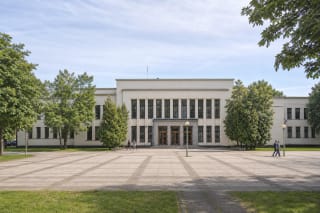
The building is still an active LSMU space, so tourist visits should focus on the exterior. From A. Mickevičiaus Street you can see the representative symmetrical facade, central portal, and side projections. From Spaustuvininkų Street, look for the more modern rounded volumes.
Interior access should be tied only to university business, an event, or an arranged visit. When photographing outside, avoid disturbing university work, and do not confuse this object with the Kaunas Clinics complex on Eivenių Street. They are two different medical-science addresses, though historically connected.