- Place
- Kaunas City Municipality
- Region
- Kaunas
- Type
- interwar university hospital complex and active LSMU hospital
- Address
- Eivenių g. 2, Kaunas
- Coordinates
- 54.91857, 23.92124
LSMU Kaunas Clinics, Vytautas Magnus University Clinics, University Clinics, Hospital of Lithuanian University of Health Sciences Kaunas Clinics, Kaunas Academic Clinics building complex
A city-sized university hospital
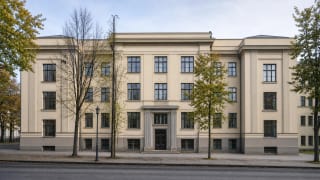
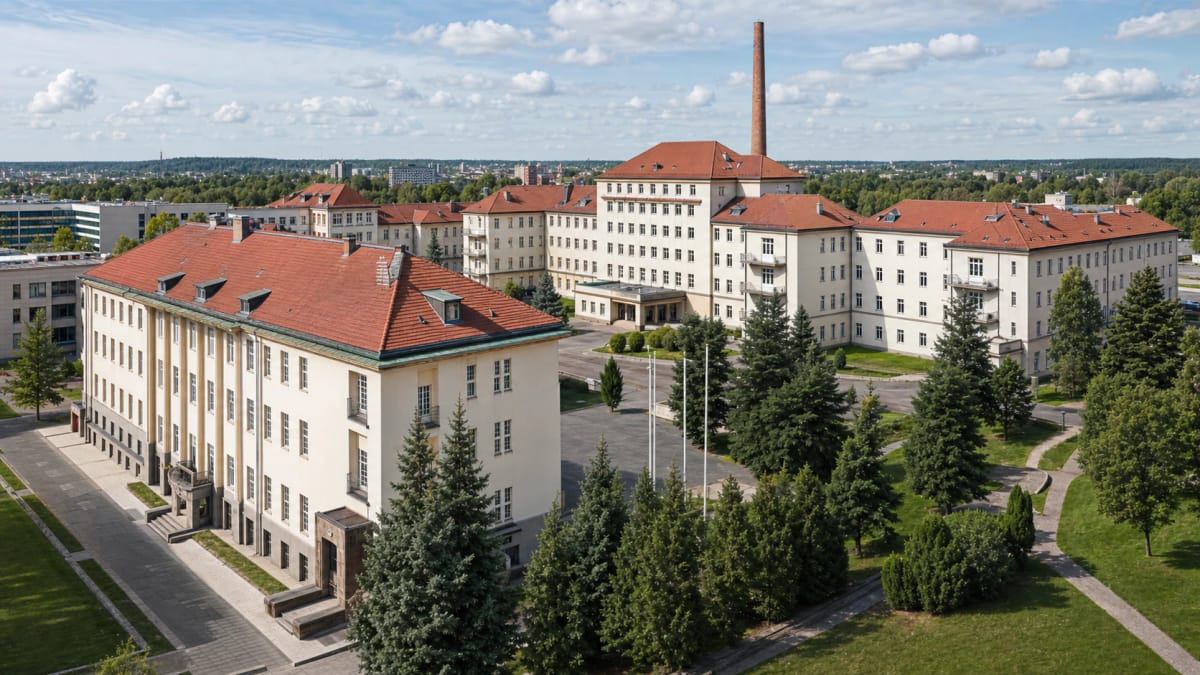
Kaunas Clinics Complex at Eivenių g. 2 is not an ordinary attraction whose value can be reduced to one facade. It is an active hospital of the Lithuanian University of Health Sciences, but also a major monument of interwar Kaunas healthcare infrastructure. Historic blocks, red roofs, inner courtyards, greenery, long axes, and the tall chimney still let visitors read the scale of a 1930s university hospital.
AUTC identifies the object as Kaunas Clinics Complex, code 16003, while the official Kaunas Clinics history states that in 2005 the complex was recognized as a protected immovable cultural property and in 2008 declared a cultural monument. Just as important, the ensemble has not changed its main purpose: treatment, teaching, and research still take place here.
Why Kaunas needed the Clinics
The official hospital history emphasizes Professor Vladas Lašas's vision: a multi-profile university hospital where treatment, teaching, and science work together. AUTC notes that a large modern medical institution was wanted in Kaunas as early as 1919, but the temporary capital long lacked a hospital matching its political and academic role.
Before the Clinics were built, the 1929 Eye and Ear Clinic on Vytauto Avenue was cited as the most modern example. A true university complex required something different: not only wards, but auditoriums, laboratories, libraries, student-practice spaces, a base for physician training, and the infrastructure that would let medicine become part of state modernization.
Site and competition
Several sites were discussed before the Eivenių Street plot was chosen. AUTC mentions Vileišio Square, Freda, Vilijampolė, approaches to Ąžuolynas, and other options. The official history states that architect Vytautas Landsbergis-Žemkalnis sketched a 12 ha plot in the VII Fort area, near St. Luke's Hospital, in 1935.
An international design competition was announced in 1936. The sources count its process differently: the official Kaunas Clinics history mentions six submitted projects, while the AUTC entry says five projects were submitted and some rejected. The essential point is the same: first prize went to French architect Urbain Cassan, working with Elie Ouchanoff, and the pathological anatomy building was entrusted to Feliksas Bielinskis.
Construction in 1937-1939
The cornerstone of the Clinics was blessed in July 1937. Construction lasted until July 1939, and the official history gives figures that show the project's scale well: the area reached about 160,000 square metres, the bed count increased from a planned 518 to 663, construction cost 11 million litas, and with equipment about 14 million litas.
This was one of the largest building projects in interwar Lithuania. The work was not only representative: some processes were mechanized for the first time, vibrated concrete was used, staircases were built in innovative ways, and a 75 m chimney rose above the complex. In 1939 Professor Kazys Oželis was appointed the Clinics' first director, and the complex began operating in July 1940.
Blocks and underground tunnels
AUTC states that in 1937-1939 the complex consisted of the central block, administration and dentistry building, infectious-disease clinics, nervous and mental-disease clinic blocks, pathological anatomy building, tunnels, and several service structures. The official history describes the final six-block design prepared within five months.
One of the most interesting engineering layers is the underground tunnel system. The official description gives 2.2-2.3 m wide tunnels with widened passing points for cargo and engineering communications. AUTC describes them as a modern complex about 1 km long, also assigned protective functions.
Modern without the white-box look
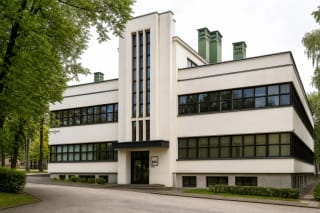
Kaunas Clinics often look different from what visitors might immediately expect from a modern 1930s hospital. AUTC stresses that we do not see a pure functionalist or International Style language here, the kind symbolized in European medical architecture by places such as Paimio Sanatorium. The Clinics belong more to the field of modernized historicism.
That means the volumes are composed symmetrically, with projections, cornice lines, granite-render finishes, red roofs, and a sense of monumentality. Functionally, however, the building was very contemporary: wards had radio wiring, light signalling, a special window system, advanced ventilation, and technical solutions.
War years and survival
By early 1941, inpatient departments with 750 beds were already operating in the Clinics. The official history states that from June 23, 1941 to July 29, 1944, Kaunas University Clinics were turned into a German army hospital treating up to 5,000 wounded.
After the German army withdrew, the complex became Red Army military hospital No. 2386, and Soviet troops left the Clinics on October 11, 1945. The buildings did not collapse during the war, but they were looted, and the light facades were repainted in camouflage colour. AUTC also mentions lost terraces, destroyed cork flooring, and later planning changes.
Expansion from the 1960s to today
From 1964, new construction and reconstruction began in the territory. The official history lists a teaching and laboratory block, Obstetrics and Gynaecology, Eye Diseases, Cardiology, Neurosurgery, Endocrinology, Cardiac Surgery buildings, and later centres. Today's visitor therefore sees not a frozen interwar ensemble, but a living, expanded medical city.
VLE presents the Lithuanian University of Health Sciences as a university established in 2010 by merging Kaunas University of Medicine and the Lithuanian Veterinary Academy, with clinical activity at Kaunas Clinics and Kaunas Hospital. This explains the present name: LSMU Kaunas Clinics are the continuation of the historic VMU university hospital.
UNESCO context
The UNESCO Modernist Kaunas inscription speaks about the city's 1919-1939 transformation and the creation of modern capital infrastructure. Kaunas Clinics matter in that story not only for architectural form, but also for function: the state created healthcare, medical science, and university practice in one territory.
For visitor text, however, precision matters. This page does not present the complex as a separate, individual UNESCO property. It is very important to the Modernist Kaunas and interwar infrastructure context, while its individual heritage status is best described at the level of a national cultural monument.
How to look respectfully
Kaunas Clinics are an active hospital, so they should not be treated like an ordinary museum. The best plan is a short exterior architecture stop: look at the historic blocks, red-roof rhythm, central approach, green structure, old chimney, and the relationship between interwar buildings and later medical infrastructure.
The official Kaunas Clinics website provides arrival information, public-transport routes, parking zones, and a site map. A free electric shuttle runs in the territory on working days for patients and visitors, but for a tourist architecture stop it is enough to plan your route in advance and avoid photographing patients, medical situations, or sensitive hospital spaces.