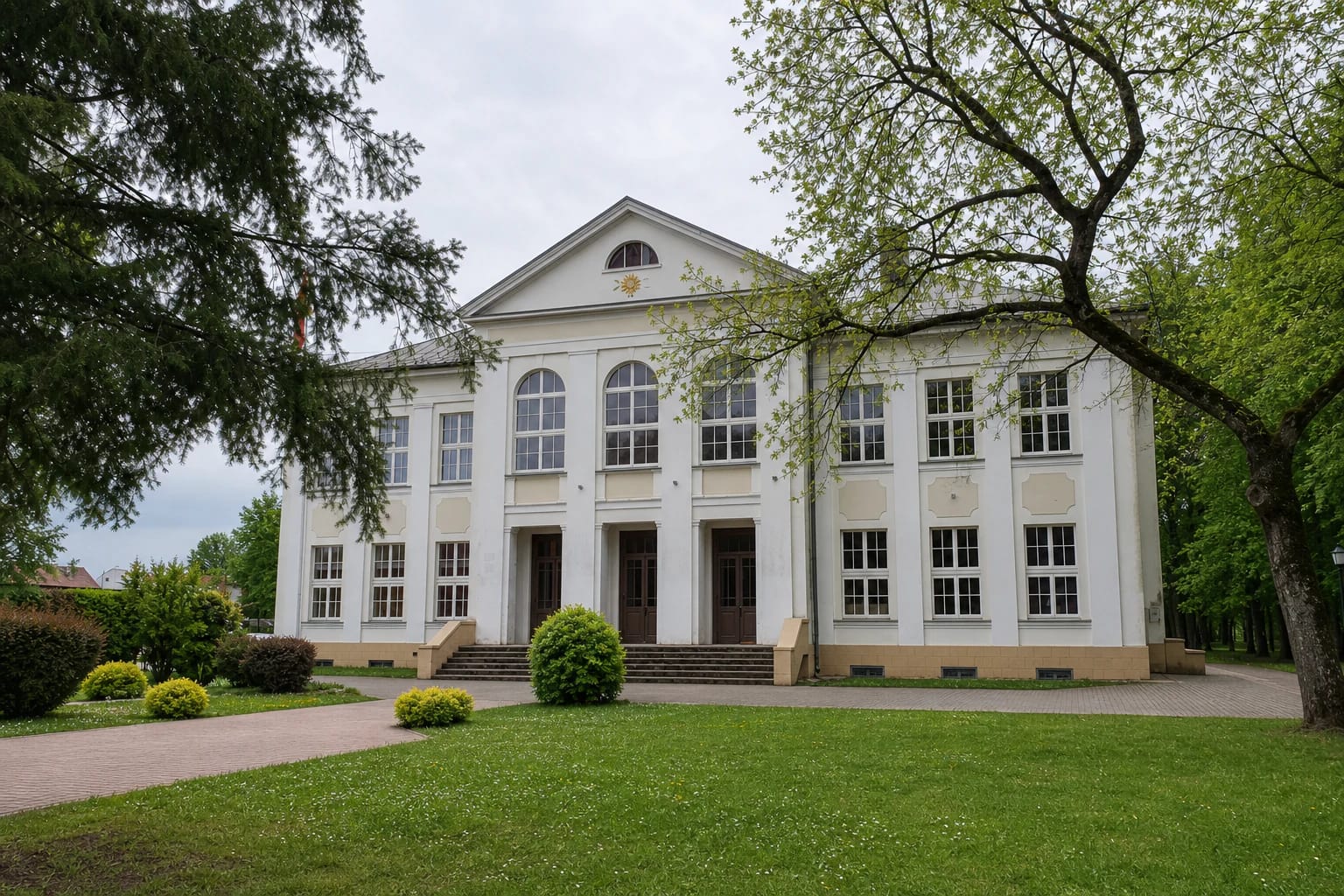
- Place
- Švėkšna, Šilutė District Municipality
- Region
- Pamarys
- Type
- local-history branch of the Šilutė Hugo Scheu Museum with archaeology, ethnography, manor-history, and town-history galleries
- Address
- 9A Bažnyčios Street, Švėkšna, LT-99397
- Coordinates
- 55.51624, 21.61964
- Visit duration
- 45-75 minutes; 2-3 hours with the manor park, church, and town centre
- Best time
- June-August, when the museum also opens on Saturday; at other times check the weekday schedule
Švėkšna Exhibition, Švėkšna Exhibition of the Šilutė Hugo Scheu Museum, Švėkšnos muziejus
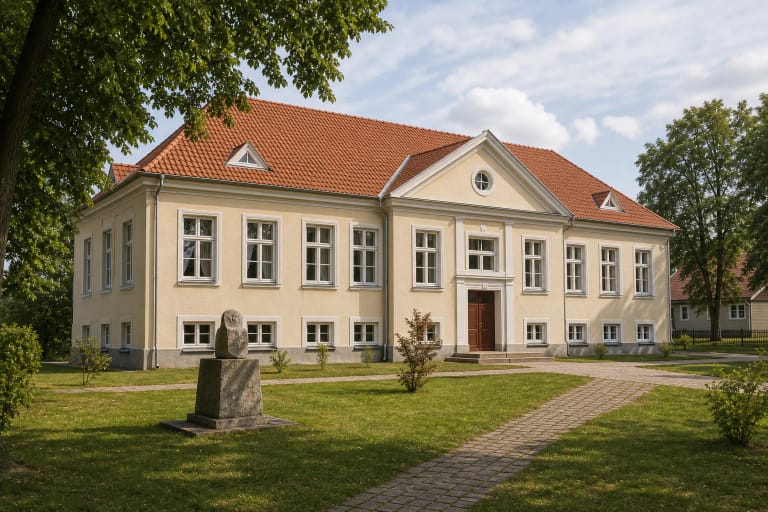
The museum is inside the Saulė Gymnasium building, not Villa Genovaitė
Švėkšna Museum is at 9A Bažnyčios Street, and its exact Google Maps listing leads to 55.5162377, 21.6196423. Its formal institutional name is the Švėkšna Exhibition of the Šilutė Hugo Scheu Museum. Since 2005 it has occupied rooms in the Švėkšna Saulė Gymnasium building, so navigation should not be set to the privately owned Villa Genovaitė or the site of the former manor house in the park.
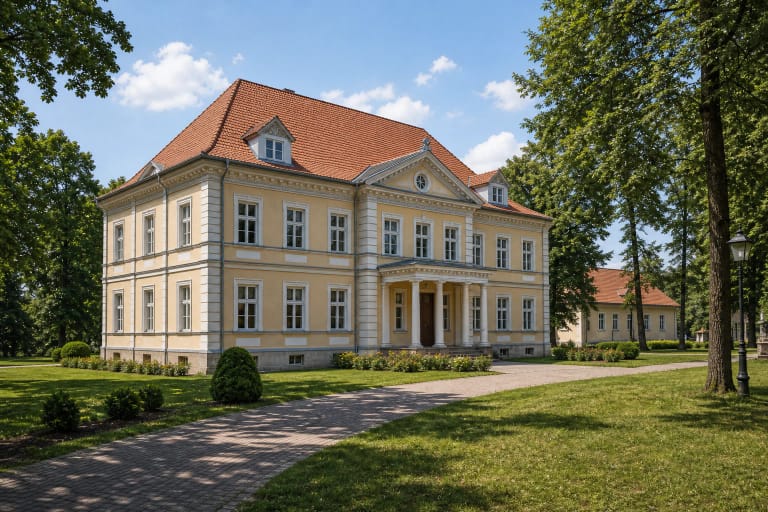
The present building is part of the story. A progymnasium founded in Švėkšna in 1919 lost its premises in the town fire of 1925. Local residents and Lithuanian emigrants in the United States donated to a replacement, which was consecrated on 25 July 1928 during the Feast of St James in the presence of President Antanas Smetona and Education Minister Konstantinas Šakenis. The symmetrical white facade is recognisable by its tall windows, shallow central pediment, and 1928 date.
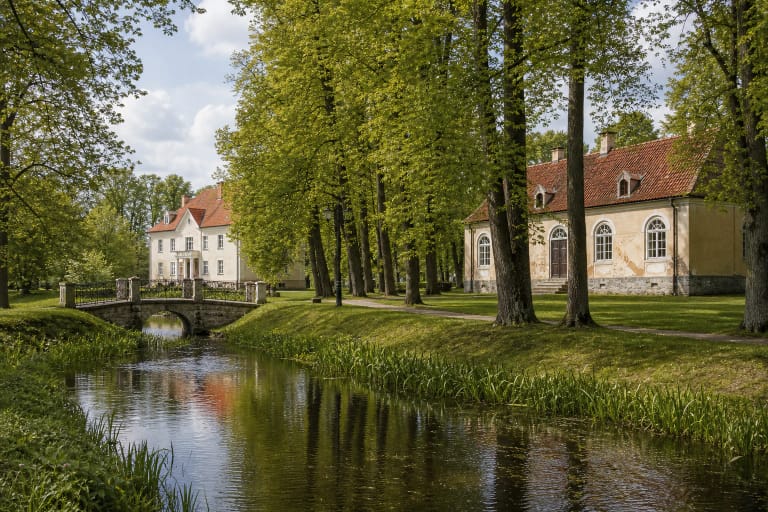
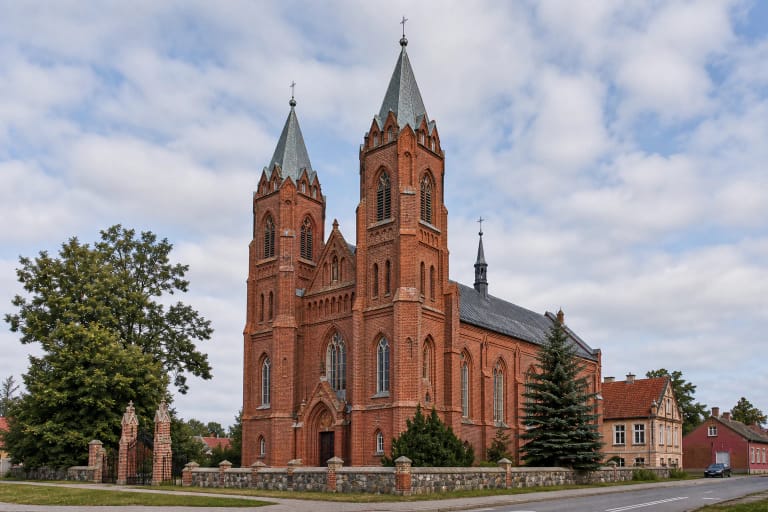
The museum also provides visitor information about Švėkšna. It is a useful starting point for a town walk because the manor park, church, viaduct, and historic centre belong to the same story, although entry to separate privately owned buildings is not included with a museum ticket.
Four galleries separate archaeology, ethnography, manor history, and town history
The exhibition comprises four galleries devoted to archaeology, ethnography, Švėkšna Manor, and the history of the town. Within a compact museum, visitors move from local finds and old tools to household life, the landowners' milieu, and the communities of the town. This is a local-history collection rather than a surviving original interior of the Plater residence.
The museum's official history recalls that the manor once contained paintings by Józef Oleszkiewicz, Jan Rustem, Ivan Aivazovsky, German engravings, Delft plates, and elaborate furniture. Those names describe a collection dispersed during the war, not a catalogue of objects now on display. Most was removed or destroyed in 1940, part reached the Alka Museum in Telšiai, and only a few items left in Švėkšna passed to the school and later the museum.
LIMIS identifies a 17th-century edition of the Statute of Lithuania as one of the collection's most valuable books. A 2015 LRT report described it more specifically as a 17th-century edition of the Third Statute and said that it and a 16th-century parchment were then kept in storage because of unsuitable environmental conditions and presented digitally. The current official page does not promise that the original is permanently in a case, so anyone travelling specifically to see it should telephone first.
From an unrealised 1921 proposal to a museum opened in 1969
In 1921, primary-school teachers discussed establishing a town museum and intended to ask Count Plater for an old Lithuanian grammar, but the plan was not realised. A single glazed cabinet later appeared in the gymnasium, displaying coins, archaeological finds, and other antiquities. Part of that small collection disappeared during the Second World War.
Teachers' fieldwork gave the idea new substance. In 1957, Jonas Vytautas Rupšys organised expeditions around Švėkšna and collected archaeological material and tools, while Romualdas Pintveris prepared historical panels in the school library in 1968. With the school's 50th anniversary approaching, Petras Čeliauskas led the museum project, and in 1969 a proper school museum opened in three rooms of a small house in the park.
The school collection became a branch of Šilutė Museum in 1993
Only a few years after the 1969 opening, the museum closed because its building was in poor condition. Under school director O. Pintverienė, the roof was repaired, display cases were made, and four rooms were prepared for exhibitions. This interruption explains why the museum's account includes both an opening date and several later changes of premises.
In 1993 the Švėkšna secondary-school museum became a branch of Šilutė Museum. It was then installed in one of the Švėkšna Manor buildings inside the park, near the church and Villa Genovaitė, before moving to its present rooms in the Saulė Gymnasium building in 2005. It is now a municipal museum branch, but the collecting work begun by teachers and pupils remains central to its identity.
Seasonal opening hours, EUR 2 admission, and a 4.9 Google rating
The official Švėkšna branch page lists 10:00-18:00 Tuesday-Friday and 10:00-16:00 Saturday from 1 June to 31 August. From 1 September to 31 May it lists 09:00-17:00 Monday-Thursday and 09:00-16:00 Friday; the table publishes no visiting hours for the remaining days. Public holidays and events can alter access, so consult the official page or telephone +370 657 57152 before travelling.
On the research date, adult admission was EUR 2 and the concession ticket EUR 1. A 45-minute overview tour for up to 25 people was EUR 15 in Lithuanian or EUR 20 in another language, and the museum requires advance booking for its listed tours. Prices and eligibility rules can change, so groups and education-session organisers should confirm them directly.
Allow 45-75 minutes for an independent museum visit, or at least several hours with the manor park and church. Official visitor pages do not publish a detailed step-free route, lift, or accessible-toilet specification, so discuss a particular mobility or sensory requirement before arrival. On 15 July 2026, the exact Švėkšna Museum Google Maps listing showed 4.9 out of 5; this public rating is not fixed.