- Place
- Kaunas City Municipality
- Region
- Kaunas
- Type
- interwar functionalist and cooperative-economy building
- Address
- Laisvės al. 55 / S. Daukanto g. 18, Kaunas
- Coordinates
- 54.89717, 23.91389
Former Pienocentras Company Palace, Pieno centras Palace, Pienocentras, Pienocentras Company Palace
A cooperative palace on Laisvės alėja
Pienocentras Palace looks like an elegant modernist corner building, but its subject is very specific: Lithuania's interwar dairy cooperative system. AUTC states that the owner and main user was the Central Union of Lithuanian Milk Processing Companies, Pienocentras.
That matters because the building is not only about architectural taste. It shows that milk processing, export, trade, and cooperation formed an economic system powerful enough to build modern multifunctional palaces in the heart of Laisvės alėja.
More than administration
AUTC calls Pienocentras Palace perhaps the most impressive interwar Kaunas equivalent of a contemporary multifunctional commercial and residential building. The description is exact: this was not only an office with desks.
The ground floor held the Pienocentras shop, dining room, and snack bar known as the Pienocentras garden. The first and second floors had J. Muralis' hair salon, the third floor contained administrative premises, and the upper floors had apartments. In other words, one corner building combined commerce, services, management, and prestigious living.
The 1931 competition and construction
KVR states that the 1931 design competition for the Pienocentras administrative palace was won by architect Vytautas Landsbergis-Žemkalnis. Karolis Reisonas contributed to the design, and structural calculations are connected with engineers Saliamonas Milius and Pranas Markūnas.
Construction was completed in 1932, but final works continued until 1934, so the safest date for the building is 1931-1934. AUTC metadata records 1931 as the project-start year, while KVR helps clarify the construction process.
One of Kaunas' clearest functionalist buildings
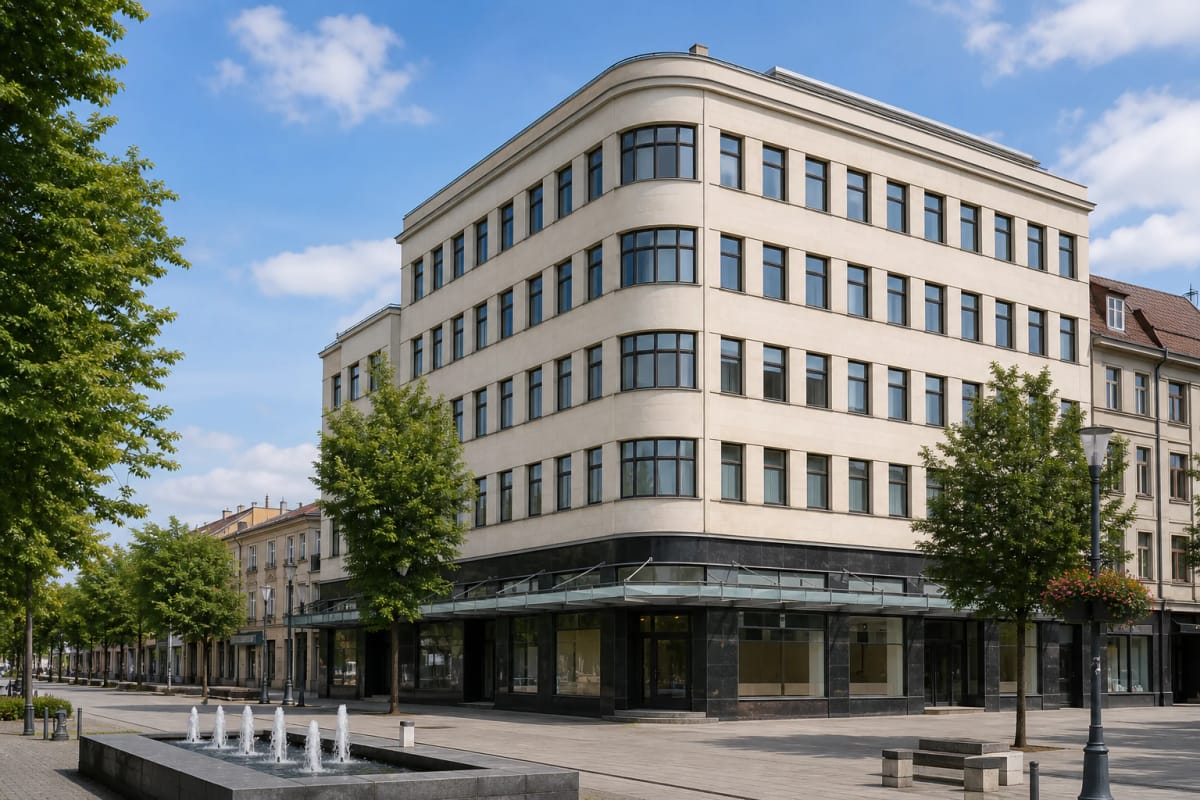
AUTC describes Pienocentras Palace as one of the clearest examples of Lithuanian functionalism. Here functionalism is not dry: the curved corner silhouette, illuminated glass-and-metal canopy, black polished labradorite on the ground floor, and restrained rhythm of the upper floors create a highly elegant urban corner.
KVR's valuable-features description mentions an L-shaped plan, five-storey main block with mansard, two-storey southeastern block with mansard, cellar beneath the building and courtyard, recessed main entrance, passage to the courtyard, balconies, and metal railings.
The curved corner to read up close
The key visitor position is the corner of Laisvės alėja and S. Daukanto Street. From here you can see how the building does not break the block sharply but rounds it gently. AUTC writes that curved corner windows gave the building modernity and elegance, although their survival today must be assessed carefully.
Below, the facade is wrapped in black polished labradorite stone slabs, and a glass-and-metal illuminated canopy runs above the display windows. This is one of Kaunas' best examples of the ground floor designed as a commercial city zone, while the volume above rises as representative office and apartment architecture.
Interior: oval stairs and urban comfort
Although visitors usually access the building only from outside, KVR helps explain the interior value. Protected elements include the main staircases with terrazzo steps and landings, ornamented metal railings, wooden handrails, wall cupboards, radiator niches, wooden panelling, and rounded interior corners.
The oval main staircase with lift shaft is especially interesting. KVR states that the authentic Swiss lift was removed in the 1980s, but the spatial logic itself helps explain how the building worked as a modern, comfortable organism for urban business and living.
Who lived above the administration
The upper-floor apartments were not a random additional function. KVR mentions that independent Lithuania's Prime Minister Juozas Tūbelis and foreign ministers Dovas Zaunius and Juozas Urbšys lived here for a time.
This fact explains the building's prestige. Pienocentras Palace was not only cooperative administration but also an elite residence on the main axis of the temporary capital. It therefore connects economic, political, and urban history of interwar Kaunas.
Paris award
KVR and AUTC state that the palace design received an honorary diploma and bronze medal at the 1937 Exposition Internationale des Arts et des Techniques in Paris. This matters because it shows that Pienocentras Palace was valued beyond the local context.
For interwar Kaunas, international recognition meant more than an architectural diploma. The young state tried to prove that its capital's architecture could be contemporary, economically meaningful, and European, and Pienocentras Palace was one of the arguments.
Soviet period and later function
KVR states that in 1946 the palace was transferred to the Agricultural Academy, and from 1964 it belonged to KPI, today's KTU. In 1982 a milk cafe opened on the ground floor, and in 1983 a milk bar, briefly returning the original Pienocentras theme symbolically.
In recent decades various institutions have changed on the lower floors, so visitors should not rely on specific tenant names or shop signs. The stable object here is the building itself: corner, proportions, materials, and the surviving logic of Laisvės alėja modernization.
How to visit today
Pienocentras Palace is not a museum and has no reliable public visiting regime. KVR's opening-hours and visitor-information fields are empty, so the main experience today is the exterior.
Approach from the Laisvės alėja side, stop opposite the corner, then walk around into S. Daukanto Street. This reveals how the building shapes the intersection and why interwar press and architectural research compared such Laisvės alėja objects with early signs of a modern capital's skyscrapers.