- Place
- Kaunas City Municipality
- Region
- Kaunas
- Type
- interwar office palace with national-style and Art Deco details
- Address
- Laisvės al. 53, Kaunas
- Coordinates
- 54.89707, 23.91438
Pažanga Company Palace, Former Pažanga Company Palace, Pažanga Palace, Pažanga Palace on Laisvės alėja
An office palace of political power
Pažanga Palace is one of the most important interwar office buildings on Laisvės alėja. It was built for AB Pažanga, a company tied to the Lithuanian Nationalist Union's political, press, and cultural environment. This was therefore not a neutral rental house but a building meant to contain institutions, editorial offices, administration, and representation of the governing political field.
The AUTC entry draws on a 1934 report submitted to Kaunas City Municipality, which shows how densely the palace was occupied: it housed the central board of the Lithuanian Nationalist Union, Pažanga administration, Lietuvos aidas offices, the Nationalist Club, Jaunoji Lietuva, Jaunoji karta, and other premises. In other words, it was one of the densest addresses of interwar Kaunas political communication.
Architect Feliksas Vizbaras
The palace was designed by Feliksas Vizbaras, an engineer-architect and graduate of Riga Polytechnic Institute. VLE presents him as one of the important twentieth-century Lithuanian engineers and architects, whose Kaunas works included the Central Post Office, the Ateitininkai Union Palace, and the Pažanga Company Palace.
Pažanga Palace reveals a different side of Vizbaras' work from the Central Post Office. Here national-style gestures are inserted into a compact commercial and administrative building in the city centre. The facade had to be both modern and ideologically recognizable.
Dates and construction
The dates differ slightly across sources. AUTC object data gives 1933-1934, while KVR context mentions a broader construction process from 1931. For visitors, the most practical point is that the palace was completed in 1934 and belongs to the most intensive decade of Kaunas modernization.
AUTC names D. and G. Ilgovskis as contractors. The building rose on the site of an older masonry house, and AUTC links its estimate with a value of 625,400 litas. That sum shows that the client sought not a simple office block, but a prestigious city address.
How the floors were used
The palace functioned as a vertical institutional machine. Lower floors held shops and more public rooms; higher up were administration, editorial offices, clubs, and organizations. KVR and researchers' descriptions mention the Parama haberdashery store, Dirva bookstore, State Central Bookstore, and a library.
In 1935 a restaurant opened on the fifth floor, and a roof terrace was arranged. This programme was very urban: the building did not only serve political and press infrastructure, but also created a place for meetings, social visibility, and the prestige of Laisvės alėja.
The facade from Laisvės alėja
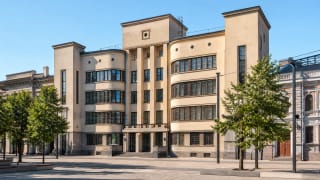
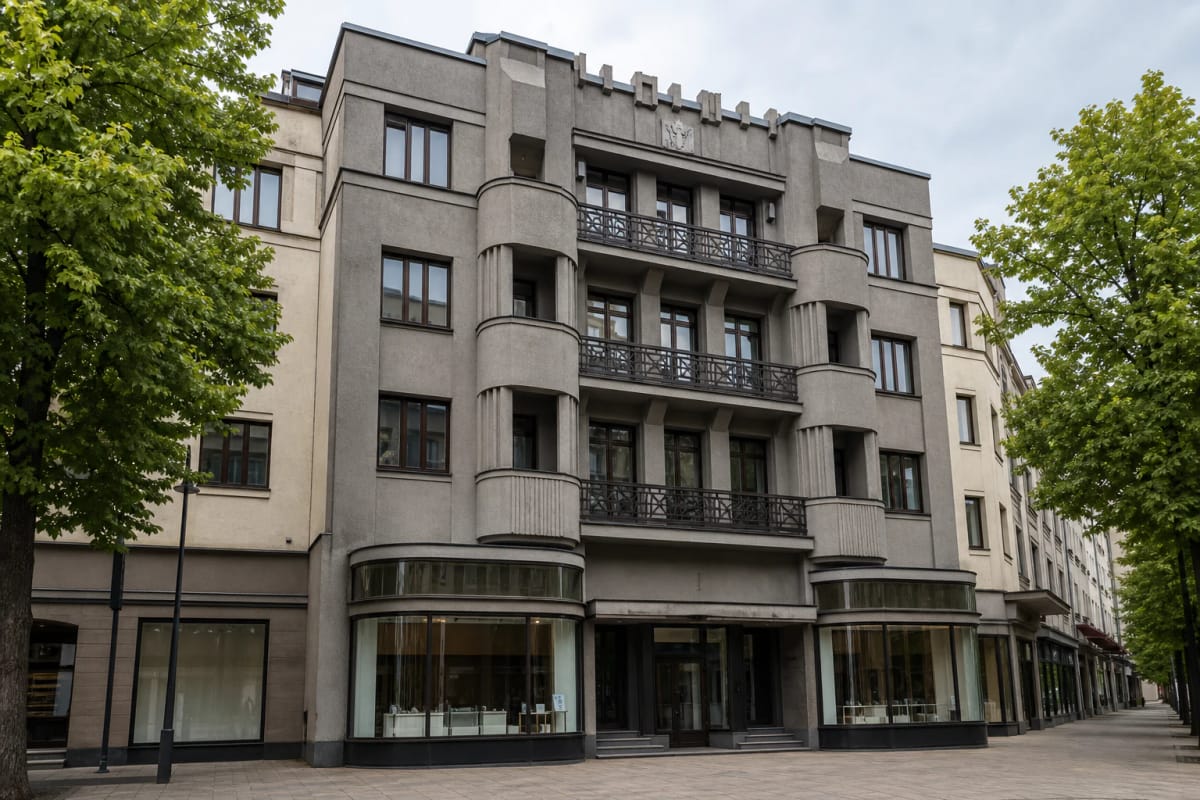
From Laisvės alėja, the two side projections, central strip of balconies, curved first-floor display windows, and dark decorative metal railings are easiest to see. The building is not completely flat: it pushes and pulls volumes, creating loggias, balcony shadows, and vertical accents.
Pažanga Palace reads best when walked slowly. First the eye catches the facade symmetry and balcony rhythm; then separate details appear: railing geometry, plant motifs, textured plaster, parapet line, and the curves of the old shop windows.
National style and Art Deco details
KVR and AUTC associate the building with national style. This does not mean copying historical forms, but attempting to enrich a modern masonry building with hints of Lithuanian ornament. In places, granitic plaster imitates the texture of woodcarving, while metal, plaster, and interior details include geometricized plant motifs.
In the context of Kaunas architecture, VLE lists Pažanga and Pienocentras palaces as examples of rationalist 1934 architecture, connecting Pažanga Palace with Art Deco decorativeness. This is a precise description: the plan and office logic are modern, but the facade does not abandon decorative representation.
The national-style debate
Pažanga Palace is also important because it entered an interwar debate about Lithuanian style. AUTC recalls criticism by Mstislavas Dobužinskis against imitating the properties of wood in stone, plaster, and gypsum. Both the Kaunas Central Post Office and Pažanga Palace were in his line of sight.
Today that debate only adds value. The building lets visitors ask how a young state tried to combine a modern city, national signs, representation, and critics' fear that ornament might become superficial decoration.
Interior and surviving details
The KVR description shows that the building's value is not only its facade. Protected or mentioned elements include curved crystal-glass display windows, wooden entrance doors and fittings, terrazzo stairs, ornamented metal stair railings, herringbone parquet, Mettlach tiles, rosettes, cornices, and polychrome staircase decoration.
The history of the basement meeting hall also matters. AUTC writes that the hall beneath the courtyard was lit through frosted-glass skylights. Later it was divided and the skylights removed. This reminds visitors that the building visible today is a document of both survival and loss.
After 1940
After 1940 the palace functions changed. AUTC mentions various institutions, apartments in courtyard blocks, large halls divided during the Soviet period, the eastern entrance closed, corridors broken into smaller parts, partitions altered, and a sixth floor added in the southern section.
In 1989, after Vytautas Magnus University was restored, the building was transferred to VMU. Current interior use and access should be checked before planning a visit, because this is not a standard museum object with regular opening hours.
UNESCO modernism context
Pažanga Palace is part of Kaunas Naujamiestis modernist heritage associated with the UNESCO World Heritage property Modernist Kaunas: Architecture of Optimism, 1919-1939. The most accurate wording is to present it as part of the wider UNESCO-recognized urban modernism fabric, not as an individually inscribed UNESCO monument.
Its significance in that context is clear: the palace shows how the temporary capital created not only state institutions but also infrastructure for political press, organizations, commerce, clubs, and city prestige in one building.
How to visit today
The best way to visit Pažanga Palace is as part of a Laisvės alėja walk. The exterior is freely visible: stop opposite the building, step back into the middle of the avenue, and read the whole facade composition from shop windows to parapet.
Interior access is not automatic. KVR mentions visiting only by advance agreement with the manager, but contacts and conditions must be checked directly through the register or current building-manager channels. Without a special tour, the most realistic and reliable visit is the exterior.