- Place
- Biržai District Municipality
- Region
- Biržai District
- Type
- karst sinkhole and cave
- Address
- Area of Karajimiškis and Kauniai villages, Biržai District Municipality
- Coordinates
- 56.20700, 24.69400
Karvės ola, Cow Pit
Cow Cave: the best-known Biržai sinkhole
Cow Cave is in Biržai District, in Biržai Regional Park, about 3 km west of Biržai, between Karajimiškis and Kauniai villages. It is one of the clearest places in Lithuania to see northern Lithuanian karst processes without needing complex geological diagrams.
Saugoma.lt calls it the best-known and most thoroughly researched geological monument in northern Lithuania. VLE states that Cow Cave belongs to the Karajimiškis geological reserve, and it has been treated as a geological natural heritage object and natural monument since 1968.
What Cow Cave actually is
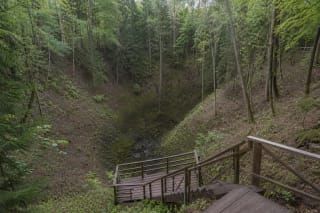
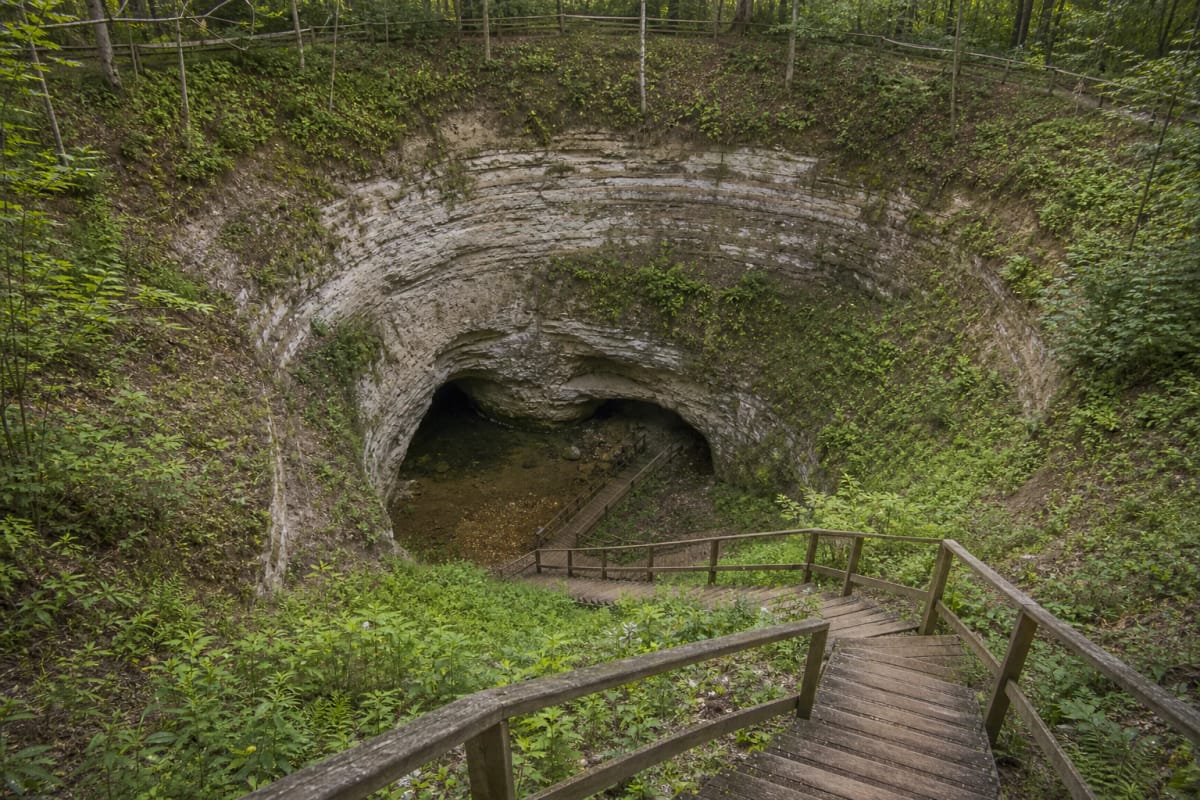
Although the name contains the word cave, visitors first see an almost circular, funnel-shaped karst sinkhole. It formed in gypsum and dolomite layers: as gypsum dissolved underground, cavities opened, and the cover above them collapsed.
Sources emphasise depth somewhat differently. VLE describes a 9 m deep funnel-shaped collapse, while Saugoma.lt gives about 12.6 m. For visitors, the key is that both describe the same sinkhole and underground-cavity system, whose measured depth depends on the chosen measuring point.
Dimensions and underground cavity
Saugoma.lt gives Cow Cave's diameter as about 10-12 m. VLE adds that the upper part of the collapse is 10-12 m wide and narrows to 2 m at about 8.5 m depth. The walls are dolomite with thin gypsum and marl interlayers.
At the bottom an underground cavity opens. VLE gives a total cave length of 46 m, a floor area of 42 sq. m, and a volume of 28 cu. m. Saugoma.lt mentions a cavity height of about 3.1 m, with caves and passages extending sideways.
Caves and underground pool
Saugoma.lt lists five passages extending from the underground cavity: Wet Cave, Narrow Passage, Bat Passage, Toad Cave with an underground pool, and Shining Cave. VLE also mentions Shining, Narrow, and Bat passages.
In the underground pool VLE gives a depth of about 1.5 m and a water temperature of 4.5 C. The source also mentions sticklebacks, molluscs, and bat skeletons found in one passage.
Research and discoveries
In 1973-1978 Cow Cave was investigated by Kaunas speleologists, who made topographic measurements, established morphometric indicators, and drew a cave plan. In 1978 diver Arkadijus Silantjevas explored the underwater part of the underground pool, which VLE links to the first cave dive with scuba equipment in Lithuanian speleology.
Saugoma.lt also notes a newer event: in August 2023 another small cave, about 0.3 m in diameter and 1 m deep, unexpectedly opened on the floor of Cow Cave. This reminds visitors that karst terrain is not finished; it continues to change.
Why it is called Cow Cave
VLE gives a simple local story: supposedly a cow once sank where the present collapse is. Such stories are typical of karst sinkholes, because sudden ground failure long seemed unexpected and dangerous.
The folklore name should not obscure the geology. Cow Cave is most valuable as a visible result of gypsum dissolution and ground collapse, while the story helps people remember its name.
How to visit Cow Cave
Wooden stairs lead down to the sinkhole floor, so the visit looks simple. Still, stay within the visitor infrastructure: do not enter passages, touch unstable places, or try to explore underground without specialists.
Saugoma.lt notes asphalt and a forest path near the object, as well as public toilets. The Barsukas Cave Geological Trail is mentioned nearby, so Cow Cave is easy to include in a broader Biržai karst-landscape route.