- Place
- Palanga City Municipality
- Region
- Palanga
- Type
- working pharmacy in a state-protected nineteenth-century timber commercial and residential building
- Address
- Vytauto g. 33, Palanga
- Coordinates
- 55.91247, 21.06327
- Visit duration
- 15-30 minutes; longer only if staff permit a closer look at the working pharmacy interior
- Best time
- in daylight while the pharmacy is open; verify the current schedule in the official pharmacy directory before travelling
Old Pharmacy of Palanga, Palanga Pharmacy, Gintarinė Pharmacy at Vytauto g. 33
The exact location and what can be seen from the street
Palanga Old Pharmacy stands at Vytauto g. 33 on the west side of the street, between the resort centre and the approaches to the Botanical Park. Coordinates 55.9124706, 21.0632693 identify the pharmacy building itself, not similarly named accommodation or the nearby public transport stop. On 14 July 2026, the official Gintarinė Pharmacy directory still listed an operating branch at this address.
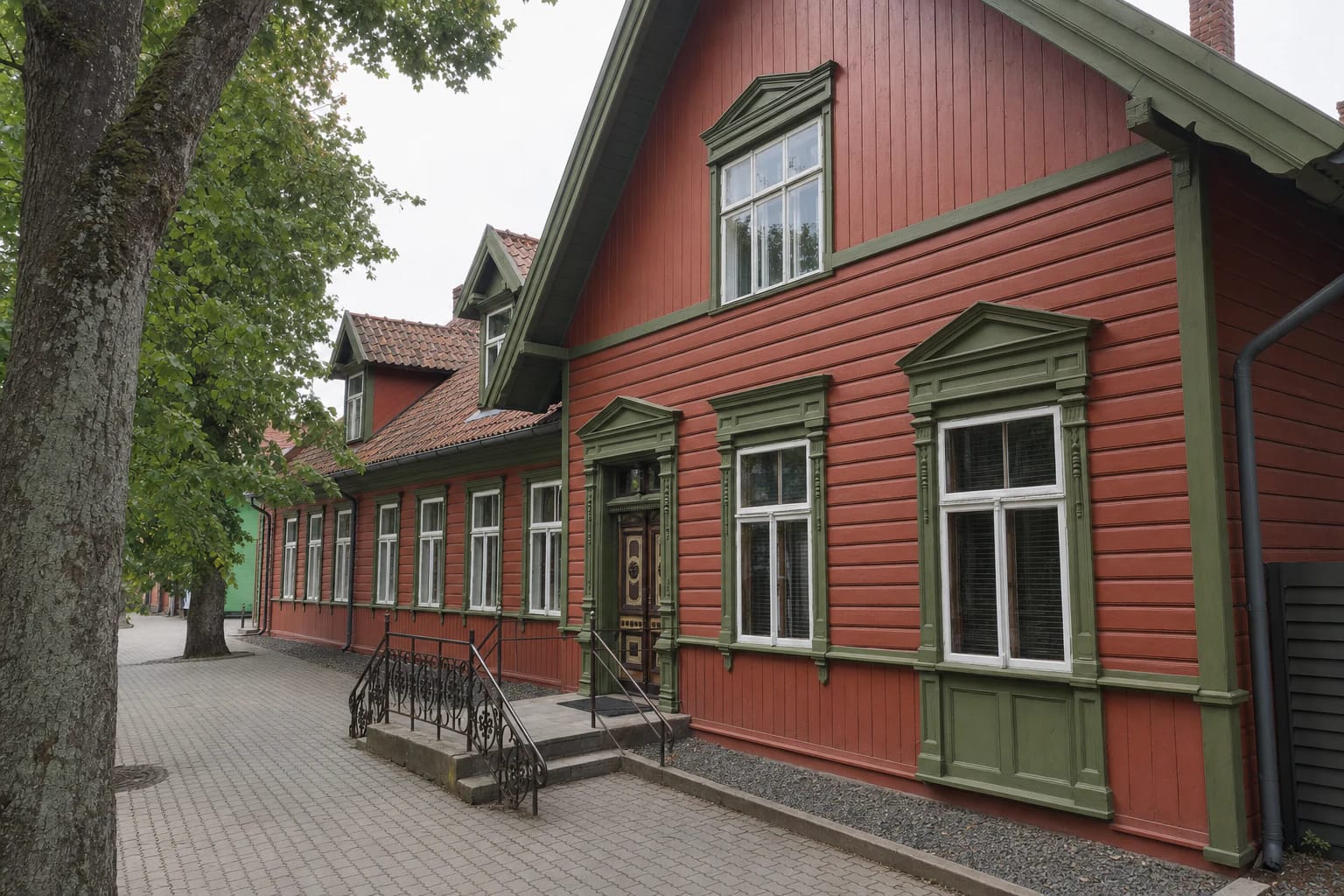
From Vytauto Street, the easiest features to recognise are a long single-storey timber wing with an attic, red-brown weatherboards, muted green trim, and a pitched roof covered in ceramic tiles. A projecting entrance bay with a triangular gable animates the east facade, while steps with delicate wrought-metal rails lead to a pair of carved timber doors.
The building is not a simple rectangle. Its street wing connects to a courtyard section, and additions made in the late nineteenth or early twentieth century included a balcony on the south facade, a half-timbered rear vestibule, and a timber workshop used for preparing medicines. Only fragments of these rear volumes can be seen from the public pavement.
An 1827 pharmacy tradition and a cautious building chronology
The historical account in the Register of Cultural Property and the AUTC study associate the pharmacy's beginnings in 1827 with pharmacist Wilhelm Johann Grüning. That year is well established in the institution's history, but the present house has not been dated to a single construction year. The register places it in the third or fourth decade of the nineteenth century and does not identify an architect or the original builders.
Heritage sources link the Grüning family of pharmacists with a patented extract made from 27 medicinal plants that became known as Trejos devynerios, or Three Nines. This is an important part of Palanga's pharmaceutical history, but products sold under the same name today should not automatically be presented as an unchanged continuation of the formula made here.
The Berting family ran the pharmacy in the early twentieth century: Wilhelm Berting is named as the owner in 1910, and his son Oskar Alexander later continued the business. The building was altered in the 1920s-1930s, repaired in 1951, restored in 1967, repaired again in 1975, and had its facade restored in 2015. This sequence makes clear that its current appearance developed over a long period.
Timber construction and a surviving professional interior
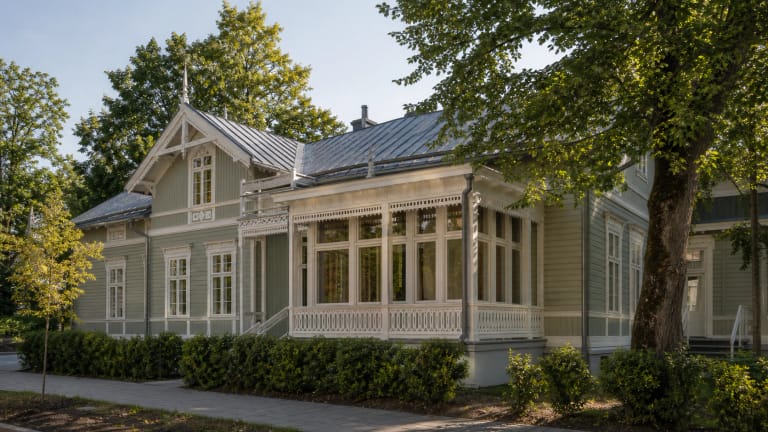
Log walls survive beneath the weatherboards and rest on fieldstone and ceramic-brick foundations. The street wing has a clay-tiled gable roof with attic windows and brick chimneys. Horizontal and vertical boarding, profiled timber window surrounds, triangular hood moulds, and a continuous sill course give the facade a disciplined commercial character rather than the air of an elaborate resort villa.
The double entrance doors, with turned and carved details and a glazed transom, are particularly valuable. The register notes that the restrained decoration now seen in the entrance gable resulted from a later restoration, so the dense openwork ornament visible in old photographs has not survived in full. The house should not be imagined as an untouched display of decoration from 1827.
Inside, the register records timber posts and exposed beams, a polychrome ornamental ceiling band, a ceramic stove, historic cabinets and a counter, a carved ceiling rosette, and an unusual wooden crocodile. The vestibule retains coloured geometric concrete tiles bearing a maker's mark. These features sit inside an operating pharmacy, so not all can be seen from the customer area and none should be assumed to form a permanent museum display.
A library, the NKVD, and memorials
The building's story is not solely pharmaceutical. Palanga's library moved into the northern section in 1940, and the NKVD used part of the premises from 1944 to 1951. The internal plan and fittings were changed during and after this period, while the pharmacy gradually expanded into the southern part of the house after 1951.
A cross dedicated to deportees and other memorial markers in the courtyard recall the building's postwar use. They represent a separate and serious strand of its history rather than decorative elements of the pharmacy. Courtyard access is not equivalent to access from the public pavement, so visitors should respect the way the private working site is used before approaching or taking photographs.
The Palanga Resort Museum history collection preserves pharmacy vessels, Berting-era packaging and labels, prescriptions, medical aids, and old photographs of the interior. This material helps separate documented objects from stories added later, but the collection is not permanently displayed inside the pharmacy.
How to visit a working pharmacy
The Old Pharmacy is not a museum with a ticket desk or a set visitor route. Its facade can be viewed from the public pavement on Vytauto Street at any time, while entry is possible only when the present pharmacy is open. Serving pharmacy customers takes priority over architectural sightseeing.
There is no separate heritage admission ticket. On 14 July 2026, the official pharmacy directory listed Vytauto g. 33 and telephone number +370 460 53657 but did not provide a dependable permanent timetable. Check current hours on the official website or by telephone before making a special journey, especially at weekends and on public holidays.
Steps lead to the main historic doors, and no reliable published information confirming step-free entry or internal circulation was found. Visitors who need an adapted entrance should arrange a suitable route with pharmacy staff in advance. Do not photograph the interior or customers without explicit permission, and examine the exterior without blocking the doors or steps.