- Place
- Palanga City Municipality
- Region
- Palanga
- Type
- memorial museum in a historic Palanga villa
- Address
- Vytauto Street 23A, Palanga
- Coordinates
- 55.91177, 21.06124
Museum of the Palanga Mayor Jonas Šliūpas, Dr Jonas Šliūpas Memorial Homestead, House of the public figure Jonas Šliūpas
The Jonas Šliūpas Museum in the Palanga mayor's villa
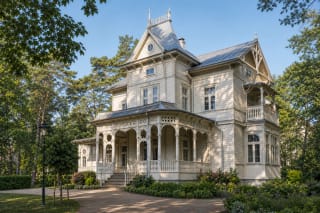
The Jonas Šliūpas Museum occupies a wooden Palanga villa built around 1900 at Vytauto Street 23A. It is not merely a memorial room but a branch of the National Museum of Lithuania, one that helps you understand a man whose biography joins the Lithuanian national revival, medicine, freethinking, the press, and Palanga's self-government.
The Register of Cultural Property lists the object as the House of the public figure Jonas Šliūpas (code 10781) and protects it as a value of regional significance. A bust of Jonas Šliūpas stands in the yard, by the path from Vytauto Street, so the place works both as a museum and as a memorial homestead.
Who the Aušra activist Jonas Šliūpas was
Jonas Šliūpas (1861-1944) was a Lithuanian political, public, and cultural figure, a philosopher, an Aušra activist, and a physician. He was born in 1861 in Rakandžiai (Gruzdžiai district) and earned his doctorate in medicine in 1891 at the University of Maryland in the United States.
Šliūpas was one of the founders and editors of the newspaper Aušra (1883-1884), an active organiser of freethinker societies, and one of the first, as early as 1887, to spread the idea of an independent Lithuania. He lived in the United States in 1884-1919, represented Lithuania in Latvia and Estonia in 1919-1920, and taught the history of medicine at the University of Lithuania in 1923-1930. He died in 1944 in Berlin.
Šliūpas in Palanga and the office of town mayor
Šliūpas moved to Palanga in 1929. AUTC notes that in 1933, when the Resorts Act took effect, Palanga was granted town rights and the office of mayor went to Dr Jonas Šliūpas - which is why he is regarded as the first mayor of Palanga after it received town status. According to VLE, he held the office in 1933-1938 and organised intensive development and rebuilding of the interwar resort.
According to the Register of Cultural Property, Jonas Šliūpas lived in this house in 1928-1944, so the museum is directly tied to the late, Palanga period of his life. This lets you see Palanga not only through its beach, the Tiškevičiai, or the resort, but also through the biographies of the builders of modern Lithuanian society.
The wooden Historicist villa and the 2023 renovation
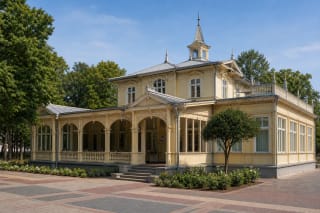
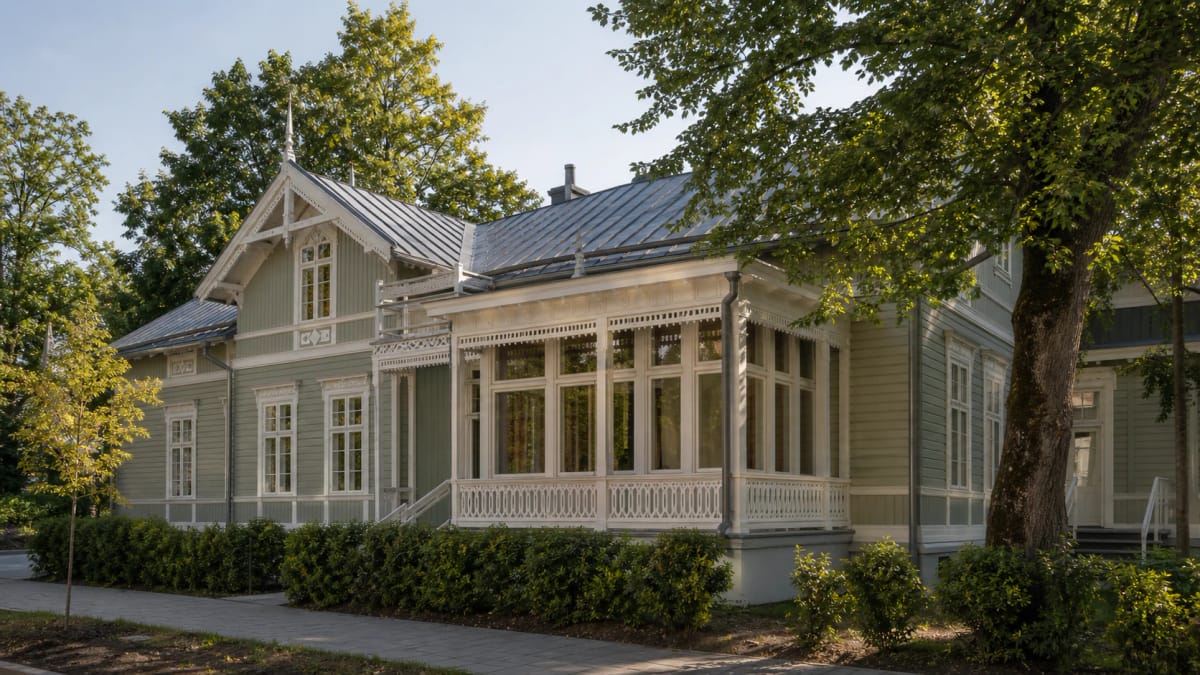
The villa is a wooden single-storey house with an attic and a mezzanine, set a little back from Vytauto Street. Its most ornate part is the south-east facade with fretwork-decorated cornices, profiled window surrounds, diamond-shaped attic windows, a glazed veranda, and a balcony above it; all of this is close to the architecture of Historicist manor houses and the old environment of Palanga villas.
In 2023 the villa was fully renovated and adapted for visitors. The present experience combines the restored historic wooden building with contemporary museum spaces: the exhibition halls are on the ground floor, and the educational and administrative rooms on the upper floor.
Exhibition, opening hours, and visiting
It is worth knowing that at the time of research the permanent exhibition telling the interwar-period and Jonas Šliūpas stories was still being prepared, so the museum ran temporary exhibitions and events. Before travelling, it is worth checking which exhibition or programme is on for a given day.
At the time of research the National Museum announced seasonal opening hours and a 4 EUR adult and 2 EUR reduced ticket, with free admission on the last Sunday of each month. Hours and prices can change, so it is essential to check the official National Museum page. The museum is easy to combine with the Palanga Resort Museum, the Kurhaus, the Counts Tiškevičiai Alley, and Birutė Hill.