- Place
- Vilkaviškis, Vilkaviškis District Municipality
- Region
- Suvalkija
- Type
- former manor estate with Napoleon's 1812 history
- Address
- Vysk. A. Karoso g. 11, Vilkaviškis
- Coordinates
- 54.64800, 23.04440
Vilkaviškis town manor
Vilkaviškis Manor: Napoleon's trace
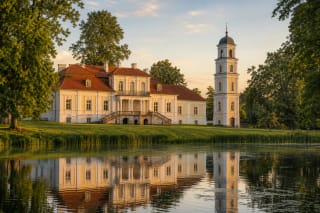
Vilkaviškis Manor stands in Vilkaviškis on a peninsula between the Šeimena and Vilkauja rivers, in Suvalkija. It is an old manor whose reputation rests less on architecture than on one historical episode: Napoleon stopped here in 1812. The estate should be distinguished from two nearby objects, Paežeriai Manor and Vilkaviškis Cathedral.
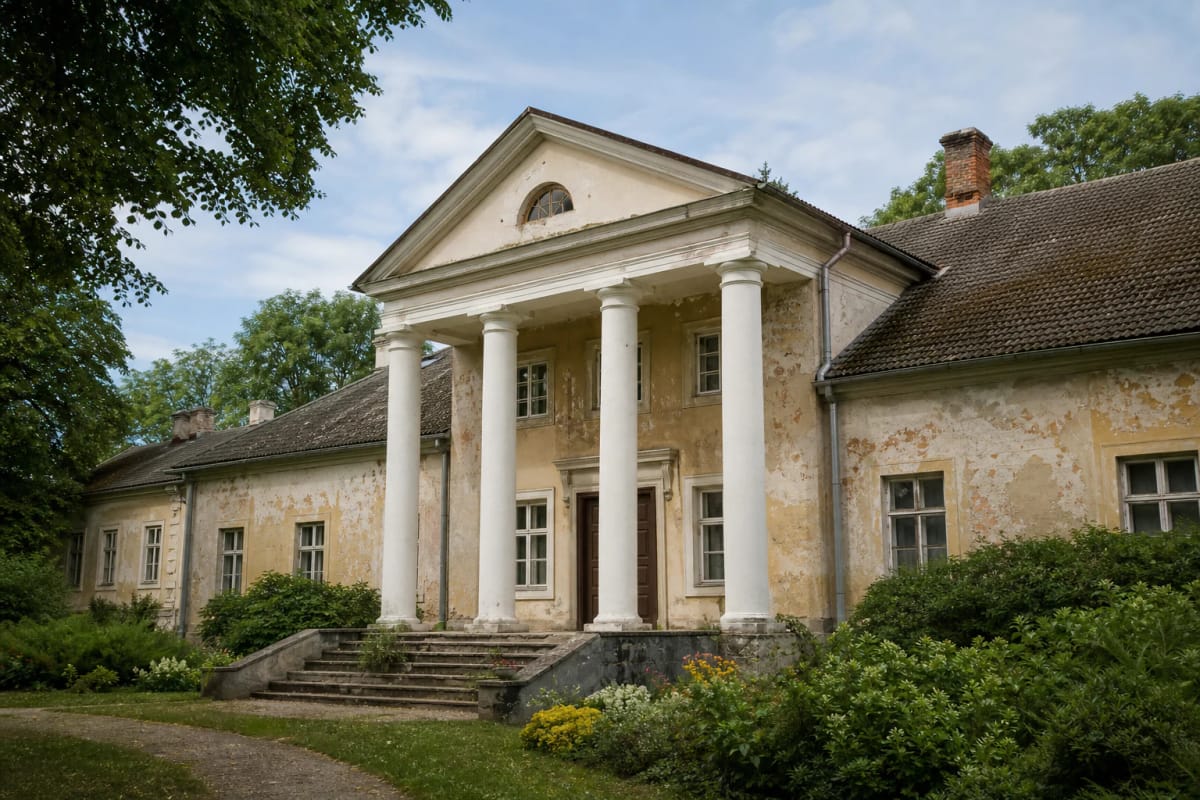
The main manor building is Classicist, with a symmetrical facade, triangular pediment, and four columns. Today it is mainly a private residential place, so visitors see only the surroundings.
Napoleon in Vilkaviškis in 1812
The most important episode in the manor's history is June 1812. Moving toward the Nemunas, Napoleon I briefly stopped in Vilkaviškis with his army. According to Visuotinė Lietuvių enciklopedija, a proclamation effectively declaring war on Russia was read here.
It is said that on June 21, 1812, Marshal Berthier read Napoleon's proclamation to the army, which is treated as the declaration of war on Russia. Sources do not agree on whether Napoleon himself slept in the manor palace, in a tent, or in another building by the Vilkauja, so that detail should be stated cautiously. What is secure is that he stopped in Vilkaviškis and that the war was proclaimed here.
Manor history and owners
The manor was established after 1744 and is mentioned in documents from the second half of the eighteenth century as an Oginski family estate. Sources do not name the building's exact architect, and the construction date of 1744 sometimes found in literature is considered unconfirmed.
In 1926-1940 the manor belonged to the Vilkaviškis Diocese: the curia operated here, and bishops Antanas Karosas and Mečislovas Reinys lived here. The street is named after Bishop Karosas. After land reform the manor was liquidated; during the Soviet period the building housed collective-farm administration and later a dormitory. The estate is surrounded by about a 4 ha park between the Šeimena and Vilkauja.
Vilkaviškis Manor and Paežeriai
Descriptions of Vilkaviškis Manor often become confused. Claims that the manor was designed by architect Martynas Knakfusas in 1795-1799 and surrounded by a park of about 12 ha actually belong to nearby Paežeriai Manor, as also confirmed by the VLE article on Knakfusas, which links his work specifically with Paežeriai.
Vilkaviškis Manor and Paežeriai Manor are therefore two different objects close to each other. Paežeriai has a museum and cultural centre, while Vilkaviškis Manor is more modest, private, and known above all for the Napoleon episode.
How to visit Vilkaviškis Manor
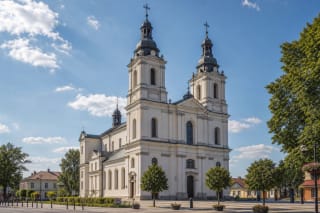
Vilkaviškis Manor is convenient to combine with Vilkaviškis Cathedral, Paežeriai Manor, and other Suvalkija sites. For the exterior and riverside park, 20-40 minutes is usually enough.
Note that the manor is not a museum but mainly a private residential place, so interior visits are not organized. Visit only the freely accessible surroundings and respect residents' privacy.