- Place
- Pagėgiai Municipality
- Region
- Rambynas Regional Park
- Type
- hillfort with a settlement and a landscape of legends
- Address
- Raudondvaris village, Vilkyškiai eldership, Pagėgiai Municipality
- Coordinates
- 55.10009, 22.12509
Opstainiai I (Vilkyškiai, Raudondvaris) Hillfort, Opstainiai, Vilkyškiai hillfort with settlement, Raudondvaris Hillfort, A508KP
Opstainiai (Vilkyškiai) Hillfort by Vilkyškiai
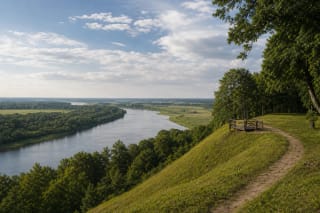
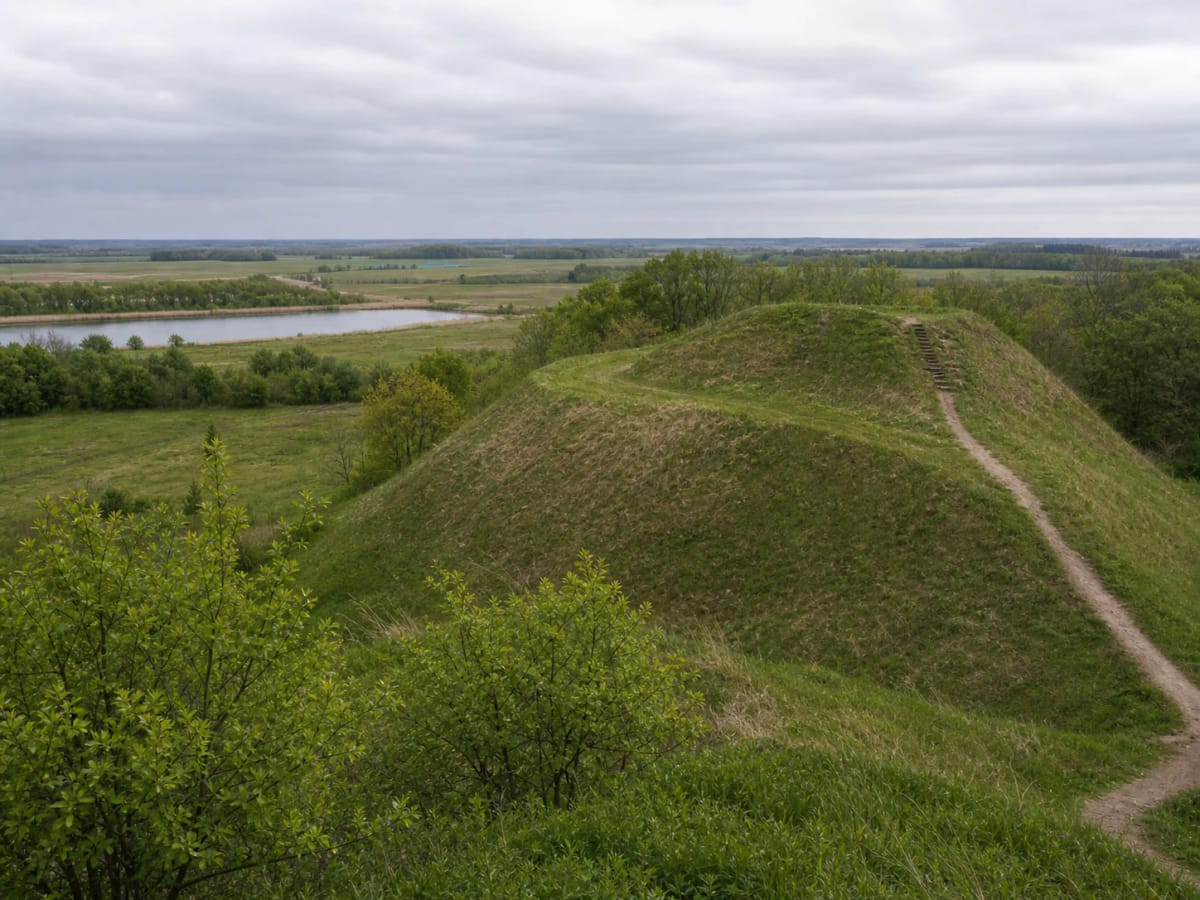
Opstainiai (Vilkyškiai) Hillfort is in Pagėgiai Municipality, in Vilkyškiai eldership, near Raudondvaris village. It is the largest and most striking of the Rambynas Regional Park hillforts: clearly visible and accessible from the Vilkyškiai-Šereiklaukis road, close to the town of Vilkyškiai.
Saugoma.lt calls it Opstainiai I (Vilkyškiai, Raudondvaris) Hillfort, while the Cultural Heritage Register uses the name Opstainiai, Vilkyškiai hillfort with settlement. The abundance of names is not a mistake: it reflects the site's links with several nearby places and different registration traditions, but in every case these refer to the same hillfort and settlement complex.
Archaeological complex of national significance
According to the Cultural Heritage Register, the complex code is 23812, its status is monument, and its significance level is national. The complex includes a hillfort and a settlement, and the listed protected area is 75,960 sq. m. The Register dates the object to the first millennium AD and the beginning of the second millennium.
The stronghold was built on a promontory surrounded by the Apsta stream - and it is from the Apsta that the name Opstainiai is derived. Saugoma.lt gives a broader story: Skalvians lived here from the first to the end of the thirteenth century, until the Teutonic Order conquered the region.
Skalvian settlements and the cultural layer
There were two ancient settlements beside the hillfort. On the eastern side of the hillfort a cultural layer 1.3-1.5 m thick was found, containing an especially large amount of burnt material - it is thought the settlements were burned down more than once.
These settlements at the foot of the hillfort are believed to have given rise to the town of Vilkyškiai. The hillfort therefore matters not only as a defensive site, but as the core of a long habitation by the Nemunas that lasted several millennia.
Bronze casting and finds
It is especially interesting that two possibly purpose-built hearths for casting bronze objects were discovered. This is confirmed by the casting moulds, crucible fragments, and remains of artefacts that were found - the hillfort was not only a stronghold but also a craft centre.
Among the other finds are many pot sherds with rusticated, burnished, and pinched surfaces, spindle whorls, pieces of daub bearing the impressions of wattle and logs, a knife, and quern stones. These objects reveal the everyday work, way of life, and building methods of the Skalvians.
The Selmytė legend and visiting
The hillfort is famous for legends recorded as early as the nineteenth century by Eduard Gisevius; the best known is about the princess Selmytė. Such stories should be taken as part of local memory rather than documented archaeological fact, yet they help explain why the hillfort remains a striking landscape marker.
It is an outdoor heritage site with no tickets or opening hours. Because of the steep slopes, up to 20 m high, it is best to come on a dry day, wear shoes with good grip, and protect the turf. Do not dig, collect finds, or drive on the slopes. A visit takes 30-60 minutes, and a fuller route can connect Vilkyškiai, Rambynas Hill, Bitėnai, and Martynas Jankus Museum.