- Place
- Vilkyškiai area, Pagėgiai Municipality
- Region
- Rambynas Regional Park
- Type
- botanical natural heritage object in Rambynas Regional Park
- Coordinates
- 55.10310, 22.14690
Great Spruce, Witches' Broom
A multi-stemmed spruce: why it is special
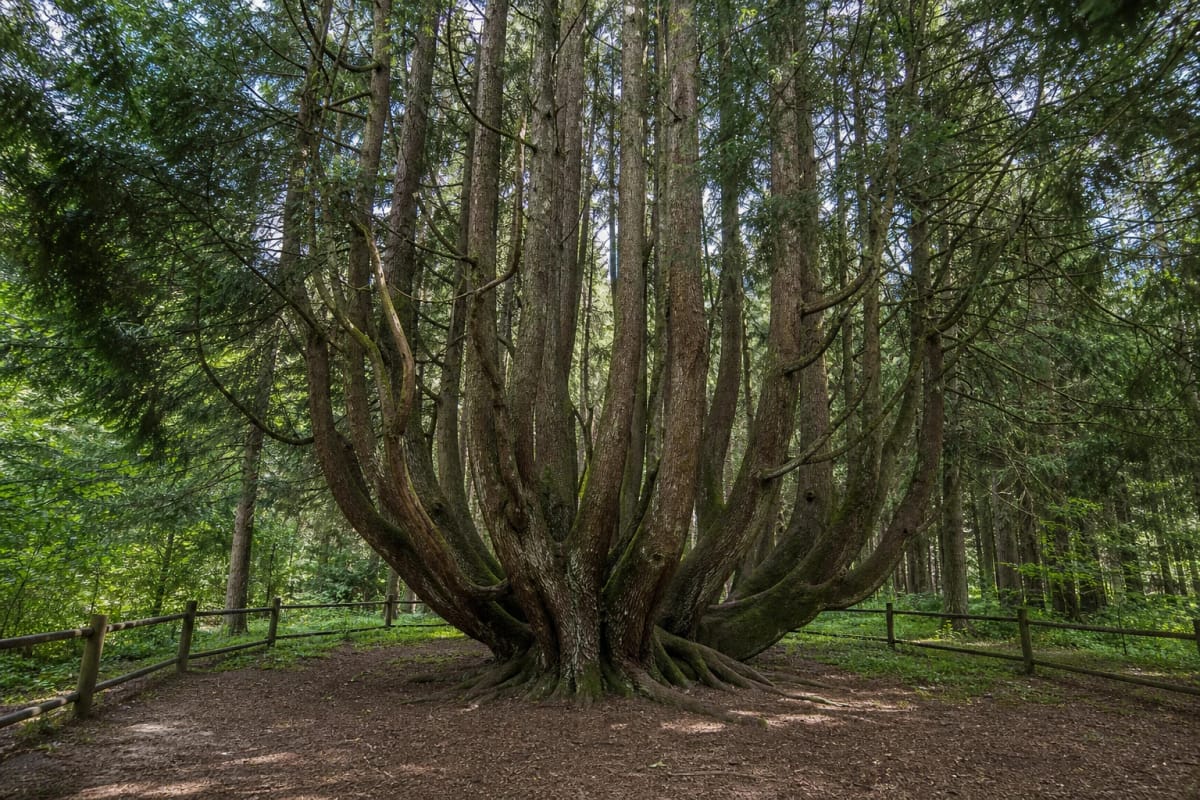
Witches' Spruce grows in Vilkyškiai Forest, about 2 km south-east of Vilkyškiai, in the Vilkyškiai Geomorphological Reserve of Rambynas Regional Park. VLE states that it is a Norway spruce, Picea abies, about 170 years old, 34 m high, with a trunk circumference at the branching point of 5.1 m. Saugoma.lt gives a slightly larger circumference in different measurements, about 5.8 m, so the exact value depends on measurement point and time, but both sources agree that the tree is exceptionally large and old.
The tree's most important feature is its form. VLE says that at about 80 cm above ground the tree branches into 13 stems; until 2007 there were 18. Saugoma.lt describes the stems as raised upward, intertwined, and in places grown into one another like tangled witches' hair. It is probably the only Norway spruce of such impressive form not only in Lithuania but in the whole natural distribution area of the species.
Storms, losses, and genetic origin
The story of Witches' Spruce is also a story of losses. VLE and Saugoma.lt state that in autumn 2007 one branch broke under the weight of heavy wet snow, and at the end of January 2022 a storm broke four more stems. The tree visible now is therefore smaller than it was two decades ago, showing how vulnerable such an unusual structure is.
In 2018, scientists from what was then Aleksandras Stulginskis University carried out a genetic study that, according to Saugoma.lt, rejected the hypothesis that the many stems were a horticultural trick. The likely cause is a unique genotype, making the tree an object of national and international importance. The public confirmed that special status too: VLE notes that in 2017 Witches' Spruce was chosen as Lithuania's Tree of the Year, in 2018 it took part in the European Tree of the Year contest, and in 2020 it was chosen as Lithuania's Spruce of the Year.
Protected natural monument in Rambynas Park
Witches' Spruce has clear legal status. VLE states that it has been a botanical natural heritage object since 2003 and a natural monument since 2000; in 1999-2003 it was listed as a natural landscape object. Saugoma.lt specifies the location: the tree grows in Rambynas Forest District, compartment 83, plot 53, in the Vilkyškiai Geomorphological Reserve.
Saugoma.lt states that a convenient access path and viewing place have been installed, and the tree itself is enclosed by a protective wooden fence to prevent trampling in the root zone. The fence is not a formality: an old tree affected by storms is sensitive, and its vitality directly depends on visitors keeping their distance.
Vilkyškiai Forest and the Rambynas context
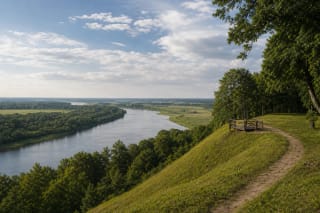
Witches' Spruce works together with the landscape of Rambynas Regional Park. Saugoma.lt states that the park, founded in 1992 and only 4,788 ha in size, protects a unique fragment of the lower Nemunas valley with famous Rambynas Hill, the Ragainė bend, oxbow lakes, and the Vilkyškiai moraine ridge. The tree is not a city-park exhibit; it belongs to the wooded ridge landscape.
This context enriches a route. If you are travelling to Rambynas Hill, the best-known sacred site of the Lithuanian nation, or to Bitėnai cemetery with the graves of Vydūnas and Martynas Jankus, Witches' Spruce offers a very concrete botanical point and a strong contrast between the open Nemunas panorama and the enclosed forest space.
Legends of witches' brooms
The name of the spruce is fed by legends that should be told as stories, not facts. VLE gives a legend in which witches stuck their brooms into this place and went off to tempt young men. When one young witch fell in love with a man and did not return in time, her broom turned green, and the strange tree appeared. It is a good etiological, place-explaining folk tale.
VLE also mentions a second, historicized legend: that the tree's strange form was caused when Napoleon, riding past, cut off the top of the young spruce. Such stories explain why the tree is called Witches' Spruce, Witches' Broom, or Great Spruce, but the scientific explanation, as the 2018 study suggests, is more prosaic: a unique genotype.
How to visit and photograph
A normal self-guided visit does not require a ticket, and 15-35 minutes is usually enough for the tree unless you combine it with a longer walk in Vilkyškiai Forest. Choose a time of day with enough forest light, because the dense crown and surrounding trees can quickly darken the view.
To understand the tree, photograph not only the stem base close up but also the whole silhouette: from farther away you see how the stems form an unusual crown structure. Most importantly, stay on the path and behind the fence, and do not enter the root zone. That is how Witches' Spruce will remain alive for other visitors.