- Place
- Plungė District Municipality
- Region
- Samogitia
- Type
- local history museum in the historic Kuliai rectory
- Address
- J. Tumo-Vaižganto g. 2, Kuliai
- Coordinates
- 55.80554, 21.65418
- Visit duration
- 45-75 minutes; about 1.5-2 hours with a guided walk through Kuliai
- Best time
- year-round, after confirming the visiting time in advance
Kuliai Museum, Kuliai Local History Museum
What you actually see in this small Kuliai museum
Kuliai Area Museum is not a large chronological display spread across dozens of galleries. Its strength is its local scale: inside the vaulted semi-basement of the former rectory, objects tell the story of Kuliai, its neighbouring villages, and the people who collected their heritage as old farmsteads disappeared during Soviet land consolidation.
The collection includes stone tools found locally, material from Gandinga Hillfort and the Reiskių Tyras wetland, interwar household and working implements, wartime objects, historic photographs, and printed matter. A separate thread covers book smugglers, the distribution of banned Lithuanian publications, and major cultural figures who lived in Kuliai.
The displays are most rewarding with a local storyteller. Many objects gain meaning through their connections to particular families, buildings, and events, so a pre-arranged tour offers substantially more than a quick independent circuit.
From a school antiquities display to a restored museum
The museum's origins lie in an antiquities display begun at Kuliai school in the late 1950s. Sources give both 1958 and 1959, so it is more accurate to describe an evolving local-history project than one ceremonial founding date. From 1967, teachers and pupils collected material systematically, with Zuzana and Romualdas Jankevičius playing central roles.
The collection moved to the former rectory in 1972. The museum was later confined to damp semi-basement rooms, and a burst water pipe in 2004 forced another move back to the school. This is an important part of the story: the museum survived repeatedly because local people collected, dried, carried, and eventually returned its objects.
The community-recreated museum in the rectory semi-basement was presented anew on 15 July 2017. The present display therefore documents not only Kuliai's past but also the town's own tradition of preserving local history.
Vaižgantas's rectory and the routes of banned print
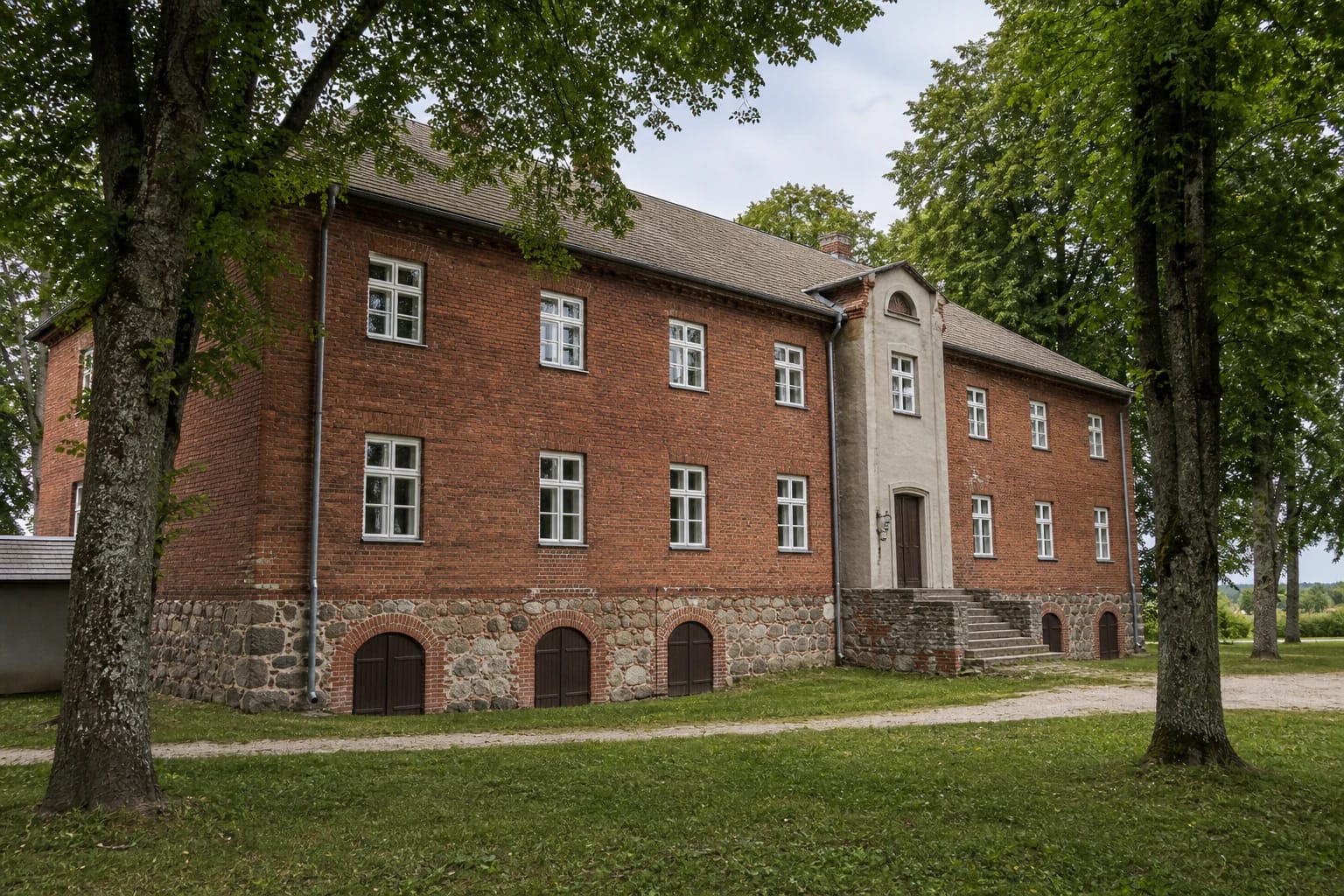
The museum's setting is part of the history. VLE dates the two-storey red-brick Kuliai rectory to 1790. Juozas Tumas-Vaižgantas, a priest, writer, journalist, and activist of the Lithuanian national movement, served as curate in Kuliai and lived in the eastern building from 1898 to 1901.
In Kuliai, Vaižgantas edited Tėvynės sargas, printed across the Prussian border at Tilsit, and the periodical Žinyčia, while supporting the circulation of banned Lithuanian publications. The museum's early books, photographs, and Vaižgantas-related objects turn the press ban from an abstract historical fact into a network of people and hiding places within one Samogitian town.
Colourful local stories about book smugglers should be distinguished from documented facts. A guided town route continues the museum's subject at the rectory, church, monuments, and sites beyond the centre, and needs considerably more time than the exhibition alone.
The Kuliai of Sofija Kymantaitė-Čiurlionienė
Sofija Kymantaitė-Čiurlionienė spent part of her childhood and youth in the same rectory as the niece of parish priest Vincentas Jarulaitis. She later became a writer, playwright, educator, public figure, and one of the most distinctive voices in early twentieth-century Lithuanian culture.
At the museum, Sofija's story joins a wider account of the town's cultural life. Kuliai holds the Sofija Festival in her name and offers historical walks, while the nearby Kultūros virenė uses another building in the church ensemble for contemporary art and community events. The setting shows why local heritage here is not confined to display cases.
Opening hours, tickets, and two neighbouring addresses
On 14 July 2026, official Plungė visitor information listed these hours: Monday 08:30-12:30 and 15:00-17:00, Tuesday 15:00-17:00, closed Wednesday, Thursday 16:00-18:00, and Friday 15:00-17:00. The adult ticket was €2, pupils, students, and seniors €1, family tickets €4 or €5, and a tour for up to ten people €25 in Lithuanian or Samogitian and €30 in English. Hours and prices can change, so verify them officially before travelling.
Arrival information needs a little care. Google Maps places the museum in the red-brick former rectory at J. Tumo-Vaižganto g. 2, while current Plungė visitor information gives the neighbouring Kultūros virenė at Liepų g. 1 as its contact point. Both buildings stand in the same church ensemble, but call or email ahead to confirm where visitors are being received and which entrance to use.
Parking in the town centre and walking around the ensemble is the simplest approach. Because the exhibition is associated with historic semi-basement rooms, possible steps, and a small operating team, discuss mobility or other access requirements before arrival.