- Place
- Kretinga District Municipality
- Region
- Samogitia
- Type
- active papal-right Poor Clare monastery with a public chapel and an enclosed cloister
- Address
- 34 Mėguvos St, Kretinga
- Coordinates
- 55.88210, 21.23940
Monastery of the Poor Sisters of Saint Clare, Kretinga Poor Clare Monastery, Order of Saint Clare Monastery, Ordo Sororum Pauperum Sanctae Clarae
What visitors can actually enter
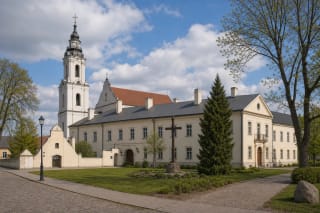
The Poor Clare Monastery stands on Mėguvos Street in south-western Kretinga at 55.882100, 21.239400. It is an active contemplative house rather than a museum or architectural tour. Visitors enter the public chapel, not the sisters' living quarters, garden, or inner enclosure.
The official page lists the chapel as open daily from 6.30 am to noon and from 3 pm to 6 pm. Mass is scheduled at 7 am on weekdays and 9 am on Saturdays and Sundays. Adoration follows Mass until noon every day except Saturday, while summer Saturdays have a listed period from 10 am to 5 pm.
The official visiting periods for meeting the sisters are 9-11.30 am and 3-5 pm daily, but 'visiting' does not mean a tour through the monastery. A conversation respects the boundary of the papal enclosure and traditionally takes place through a grille in the parlour. Contact the community in advance for a group, a longer meeting, or a specific spiritual question.
From Mantua to the Baltic states' only foundation
The Kretinga community began in 1993-1994, when the Friars Minor gathered Lithuanian women discerning a Franciscan contemplative vocation. In 1994, seven candidates travelled for formation to a Poor Clare monastery in Mantua, Italy. That relationship helped establish an authentic community of the order in Lithuania rather than merely borrow its name.
Rome granted permission for the foundation in 1997. The first sisters came to Kretinga in 1998 and initially stayed in a house belonging to the Franciscans. On 13 May 1998, Bishop Antanas Vaičius of Telšiai blessed the future monastery's cornerstone, and construction was completed in 2000.
The monastery was canonically established on 25 March 2003. VLE identifies it as the only Poor Clare monastery in the Baltic states, while Vatican News calls it the first and only one in Lithuania. VLE recorded seven solemnly professed sisters in 2022, but the composition of a living community can change.
Clare's Rule, poverty, and papal enclosure
The sisters belong to the Order of Saint Clare, formally the Order of the Poor Sisters of Saint Clare, Ordo Sororum Pauperum Sanctae Clarae or OSC. The order began at San Damiano in Assisi in 1212, when Clare of Assisi, guided by Francis of Assisi, formed a Franciscan community for women.
On 9 August 1253, two days before Clare's death, Pope Innocent IV approved the Rule she had written. Its centre is Gospel life in community, prayer, penance, and a distinctive commitment to poverty. Clare is recognised as the first woman in Church history to write a rule for a religious order.
Papal enclosure is a deliberately chosen form of contemplative life, not a mysterious stage set for visitors. It explains the physical boundary in the meeting room and why the sisters are rarely seen around town. Their daily life is focused on the Liturgy of the Hours, Eucharist, silence, community, and intercessory prayer for intentions entrusted to them.
A rose-coloured complex above the Akmena
The monastery was built from 1998 to 2000 on the bluff above the River Akmena, beside Kretinga's old Jewish cemetery, to a design by Italian architect Nunnzio Rimmaudo. When the cornerstone was laid, meadows and only a few houses surrounded it. A residential neighbourhood and the sisters' now-mature garden frame the low complex today.
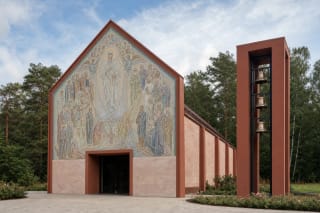
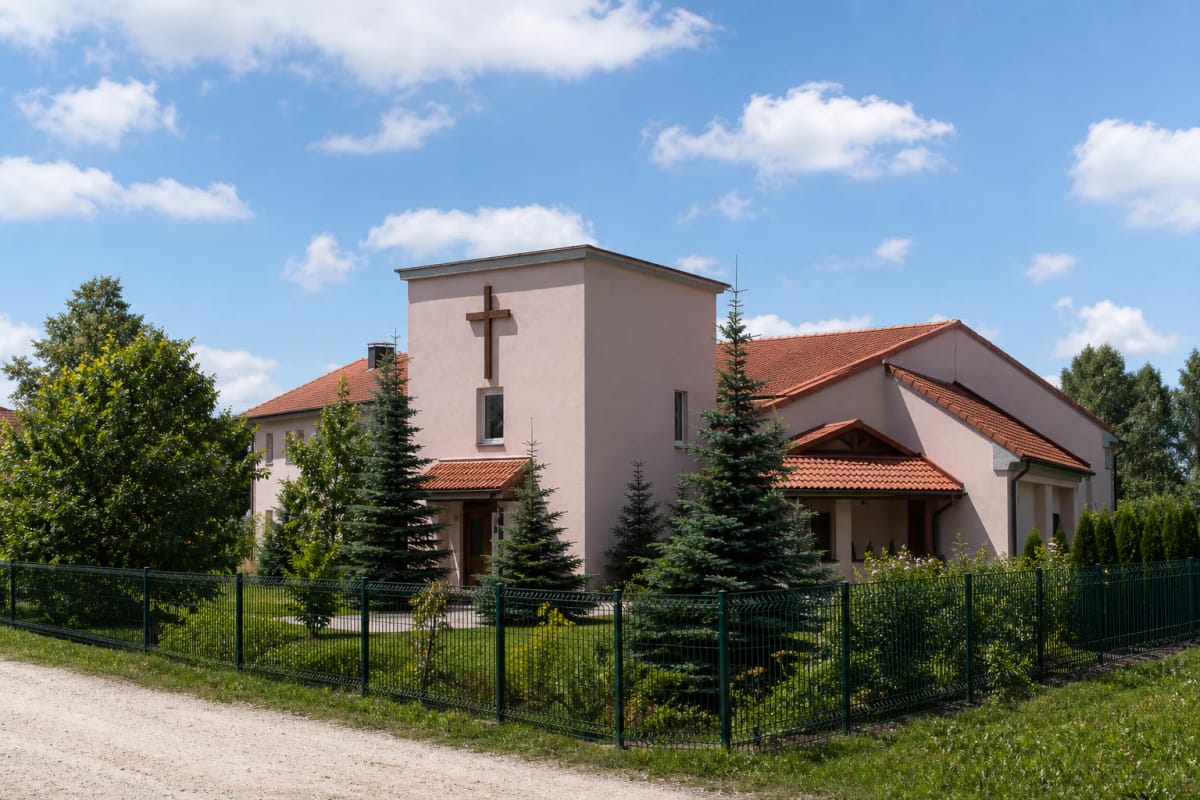
From the street, the ensemble is recognised by restrained pale-rose rendered volumes, red clay-tiled pitched roofs, and a higher flat-topped chapel block with a plain cross on its facade. It does not imitate a historic church style. The Italian character lies in its scale, courtyard logic, warm material colours, and a plan shaped for monastic life.
Treat the neighbouring street and cemetery as two separate spaces that each require respect. The old Jewish cemetery is neither monastery property nor part of its display. Do not walk over graves, make noise, or use the burial ground merely as a convenient photography backdrop.
A rhythm of prayer and work, and how to visit respectfully
The Poor Clares' day is not a public performance. The Liturgy of the Hours and Eucharist are the centre of communal life, while the sisters support themselves through simple manual work. In 2023, Vatican News mentioned baking altar breads, making rosaries, sewing, and embroidery; earlier local records also describe care of the garden and vegetable plot.
Speak quietly in the chapel, silence your phone, avoid walking around during the liturgy, and never photograph the sisters or enclosed areas without explicit permission. There is no ticket office or admission fee, but this is not a free attraction in the commercial sense. Donations may be offered, yet Mass and quiet prayer do not depend on one.
At this page's review date, the official schedule listed specific daily hours, but feasts, retreats, or community circumstances can alter a monastery's rhythm. Check the official page before a long journey. Contact the sisters ahead if you require step-free access, hearing assistance, or a group reception, because no detailed accessibility statement is published.