- Place
- Šakiai District Municipality
- Region
- Suvalkija
- Type
- Panemunė manor homestead with historic granary, park, and events
- Address
- Mokyklos g. 2, Kiduliai, Šakiai District
- Coordinates
- 55.08550, 22.79440
Kiduliai Manor Homestead
Kiduliai Manor: a royal village on the left bank of the Nemunas
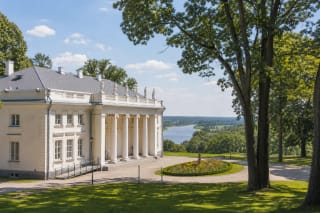
Kiduliai Manor stands on the left bank of the Nemunas, almost directly opposite Jurbarkas. According to Visuotinė Lietuvių enciklopedija, the royal village of Kiduliai is mentioned in 1559; in the sixteenth century it passed to a private manor, and at the end of the eighteenth century it came under Prussian rule. From the early nineteenth century, only the old manor was called Kiduliai, while the new folwark and village were called Kaimelis.
The place is best understood not as a single building but as a stop on the Nemunas route. For centuries the river shaped trade, roads, troop movements, and the network of manors, so Kiduliai naturally connects with other Panemunė manors and castles on both sides of the Nemunas.
Kiršenšteins, Karpis family, and General Offenberg
The official manor page states that in 1584 Kiduliai was acquired by Krišpinas Kiršenšteinas, a timber merchant from Prussia. In 1708, after the death of Bishop Jonas Jeronimas Kiršenšteinas, the manor passed to the Karpis family; in 1739 Samogitian Bishop Juozapas Mikalojus Karpis died here.
In 1837 the Russian authorities gave Kiduliai to General Offenberg for his merits in the 1812 Franco-Russian War; Napoleon's army had marched through this region in 1812. The Offenberg family held the manor until the early twentieth century. The last aristocratic owner left the manor around 1922, when the homestead had about 27 buildings.
The surviving manor homestead and granary
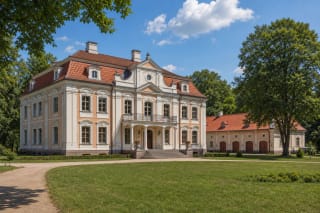
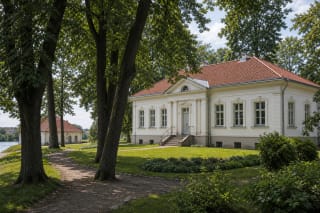
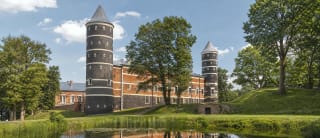
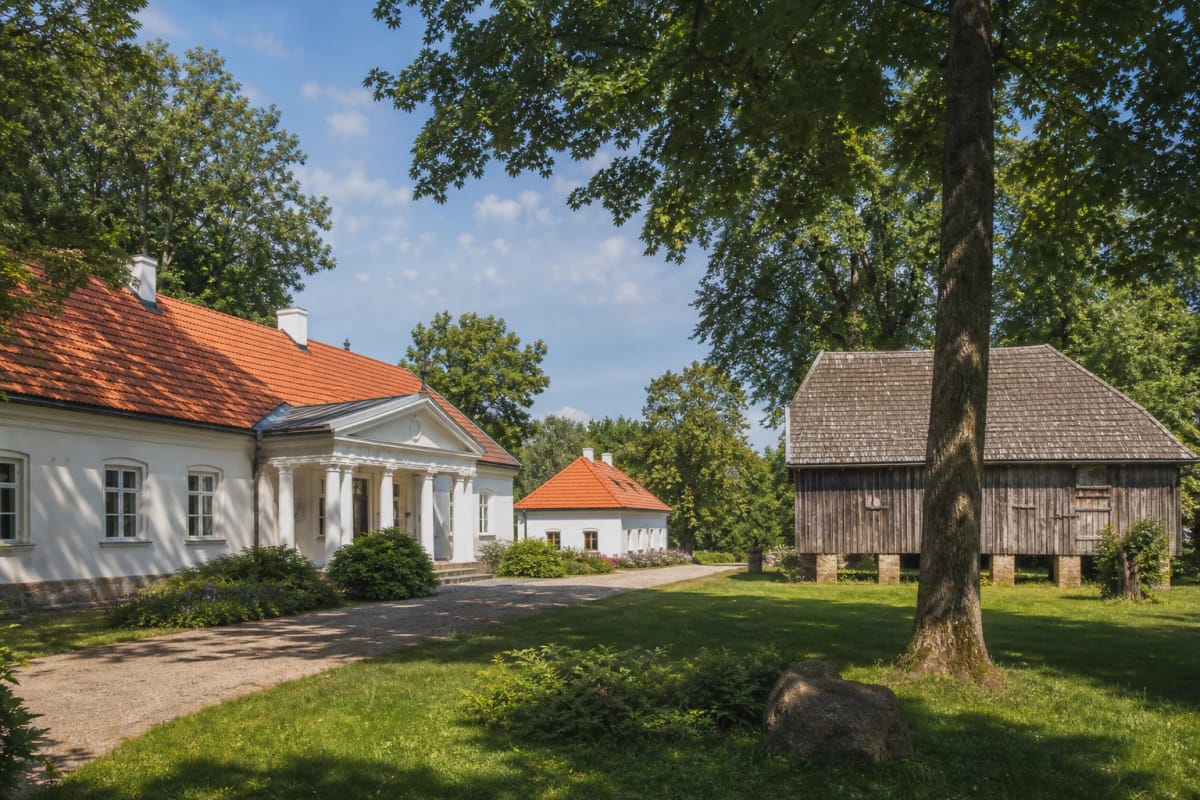
According to Visuotinė Lietuvių enciklopedija, the nineteenth- to early-twentieth-century manor homestead preserves residential buildings, including the palace, gardener's and wheelwright's houses, and two servants' houses; production buildings, including a brewery, cheese dairy, smithy, and brick-style grain storehouse; and farm buildings, including a grain barn and cowsheds. This range reveals the whole structure of a manor economy, not only a representative facade.
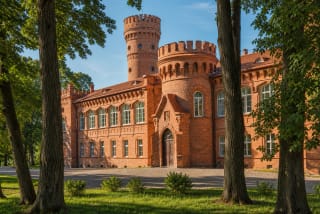
Kiduliai Manor's granary is singled out as one of the more important objects. It recalls the economic side of the manor - storage, harvest, and the organization of farm work - which often remains in the shadow of the palace. It is worth looking at the granary from several sides, observing its construction, proportions, and relationship to the courtyard.
Book-smuggling routes and twentieth-century events
During the Lithuanian press ban, book smugglers carried Lithuanian publications from Prussia through Kiduliai Volost; the Nemunas border here was a direct route for smuggling print. In the early twentieth century a brewery operated at the manor.
In 1906 Kiduliai peasants occupied the volost administration building, destroyed portraits of the tsar, burned mobilization documents, and demanded that paperwork be handled in Lithuanian. After the Second World War, partisans of the Žalgiris unit of the Tauras District operated in the area, and in 1978 a bridge across the Nemunas was built near Kiduliai.
The manor today: events and education
The revived manor hosts early-nineteenth-century-style manor dance afternoons, art exhibitions, concerts, theatre performances, and lectures on manor history and culture. A library also operates in the building, so Kiduliai functions as a living cultural space for the town.
Educational programmes, such as a dance lesson or the "Aptiekėlė" activity, need to be booked in advance. At the time of research they were listed at about 10 EUR per person for groups from 15 people and were booked by phone, but current official information should be checked before planning.
How to visit Kiduliai Manor
For Kiduliai Manor, it is best to choose the visit format in advance: a short exterior and park visit, an event or educational programme, or a broader Panemunė manor route. That choice determines how much time you need.
Without a programme, allow about 45 minutes; with an educational activity or event, plan 1.5 hours or more. When travelling along the Nemunas, Kiduliai combines conveniently with Jurbarkas Manor across the river, Gelgaudiškis, Zypliai, and Panemunė Castle.