- Place
- Šakiai District Municipality
- Region
- Suvalkija
- Type
- Neoclassical manor palace with a park by the Nemunas
- Address
- Parko g. 5, Gelgaudiškis, Šakiai District
- Coordinates
- 55.07650, 22.97620
Gelgaudiškis Manor Palace
Gelgaudiškis Manor in Panemunių Regional Park
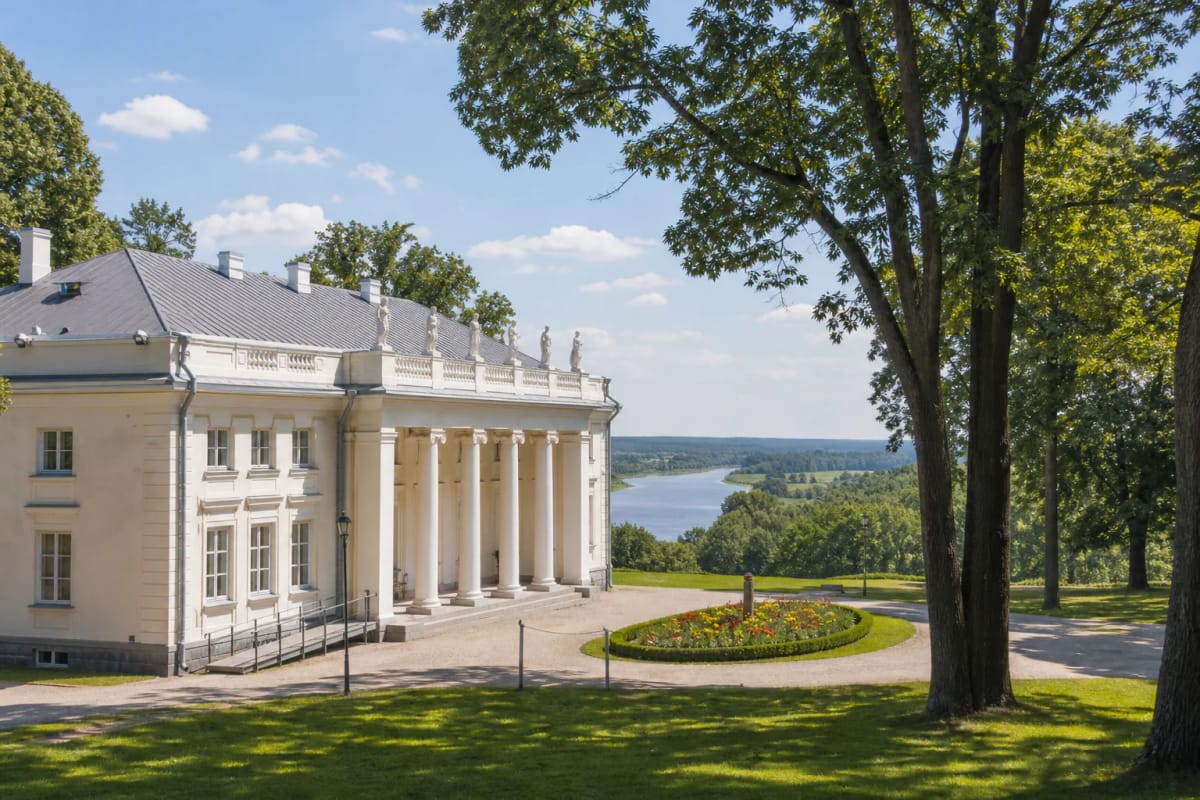
Gelgaudiškis Manor is strongest when seen together with the Nemunas landscape. The town and manor stand on the left bank of the Nemunas, within Panemunių Regional Park, so the palace, park, and river slopes create not only an architectural object but a route - a place for walking, not just stopping for a photograph.
The locality's history is old: in 1517 a small Gedigaudiškis manor is mentioned in the Skirsnemunė manor forest belonging to Jonas Sapiega, and in 1578 Gelgaudiškis is already mentioned as a town. Over the centuries the manor belonged to the Sapieha, Masalskis, Gelgaudas, Zabiela, Czartoryski, and von Keudell families, as well as to the Kaunas Jesuit College.
Gelgaudiškis Manor palace and architecture
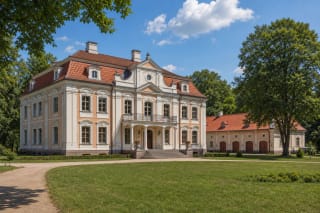
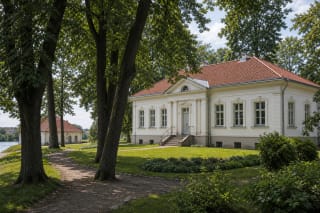
Visuotinė Lietuvių enciklopedija states that the present one-storey masonry Neoclassical manor palace was built in 1846. It has a long rectangular plan with two corner projections and a wing, while the main-facade portico is supported by two Ionic columns. Inside, rooms are arranged semi-enfilade around two vestibules, and hall ceilings and doors are decorated with Art Nouveau ornaments.
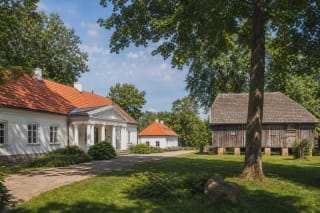
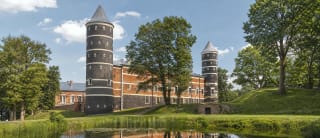
The homestead ensemble is completed by other buildings: a servants' house, granary, orangery, kitchen, service wing, tower, cowshed, and cellar. The manor homestead with its French-style park was reconstructed in 2015, so visitors see an ordered rather than abandoned complex. It is a cultural heritage object of national significance, listed under Cultural Heritage Register code 1013.
Owners, uprising, and twentieth-century history
Gelgaudiškis Manor is also connected with historical events: during the 1830-1831 uprising, rebel commander Antanas Gelgaudas crossed the Nemunas with his army near Gelgaudiškis. In the late eighteenth century the manor was divided into Upper and Lower Gelgaudiškis manors, and in the second half of the nineteenth century a cheese dairy operated here.
After the landowner period, the palace housed a children's shelter, founded during the First World War, and later schools and other institutions. The building therefore survived not as a purely private relic but as a repeatedly reused community space.
French-style park and Nemunas slopes
Gelgaudiškis Manor palace is surrounded by one of Lithuania's largest manor parks, where a geometric French-style part passes into the natural forest of the Nemunas valley. This is one reason to visit in the warm season: the park and river landscape matter here no less than the palace facade.
If you have time, choose a slower walk through the park. The manor buildings are best understood when you see how they relate to paths, trees, and the direction of the Nemunas.
Tours and practical visiting
Gelgaudiškis Manor is known for cultural and theatrical tours, art exhibitions, and concerts, but schedules and prices can change. Practical information is usually linked to the Gelgaudiškis cultural branch, so check official local contacts before travelling.
Allow about an hour for the grounds, or 1.5-2 hours with a palace tour or event. Gelgaudiškis combines well with Kiduliai, Zypliai, or Jurbarkas manors and other places in Panemunių Regional Park.